49 works in this view — arrow keys or swipe to move between them.
Dance in Art
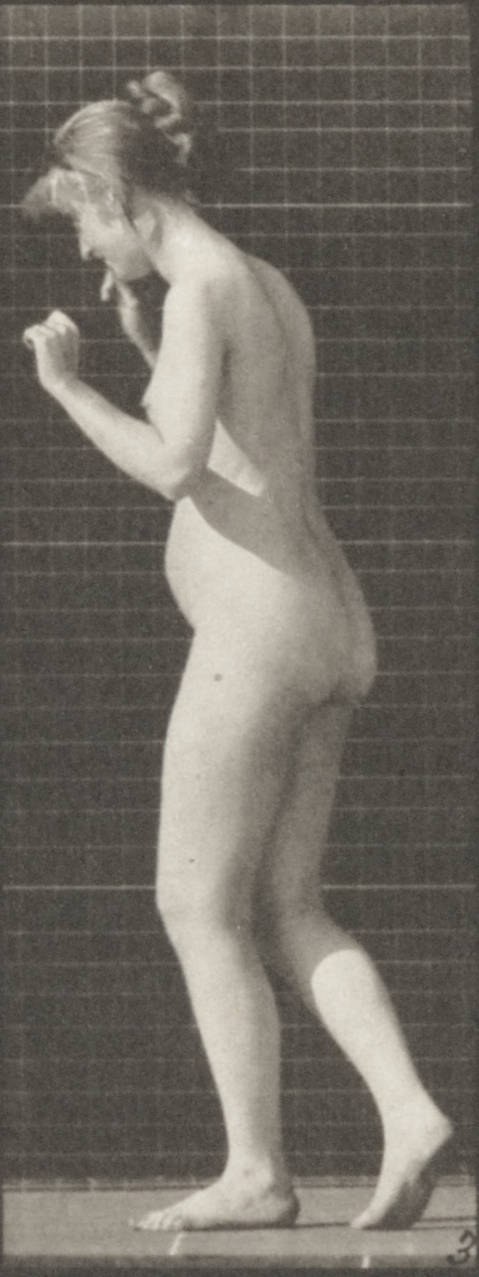
Nude woman dancing a waltz (rbm-QP301M8-1887-195a~3)
Muybridge, Eadweard, 1830-1904
- Source:
- Wikimedia Commons
- Rights:
- Public domain — free to use, share and adapt.
- Recorded as:
- public_domain
This image captures a moment when dance and science met. For dancers and choreographers, Muybridge's sequences provided an unprecedented visual record of actual technique in motion, free from the conventions of posed portraiture. For historians, it documents what the waltz looked like—how a body actually moved—at a moment when the dance was transitioning from Victorian drawing-room to modern ballroom. The fact that the dancer is unclothed and studied on a grid, rather than dressed and performing socially, reminds us that the waltz was increasingly seen as a mechanical system to be analyzed, not just a social ritual.
What you are looking at
A single female figure stands barefoot in profile against a gridded background, captured mid-movement in what appears to be a sequential motion study. The woman is nude, with light-colored hair styled up, and her body is angled to the left with one arm raised near her head and the other extended forward at waist height. Her torso is tilted and her weight appears shifted onto one leg, creating a sense of dynamic turning or rotation through the body. The grid behind her suggests this is part of a systematic photographic analysis rather than a staged performance piece. The image has the grainy quality and slightly soft focus characteristic of early photogravure reproduction from the 1880s.
The dancing
The single dancer's frame is open and asymmetrical, with the raised arm creating an upward line and the forward arm balancing the composition. Her weight is concentrated on one leg, the other appearing lighter or lifted. The torso shows clear rotation at the spine, suggesting a pivoting or twisting action. The stance is neither the rigid turnout of ballet nor the grounded earth-connection of many folk traditions, but rather a naturalistic, anatomically centered positioning that prioritizes the observation of actual human movement.
The dance depicted
The catalogue identifies this as 'dancing a waltz,' and the image does support a connection to ballroom dance: the open frame, the three-quarter turn of the body, and the suggestion of rising and lowering through the torso are all consistent with Viennese or English waltz technique. However, the anatomical focus of Muybridge's project complicates any simple identification. This plate appears to be one of a sequence (the filename suggests up to 12 images in this series), documenting the actual mechanics of the waltz step rather than performing it as social spectacle. The barefoot stance, the nudity, and the clinical grid all mark this as an analytical documentation rather than a dance as it would have been seen in a ballroom.
How it was made
This is a photogravure reproduction from Muybridge's *Animal Locomotion*, a monumental project published 1887 by the Photo-Gravure Company of Philadelphia. Photogravure allowed fine detail and the illusion of continuous tone, making it ideal for the scientific documentation of human and animal movement that was Muybridge's obsession. The process involved photographing motion in rapid sequence, then translating those photographs into engravings for mechanical reproduction. This specific plate is one of approximately 781 in the published series, and the grid background was standard to Muybridge's method—it provided scale and perspective reference for analyzing movement trajectories.
About this work
This is a single frame from Eadweard Muybridge's *Animal Locomotion*, a systematic photographic and photogravure study of human movement in motion conducted between 1872 and 1885. The series documented hundreds of subjects—men, women, children, athletes, performers—executing everyday and trained actions, including dance. Plate 195, showing a woman waltzing, sits at the intersection of three histories: the development of motion photography as a scientific tool, the codification of ballroom dance technique in the late nineteenth century, and the nineteenth-century fascination with the nude figure as a subject for anatomical study. Muybridge's work was neither pure science nor pure art; it was circulated to artists, physicians, dancers, and the educated public as a visual resource for understanding how bodies actually move.
How to look at it
Look at the grid: it is the key to reading this image. Muybridge used the grid not for aesthetic composition but for precise measurement of position and trajectory. The single image here is one moment in a sequence; to understand the dance, you would need to see the series. Notice the openness of the frame—one arm high, one forward—and the clear rotation of the torso. This is not the turned-out, vertically centered stance of ballet; it is a more naturalistic turning movement captured mid-action. The barefoot condition and the anatomical focus make clear this is analysis, not performance.
The artist
Eadweard Muybridge (1830–1904) was a British-American photographer and photographic pioneer best known for his studies of animal locomotion. After initially working as a landscape photographer in California, he gained fame in the 1870s for high-speed photography of horses in motion (work commissioned by businessman Leland Stanford), which famously settled a debate about whether a galloping horse's hooves ever left the ground simultaneously. His success with horses led him to turn his attention to human movement. Between 1872 and 1885, often at the University of Pennsylvania, he photographed thousands of sequences of people and animals in motion, compiled into the multivolume *Animal Locomotion*. His work influenced artists, scientists, and choreographers, and prefigured motion-picture technology.
The period
The 1880s were a moment of intense interest in motion, mechanism, and the scientific analysis of the body. Photographic technology was advancing rapidly, making sequential imaging possible. Artists and scientists alike were fascinated by questions of how the body actually moves versus how it appears in still representation. In dance, this was the era of the waltz's transformation: once scandalous for its close hold and speed, it had become formalized into competing national styles (Viennese, English, American). Muybridge's documentation coincided with the codification of ballroom technique into teachable, reproducible forms. His work was embraced by painters and sculptors seeking anatomically accurate movement, but also by dance teachers seeking objective documentation of technique.
Where it lives
This image is sourced from Wikimedia Commons and is identified as plate 195 from *Animal Locomotion: An Electro-Photographic Investigation of Consecutive Phases of Animal Movements, 1872–1885*, published under the auspices of the University of Pennsylvania in 1887 by the Photo-Gravure Company, Philadelphia. The original photographs are held in collections including the Library of Congress; the photogravure plates are distributed widely in research libraries and online.
Dance in this work
Questions about this work
Is this really a waltz?
The catalogue identifies it as such, and the body position—the open frame, the turning, the rising action through the torso—is consistent with waltz technique. However, Muybridge's goal was anatomical analysis, not dance documentation. The image records the mechanics of a waltz step, not the waltz as a social or theatrical experience. This is what the waltz looked like in motion to the camera; whether it felt or was performed as a 'waltz' to the dancer herself is a separate question.
Why is the dancer nude?
Muybridge used nude or minimally clothed models to allow clear visibility of joint action, muscle engagement, and the actual line of the body in motion. This was standard in anatomical photography of the period. The nudity served the goal of scientific documentation, though it also reflected nineteenth-century conventions about the aesthetic study of the human form.
Is this a photograph or an engraving?
It is a photogravure: a hybrid process. The original was a photograph; what you see here is a fine-art print made from an engraved plate derived from that photograph. Photogravure allowed for high-quality reproduction and distribution of photographs before half-tone printing became standard.
Why does this matter to dancers today?
Muybridge provided the first reliable visual record of how bodies actually move through space and time. For ballroom dancers, his waltz sequences document technique in an unidealized, anatomically honest way. For choreographers and movement researchers, *Animal Locomotion* remains a resource for understanding human kinematics and a precedent for motion analysis as an art form.
More dance artwork





