49 works in this view — arrow keys or swipe to move between them.
Dance in Art
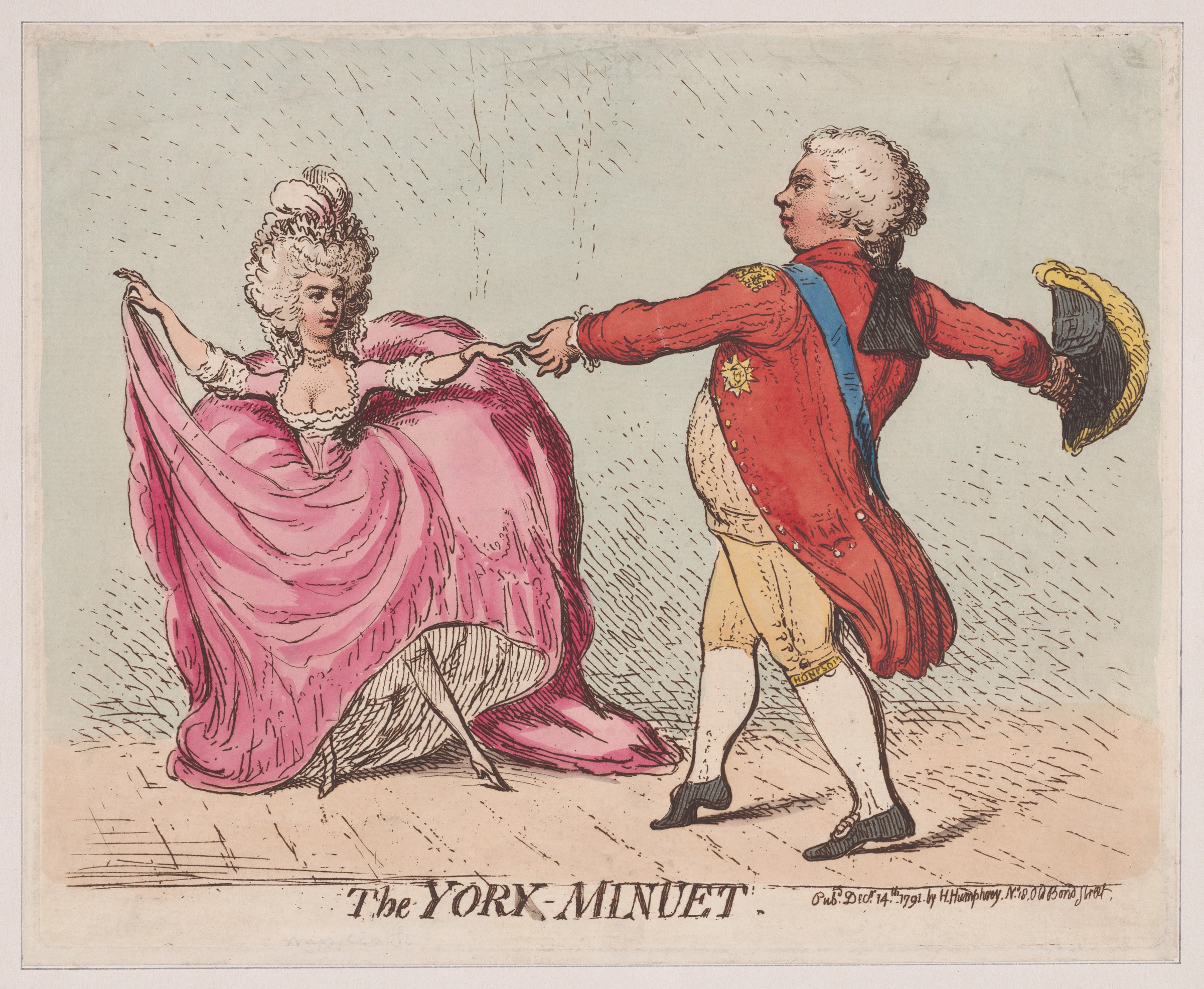
The York-Minuet
James Gillray
- Source:
- Wikimedia Commons
- Rights:
- Public domain — free to use, share and adapt.
- Recorded as:
- cc0
This work documents the minuet not through action but through the formal social grammar that governed its performance—the separation, the invitational gesture, the dressed bodies. For historians of dance, it reveals what contemporaries understood as the essential ritual of minuet engagement. For historians of print culture, it shows how Gillray used dance as material for satire and social commentary, reaching a mass audience through an economical medium.
What you are looking at
A man in a red military coat with gold ornament and blue sash faces a woman in an elaborate pink gown with elaborate coiffure and jewels. The man extends his right arm toward her in a formal gesture, while holding what appears to be a military emblem or decoration in his left hand. The woman's pink silk skirts are voluminous and draped dramatically; she holds a fabric—possibly a handkerchief or veil—in her outstretched hand. Their bodies are separated, not in contact. The setting is minimal, with simple hatching to suggest a background. The composition captures a moment of formal social interaction rather than active dancing, though the posed, gestural quality and the man's stance suggest courtship or social performance.
The dancing
The couple maintains open, separated positioning typical of formal social dance of the late 18th century. The man's extended right arm and slight forward lean suggest an invitational or presentational gesture rather than an active dance step. The woman's posture is upright and formal, with her arm extended in kind. Neither figure shows the bent knees, ball-of-foot weight placement, or dynamic momentum that would indicate active movement or elevated steps. The composition suggests the prelude to dance—an offer and acknowledgment—rather than the dance itself in progress.
The dance depicted
The title identifies this as a minuet, the most formal of social dances in the late 18th century. However, the image captures not the minuet proper but the moment of greeting or invitation that preceded it. The York Minuet was a known tune and social format of the period. The dress—the man's military uniform and the woman's high-fashion gown—places this among the elite social circles where minuets were the dominant ballroom dance. The stylised, restrained postures and separated bodies align with minuet conventions, which emphasised formal presentation, linear movement, and courtly restraint over physical intimacy.
How it was made
This is a hand-coloured engraving, identifiable from the fine line work, the inscription at the bottom, and the characteristic appearance of 18th-century satirical prints. Engraving allowed for mass reproduction and wide circulation among the English reading public. The inscription credits "Pubd Decr 14 1791 by H Humphrey N° 27 St Andrews Street" (published December 14, 1791, by Hannah Humphrey, James Gillray's printer and publisher). The hand colouring—the pink gown, red coat, and flesh tones—was applied after printing and distinguishes this as a high-quality print intended for a clientele who could afford colour. The technique enabled satirical commentary to reach a broad audience while remaining economical compared to painting.
About this work
This is a satirical engraving by James Gillray from December 1791, capturing the formal social ritual of the minuet at the moment of invitation rather than in active dance. The work belongs to a tradition of 18th-century English satirical prints that used social dance as a vehicle for commentary on manners, fashion, and courtship. The military uniform and fashionable dress locate the scene in aristocratic or gentry circles; the minuet was the lingua franca of polite society, and Gillray's precise rendering of costume and posed gesture suggests both familiarity with ballroom conventions and potential irony about their rigidity. As a hand-coloured engraving, it circulated widely in printed form and represents dance not as movement but as social performance.
How to look at it
Attend first to the separation between the figures and the formal quality of their gesture—there is no dance happening in the instant captured, only the ritual that frames it. Notice the precision of Gillray's rendering of fabric and ornament: the woman's looped and draped skirts, the man's military details, the careful hatching of hair and shadow. The title is a cue to look for the specific conventions of minuet presentation—the linear positioning, the formal arm extension, the absence of elevation or dynamic weight shift. The work's satirical potential lies in the gap between the formal ritual depicted and the actual pleasure or intimacy such occasions were supposed to offer.
The artist
James Gillray (1756–1815) was the pre-eminent English satirical engraver and caricaturist of his era. Working primarily in hand-coloured engraving, he produced hundreds of prints on political, social, and cultural topics, published by Hannah Humphrey from premises on St. Andrews Street and elsewhere. Gillray was a master of physiognomy and costume detail; his works were expensive enough to circulate among the educated and affluent, but cheap enough to be viewed in print-shop windows and to be collected widely. He worked at the intersection of fine art and popular culture, and his prints often encoded multiple levels of satire—visual, textual, and behavioural.
The period
In 1791, the minuet was in its last decades of dominance in English ballrooms. It had been the presiding form of polite dance for over a century, but the 1790s saw the rise of the cotillion and country dance as serious competitors. The minuet's reputation was increasingly associated with formality, constraint, and the older generation—precisely the satirical territory Gillray worked. The French Revolution was underway, and social hierarchies (including the rituals that reproduced them) were increasingly subject to scrutiny and satire. In artistic practice, Gillray's prints belong to a boom in satirical engraving in late 18th-century London; these works were a dominant form of visual culture and political commentary. The refinement of dress and the minute observation of social gesture visible here were characteristic of the period's sophisticated satirical tradition.
Where it lives
This is a dated print from the Wikimedia Commons, identified as published by Hannah Humphrey on 14 December 1791. It represents a widely circulated popular print rather than a unique artwork; other hand-coloured impressions and uncoloured versions would exist in collections, print shops, and private hands of the period.
Dance in this work
Questions about this work
Is this a real dance or satirical invention?
The minuet is real and was the dominant ballroom dance of the 18th century. The 'York Minuet' was a known tune. However, Gillray was a satirist, and the print likely comments on the minuet's formality, the pretensions of those who danced it, or both. The image captures a moment of greeting rather than the dance in motion, which may itself be part of the satire.
Why are they not dancing?
The minuet always began with a formal greeting and invitation—the gentleman would approach the lady, they would acknowledge each other with ceremony, and then the dance proper began. Gillray has frozen this preliminary moment, which allows him to focus on costume, posture, and social ritual rather than movement.
What does the military uniform tell us?
The red coat with gold ornament indicates an officer in the British armed forces or a courtier in formal dress. This identifies the man as elite in status and places the scene in aristocratic or gentry circles where minuets were obligatory social performances. It also widens the potential for satire—military men dancing minuets was itself a subject of comment.
What is the woman holding?
She holds what appears to be a handkerchief, veil, or length of fine fabric—common accessories for fashionable women of the period. She may also be gesturing with it as part of the formal exchange or performance of minuet etiquette.
More dance artwork





