49 works in this view — arrow keys or swipe to move between them.
Dance in Art
The Minuet
Giovanni Domenico Tiepolo
- Source:
- Wikimedia Commons
- Rights:
- Public domain — free to use, share and adapt.
- Recorded as:
- cc0
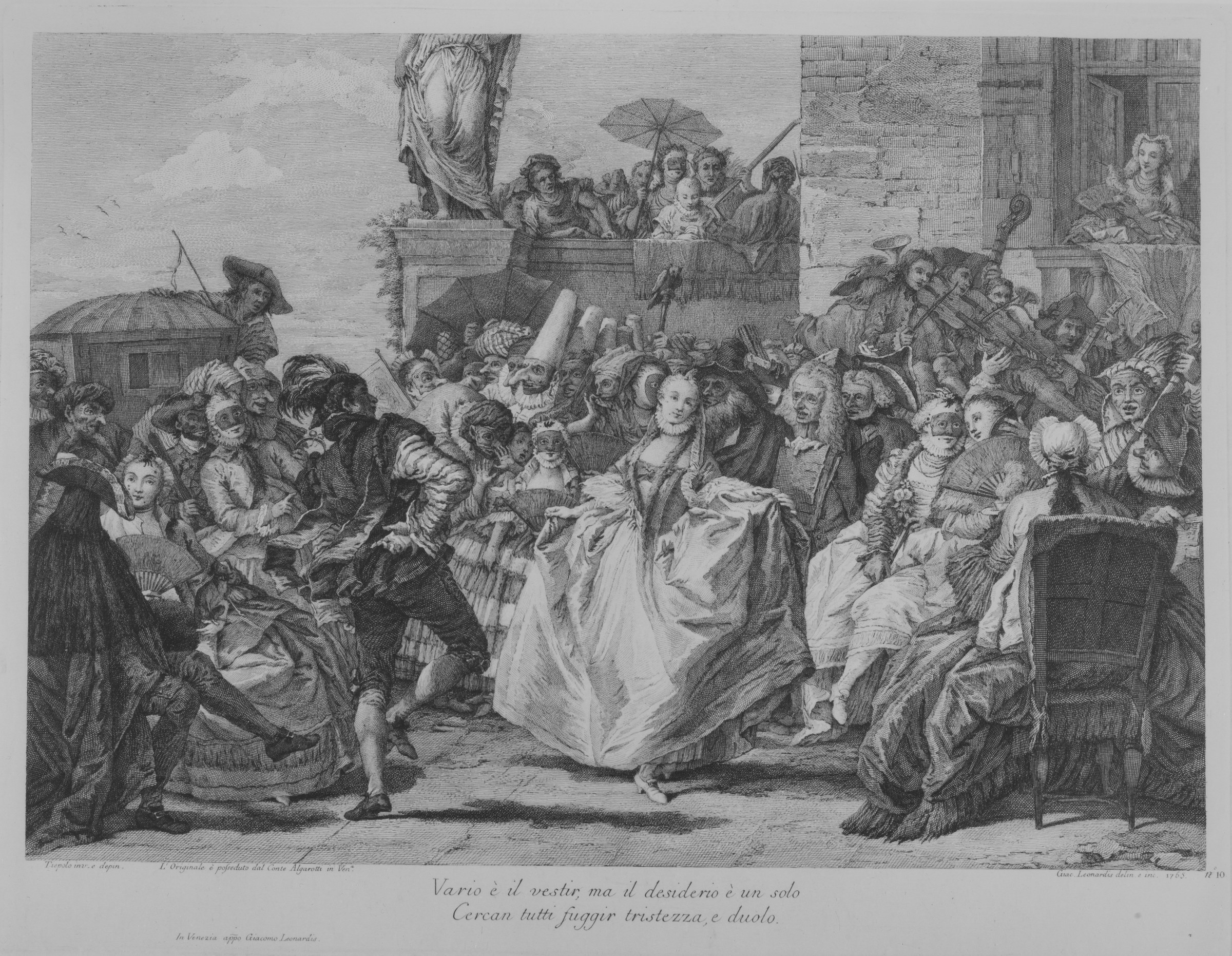
This engraving provides rare visual evidence of the minuet in actual social performance, captured by a leading artist of the period who was documenting contemporary customs with documentary intent. It shows the dance not as a teaching manual or an idealized court scene, but as a living social practice embedded in public ceremony, witnessed and commented upon by numerous onlookers whose varied reactions tell us how the dance was understood and valued in its own moment.
What you are looking at
A crowded urban plaza in what appears to be 18th-century Venice or another Italian city, densely packed with figures in aristocratic dress watching a central dance. The composition is theatrical and angled, with architecture framing the scene—a statue on a tall pedestal dominates the upper left, while buildings create a receding backdrop. A woman in white—the focal point—dances in the center with what appears to be a male partner, her skirt billowing outward in a wide, elegant arc. Around them press dozens of onlookers in silks and satins, some sheltering under parasols, others leaning from balconies and windows above. The print employs deep shadow and carefully controlled light to guide the eye toward the dancing couple amid the crush of spectators, creating a sense of occasion and public ceremony. The mood is one of leisure and sociability, captured in a moment of courtly diversion.
The dancing
The central female dancer displays the lifted carriage and graceful arm position characteristic of courtly dance, her body held upright and elegant as her skirt swells outward in the rotational movement. Her partner appears to maintain a formal, upright stance facing her. The surrounding figures—both male and female spectators—are dressed in the stiff, corseted silhouettes of 18th-century aristocracy, many posed in attitudes of relaxed attention or animated conversation. Several onlookers gesture or point toward the dancers, their poses suggesting appreciation and commentary. The massed crowd creates layers of depth, with some figures more sharply rendered and others suggested through shadow and outline.
The dance depicted
This depicts the minuet, the dominant courtly dance of the 18th century and the emblem of aristocratic refinement and social rank. The title, inscription, and visual evidence—the formal facing couple, the woman's sweeping skirts, the composed vertical carriage, and the public plaza setting—all confirm this identification. The minuet was performed in formal social contexts, often as a prelude to other dances, and was marked by precise, restrained footwork and considerable spatial awareness. The crowded plaza setting documents what was evidently a significant public occasion, possibly a festival or state ceremony where the minuet functioned as a display of courtly elegance and social order. The inscription suggests this is a specific narrative scene, likely from a contemporary account or literary work.
How it was made
This is an engraving, executed with the fine cross-hatching and tonal control that characterize 18th-century Venetian printmaking. The technique allowed Tiepolo to render complex spatial recession and atmospheric depth—notice how the crowd recedes into shadow and architectural suggestion rather than being rendered in equal detail. Engraving permitted wide circulation and reproduction, making this image a durable record of courtly dance practice accessible beyond the Venice elite. The fineness of the line work and the subtlety of tonal gradation suggest this is the work of a skilled reproductive engraver working from a drawing or painting by Tiepolo.
About this work
This is an engraved print documenting a minuet performed in an 18th-century Italian piazza, drawn from Giovanni Domenico Tiepolo's portfolio of social scenes. The work captures the minuet at its peak as a ceremonial courtly dance, performed in a public setting before an engaged crowd of aristocratic spectators. The composition emphasizes the dance as spectacle and social occasion—a formal ritual that ordered rank, demonstrated refinement, and provided entertainment within the urban patrician world. The print belongs to Tiepolo's substantial body of work documenting contemporary Venetian life and custom, executed with the observational precision and compositional sophistication that made him one of the period's most important documenting artists.
For historians of dance and dress, this image is invaluable: it shows the minuet not in a ballroom or court setting, but as a public performance, drawn as a specific moment and identified by title and inscription. The wealth of incidental detail—the architecture, the variety of poses and expressions in the crowd, the parasols and fine dress—grounds the dance in historical specificity and reveals how deeply embedded the minuet was in patrician social life.
How to look at it
Attend first to the moment the artist chose: the dancer's skirt is fully extended in mid-rotation, capturing the characteristic swelling amplitude of the minuet's movement. Notice how the composition draws your eye from the crowd inward toward the couple—the receding architecture, the shadows, and the gesturing figures all funnel attention toward the dance itself, yet the crowd remains the context and frame. Look at the variety of poses and expressions in the onlookers: some watch intently, others converse or gesture, revealing that the minuet was as much a social display as a dance. The engraving technique, with its precise lines and controlled shading, lends the scene an almost documentary quality, as if Tiepolo is recording a specific, witnessed event rather than imagining an ideal.
The artist
Giovanni Domenico Tiepolo (1727–1804) was a Venetian painter and printmaker and the son of Giambattista Tiepolo, the period's preeminent decorative painter. While his father specialized in grand religious and allegorical ceiling frescoes, Domenico turned increasingly toward the depiction of contemporary social life—carnival scenes, street vendors, fashionable gatherings, and public ceremonies. His prints and drawings form one of the most detailed visual records of 18th-century Venetian society, executed with sharp observation and often with witty or satirical intent. He worked extensively in engraving and etching, producing images that circulated widely and shaped later understanding of his era's customs.
The period
The minuet reached the height of its prestige in the mid-to-late 18th century, codified in dance manuals and performed at courts and in aristocratic households across Europe as the mark of gentle birth and cultivation. By the 1760s, when this print was made, the minuet was no longer a novelty but an established ritual, often danced at the opening of a ball or as a formal display piece. Simultaneously, the rise of public assembly and the development of urban leisure spaces meant that courtly dances were increasingly visible to a broader public, performed in streets, piazzas, and gardens as well as private chambers. In artistic practice, Tiepolo's turn toward documenting contemporary social life reflects a broader 18th-century interest in genre scenes and the representation of manners—a counterweight to the allegorical and historical grandeur that had dominated earlier periods.
Where it lives
The print is held in Wikimedia Commons and appears to be a reproductive engraving of the 18th century. The catalogue record provides no acquisition history, collection location, or accession number. The inscription at the foot of the plate provides the Italian text and credits Tiepolo's design.
Dance in this work
Questions about this work
Was the minuet really danced outdoors in public like this?
Yes, though formal minuets were typically danced in ballrooms and chambers, they were also performed at civic celebrations, festivals, and public ceremonies in piazzas and gardens. This print documents such a public occasion, where the minuet functioned as a display of courtly elegance and civic order. The presence of a large crowd suggests this was a special event rather than everyday practice.
What does the woman's costume tell us about the minuet?
The full, billowing skirt—gathered or hooped to create maximum volume—was essential to the visual effect of the minuet, particularly during rotational figures. The width of her skirt frames and emphasizes the geometry of her movement. The white dress and elaborate construction also signal her status and the formality of the occasion.
How do we know this is a minuet and not another 18th-century dance?
The title, the formal facing position of the couple, the vertical carriage and precise arm position, and the character of the woman's movement all identify this as a minuet. The minuet was the preeminent courtly dance of the period and would have been instantly recognizable to Tiepolo's contemporaries. Other dances of the era—contradances, cotillions, allemandes—had distinctive figures and arrangements that are not present here.
Why did Tiepolo make prints of social scenes like this?
Tiepolo was documenting contemporary Venetian life with observational precision. His prints circulated widely and served both as a record of customs and as entertainment for a literate, urban audience interested in seeing their own social world reflected in art. The prints also offered a more accessible and economical alternative to paintings for collectors.
More dance artwork





