49 works in this view — arrow keys or swipe to move between them.
Dance in Art
The Mitred Minuet
Paul Revere
- Source:
- Wikimedia Commons
- Rights:
- Public domain — free to use, share and adapt.
- Recorded as:
- cc0
This is one of the few explicitly satirical engravings of 18th-century dance in America, making it invaluable for understanding how minuet culture was perceived during the Revolution. It reveals the minuet not as a neutral social practice but as a target for political caricature, showing that Americans of the period weaponized formal dance as a means of critiquing institutional power. The work's publication in the *Royal American Magazine* proves that dance satire was considered newsworthy and politically charged enough for a periodical audience.
What you are looking at
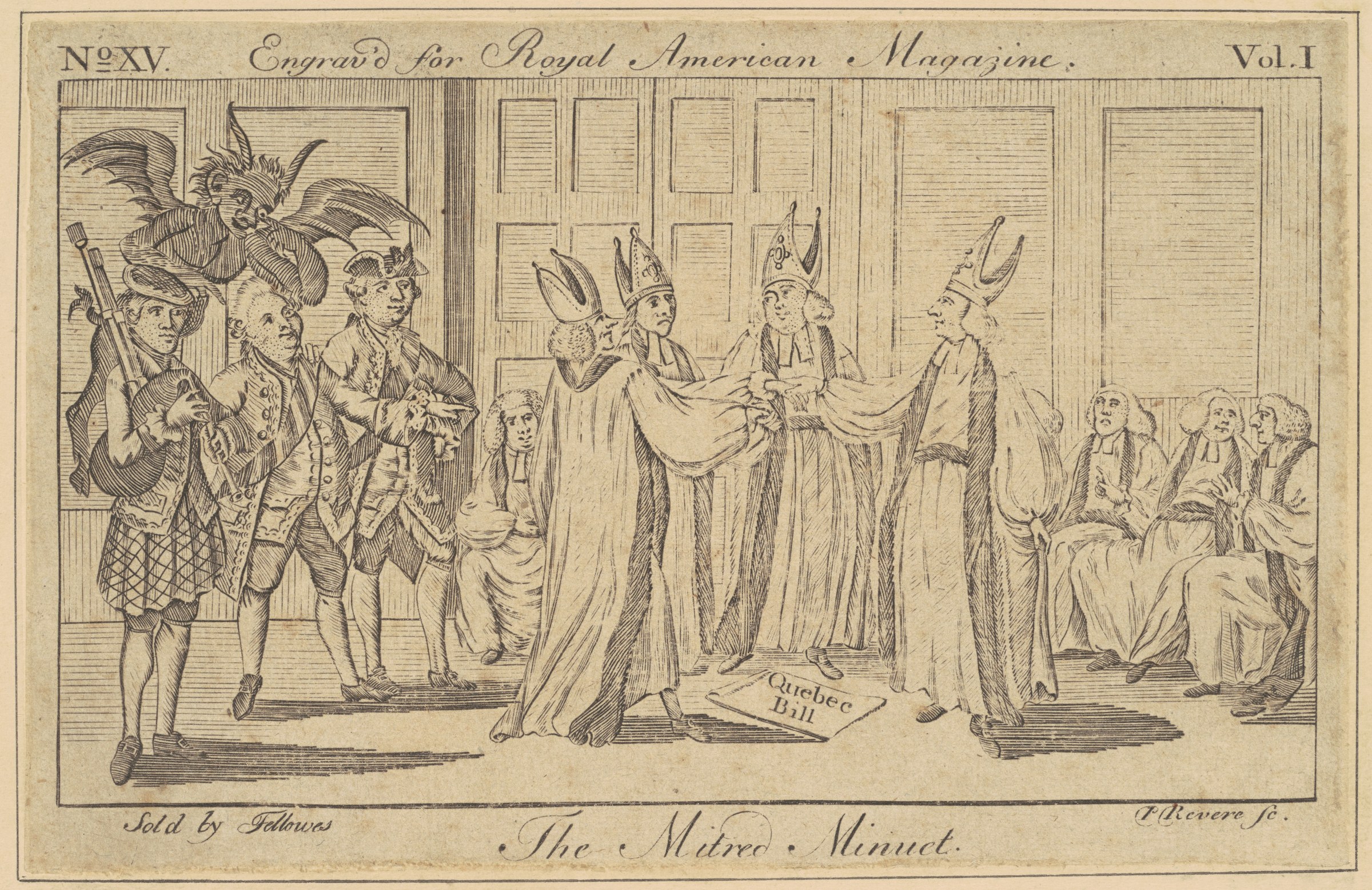
A satirical engraving depicting a formal dance scene set in an interior with tall windows. At left, a military or courtly figure with a tricorn hat holds a staff or weapon, flanked by two elegantly dressed men in 18th-century court dress. At center-right, four figures wearing tall, pointed ecclesiastical mitres and flowing robes stand in an exaggerated posture, holding hands or gesturing dramatically as if dancing. The figure second from left leans back theatrically. To the right, three seated or standing figures in civilian dress observe the scene. The composition contrasts the military-civilian observers on the left with the absurdly costumed "dancers" at center, suggesting mockery of religious or political authority figures engaged in an undignified minuet. The engraving style is precise and heavily cross-hatched.
The dancing
The central figures wearing mitres adopt an exaggerated, almost grotesque minuet posture—bodies angled, one figure leaning backward in an unnatural arch, hands linked or raised in theatrical gestures. Their rigid, stiff-legged stance and elongated forms are deliberately ridiculous. The military observer maintains an upright, formal bearing with staff held vertically. The seated spectators on the right remain static and composed, their expressions suggesting bemused detachment. The overall frame emphasizes the contrast between the pompous, mincing movements of the mitred figures and the static authority of the military-civilian witnesses.
The dance depicted
This is a satirical representation of the minuet, the formal court dance of the 18th century, but executed as caricature. The title "The Mitred Minuet" identifies the dance explicitly. The mitred figures—clearly meant to represent clergy or bishops—are shown attempting the minuet in an absurdly exaggerated manner, with impossible body angles and affected gestures. The work mockingly presents the minuet not as an accomplishment of grace and refinement but as a ridiculous pantomime performed by pompous ecclesiastical figures, suggesting social or political satire on religious authority of the period. The minuet itself is recognizable in the formal positioning and the paired or linked grouping, but rendered grotesque through the artist's distortion.
How it was made
This is a line engraving—a relief print produced by incising lines into a metal plate (likely copper or steel) and inking the resulting ridges. The technique is evident in the controlled parallel hatching that creates volume and shadow, particularly visible in the robes, faces, and background architecture. Engraving allowed for fine linear detail and was the standard reproductive medium for satirical prints in 18th-century America and Britain. The credit line notes it was "Sold by Fithwes" (a publisher), indicating this was a commercial print distributed to a wide audience, likely as political or social commentary. The notation "Engraved for Royal American Magazine" confirms it was made for mass circulation in a colonial periodical.
About this work
This is a satirical engraving from 1774 America depicting religious or political authority figures grotesquely performing a minuet—the quintessential dance of refined 18th-century court culture. By pairing the minuet, a symbol of aristocratic grace, with the absurd, exaggerated physicality of mitred (episcopal or clerical) figures, the artist ridicules both the dance form and the institution it represents. The work belongs to a tradition of political and social satire using the body and formal dance as vehicles for critique. It provides direct visual evidence of how the minuet was understood in Revolutionary-era America—not merely as a dance, but as a loaded symbol of establishment authority ripe for mockery.
How to look at it
Attend to the contrast in body language: the military observer stands rigidly vertical and authoritative, while the mitred figures contort themselves into exaggerated, unnatural positions supposedly executing the minuet. The artist freezes the dancers at the moment of maximum grotesquerie—leaning backward, gesturing wildly—to emphasize the ridiculousness of the pose. Notice how the engraver has distorted the proportions of the mitred figures' bodies and robes, elongating limbs and exaggerating the slope of their posture to amplify the mockery. The architectural setting (formal interior with windows) establishes this as a court scene, yet the figures inhabiting it are made absurd, creating cognitive dissonance that drives the satire.
The artist
Paul Revere (1734–1818) was a Boston silversmith, engraver, and political activist whose prints were widely circulated during the American Revolution. Though now remembered primarily as a midnight rider, Revere was a prolific engraver who produced satirical and political imagery, including caricatures and commentary on British authority. His engravings were tools of propaganda and public discourse, distributed through newspapers and magazines. Revere's prints typically combined technical skill with pointed social messaging, making him a key figure in the visual culture of Revolutionary America.
The period
The minuet reached its peak of social importance in the mid-18th century as the dominant dance of European and colonial aristocratic society. By the 1770s, it was becoming a symbol of old-world refinement and establishment authority—precisely what Revolutionary-era Americans were beginning to reject. The publication of this print in 1774, the year of the First Continental Congress, situates it at a moment of escalating political tension between colonial and British authority. Ecclesiastical figures (suggested by the mitres) would have carried particular satirical charge in a period of questioning institutional hierarchy and religious establishment. The engraving mocks not only the minuet's affectations but the social order it embodied.
Where it lives
This engraving is credited to Paul Revere and published as part of the *Royal American Magazine*, Vol. I, indicating it was a mass-produced satirical print distributed as a periodical illustration. The source is Wikimedia Commons; no holding collection is currently recorded in the catalogue.
Dance in this work
Questions about this work
What are the tall pointed hats the dancers are wearing?
Those are mitres, the tall ceremonial headdresses worn by bishops and other high-ranking clergy in the Christian church. Their presence in a satirical minuet scene strongly suggests the print is mocking ecclesiastical authority, possibly in the context of colonial anti-establishment feeling in 1774.
Why would a minuet be considered satirical?
The minuet was the formal dance of European aristocratic courts and represented refinement, hierarchy, and old-world authority. By the 1770s in America, depicting it as something grotesque or ridiculous was a way of mocking the very social order it symbolized—aristocracy, establishment religion, and British cultural dominance.
Is this actually showing people dancing, or is it purely mockery?
It is both. The central figures are unmistakably attempting a minuet—the formal paired positioning, the hand-linking, the upright bearing are all present—but the artist has grotesquely distorted the execution to make it look absurd. This suggests the satire is directed at both the dance and the people performing it.
How do we know this was by Paul Revere?
The engraving is labeled as engraved by Revere (the signature or credit may be visible in the original print), and the catalogue record attributes it to him. Revere produced many satirical engravings during the Revolutionary period, and this style and subject matter align with his known work.
More dance artwork





