49 works in this view — arrow keys or swipe to move between them.
Dance in Art
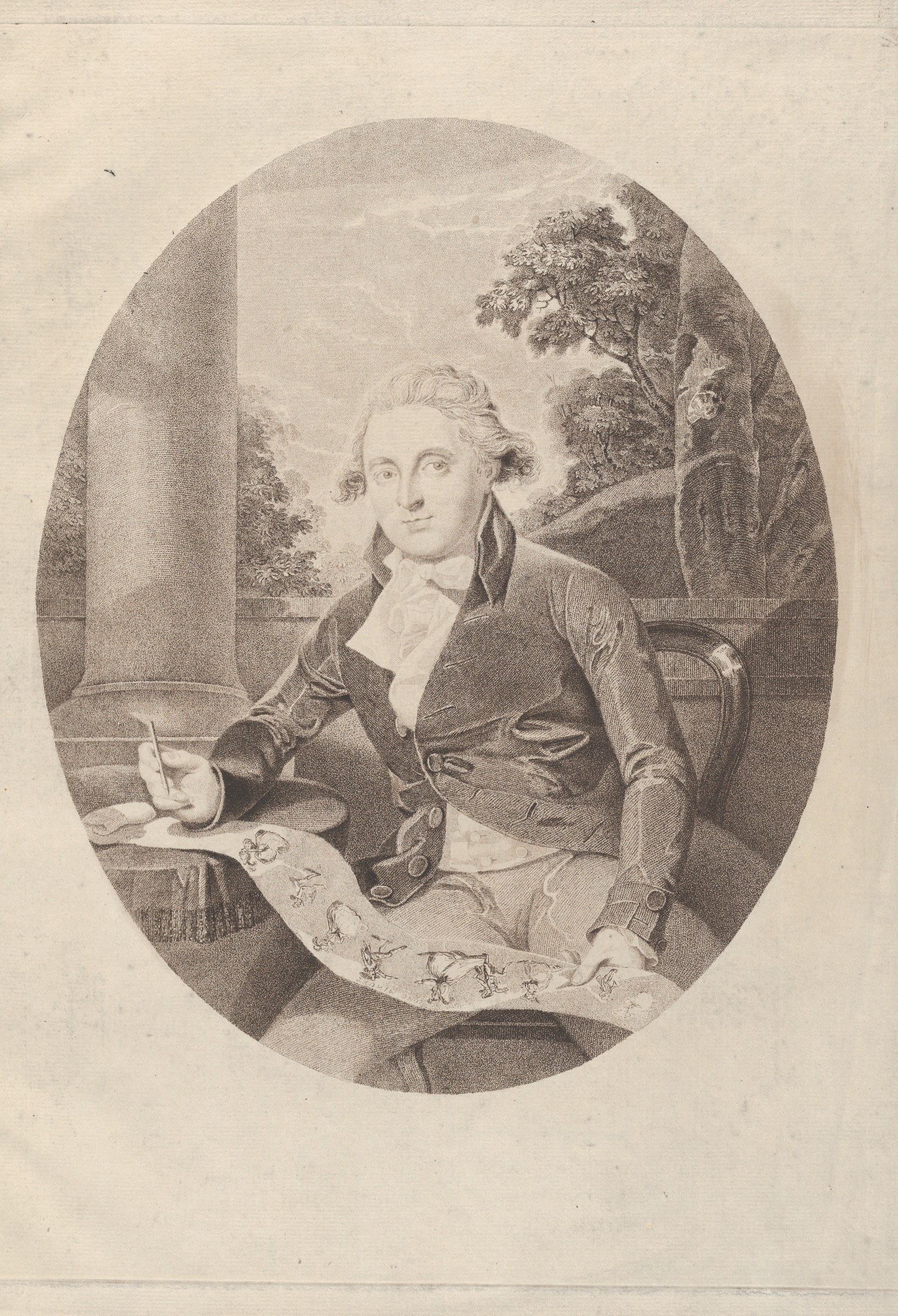
Henry William Bunbury Drawing his "Long Minuet"
Creator:Thomas Ryder I
- Source:
- Wikimedia Commons
- Rights:
- Public domain — free to use, share and adapt.
- Recorded as:
- cc0
This image is one of the few visual documents of eighteenth-century dance notation practices and of the amateur choreographic activities of educated gentlemen during the period. It provides evidence that the minuet, by the late 1700s, was being studied, recorded, and composed by amateurs as a form of artistic practice, not merely danced socially. For historians of dance notation and of the minuet's evolution, it offers a rare glimpse of how the dance was preserved and transmitted in manuscript form before the age of mechanical recording.
What you are looking at
A gentleman seated in an interior with a garden visible through tall windows behind him draws or sketches on a large sheet of paper held across his lap. He wears the formal dress of the late eighteenth century: a dark coat with buttons and decorative frogging, a white cravat, and pale breeches. His posture is relaxed and assured, leaning back slightly in his chair as he works. The sheet he holds bears small sketched figures—dancers in motion—which he appears to be composing or copying. The setting is architectural and refined, with classical columns framing the garden view and suggesting the interior of a gentleman's study or studio. The engraving technique renders the scene in fine detail, from the texture of fabric to the play of light across surfaces.
The dancing
The primary figure is a single seated man in a composed, contemplative attitude. His right arm extends to hold the paper steady while his left (implied by the angle) would guide the pencil or stylus. His body is upright but relaxed, weight settled into the chair, suggesting concentration without strain. The small figures sketched on his paper are rendered too small to read individual limbs or holds clearly, but they appear to be in various attitudes of motion—some upright, some with raised arms—consistent with choreographed dance positions rather than naturalistic movement.
The dance depicted
The title identifies the work as depicting Bunbury drawing his 'Long Minuet,' suggesting that the small figures on the paper represent a minuet composition or choreographic notation. The minuet was the dominant court dance of the eighteenth century, performed in formal dress at balls and assemblies, and by this period it was also studied as a compositional form by dancing masters and amateurs. The image documents not a performance but the act of choreographic creation or transcription—a gentleman artist-scholar recording the steps, figures, and spatial patterns of a minuet for study or publication. The work thus captures a moment in the social and intellectual life of dance during the Regency era, when amateur engagement with dance notation and composition was fashionable among the educated gentry.
How it was made
This is an engraving, executed in the fine stippled and linear technique characteristic of late-eighteenth-century reproductive prints. The medium allowed for wide circulation among the educated classes and suggests an audience familiar with both the sitter (or his reputation) and the subject of dance notation. Engraving required skilled labour and was relatively expensive, indicating that the image was valued as a record of a notable figure or practice. The technique's precision and tonal range—achieved through careful gradation of line and stipple—permits the rendering of fabric, light, and spatial depth that would have been appreciated by contemporary viewers familiar with both art and polite society.
About this work
This engraving documents Henry William Bunbury, an amateur artist and dance enthusiast of the Regency era, in the act of composing or transcribing a minuet. Rather than depicting a dance performance, it records the intellectual and creative labour behind choreography—a moment of study and composition in a gentleman's interior. The work belongs to a small but significant tradition of images that treat dance not as spectacle but as a subject of serious amateur study and artistic practice. It reveals the status of the minuet in late-eighteenth-century culture: no longer merely a social accomplishment, but a form worthy of artistic notation and preservation.
The engraving was made by Thomas Ryder I, a reproductive engraver of considerable skill, from a design or painting by an unrecorded artist. It circulated among the educated gentry as a portrait of Bunbury and as a document of his intellectual interests. The work thus sits at the intersection of portraiture, dance history, and the social history of the amateur in the Georgian era.
How to look at it
Attend first to the gentleman's posture and the placement of his paper: the engraver has chosen to show him in a moment of concentration, his body settled and his attention focused on the small figures he is drawing. The contrast between his large, dignified seated form and the tiny, intricate choreographic notations on his paper is the visual core of the image—it suggests that serious intellectual work can be done in an attitude of ease and refinement. Look also at the setting: the classical architecture and garden view frame him as a man of taste and leisure, placing choreographic study within the context of polite accomplishment and gentlemanly learning. The engraver's technique—the fine stippling and careful gradation of tone—reinforces the sense of careful, patient labour.
The artist
Thomas Ryder I (1746–1810) was a prolific English reproductive engraver, trained in the stipple engraving technique that was fashionable in Britain in the late eighteenth century. He specialized in portraits and conversation pieces, translating paintings and drawings into prints for the print-collecting public. Ryder was known for his technical skill and his ability to render fine detail and subtle tonal effects through stippled and linear work. His practice of reproductive engraving placed him in the service of artists and patrons who wished to circulate images widely, and his engravings were aimed at the educated middle and upper classes.
The period
The minuet had dominated European court dance for over a century by the late 1700s, but by the Regency period it was becoming historicized—valued as a refined accomplishment and a subject of study rather than as a living social dance form. The rise of amateur interest in dance notation, choreographic composition, and the preservation of dance forms in manuscript coincided with the growth of dance master practice and dance instruction manuals. At the same time, engraving as a medium was experiencing a golden age of refinement and circulation in Britain, with stipple and fine-line techniques allowing for unprecedented detail and tonal subtlety. The combination of these factors—amateur interest in dance study, the prestige of notation and composition, and the accessibility of reproductive engraving—made images such as this both possible and culturally resonant.
Where it lives
The work is known from Wikimedia Commons, where it is documented as an engraving by Thomas Ryder I dated 1789. Neither the collection holding nor the current location is recorded in the catalogue.
Dance in this work
Questions about this work
What is a 'Long Minuet'?
The 'Long Minuet' likely refers to an extended or elaborate minuet composition, possibly one with a longer sequence of figures or steps than the typical social minuet. In the late eighteenth century, dance masters and choreographers created elaborate minuets that were studied and preserved in notation. Without access to Bunbury's original notation, the precise meaning remains uncertain, but the image suggests it was a work considered significant enough to be recorded and drawn by hand.
How were dances notated in the eighteenth century?
Eighteenth-century dance notation systems varied, but most recorded steps, positions, and directional patterns using symbolic marks and written descriptions. Bunbury appears to be using a freehand sketch method—drawing small stick or outline figures in various dance positions to capture the spatial and bodily forms of the minuet. This informal notation was common among amateurs and choreographers who wished to preserve or communicate dance sequences without relying on formal notation systems such as Beauchamp-Feuillet notation.
Who was Henry William Bunbury?
Henry William Bunbury (1750–1811) was an English amateur artist, illustrator, and caricaturist known for his satirical drawings and social commentary. He was also a man of leisure with interests in dance, music, and the arts. The engraving celebrates him as a figure who combined artistic practice with engagement in dance study—a mark of his status as an educated gentleman.
Why did amateurs study and notate dances?
In the Regency era, dance study and composition were marks of refinement and education among the upper and middle classes. Amateurs engaged in notation and choreographic practice to preserve dances they valued, to study the principles of movement and composition, and to participate in the intellectual life of polite society. For some, like Bunbury, it was also a form of artistic practice—a way to apply drawing and design skills to the record of the body in motion.
More dance artwork





