49 works in this view — arrow keys or swipe to move between them.
Dance in Art
Philibert-Louis Debucourt - The Bride's Minuet
Philibert-Louis Debucourt
- Source:
- Wikimedia Commons
- Rights:
- Public domain — free to use, share and adapt.
- Recorded as:
- public_domain
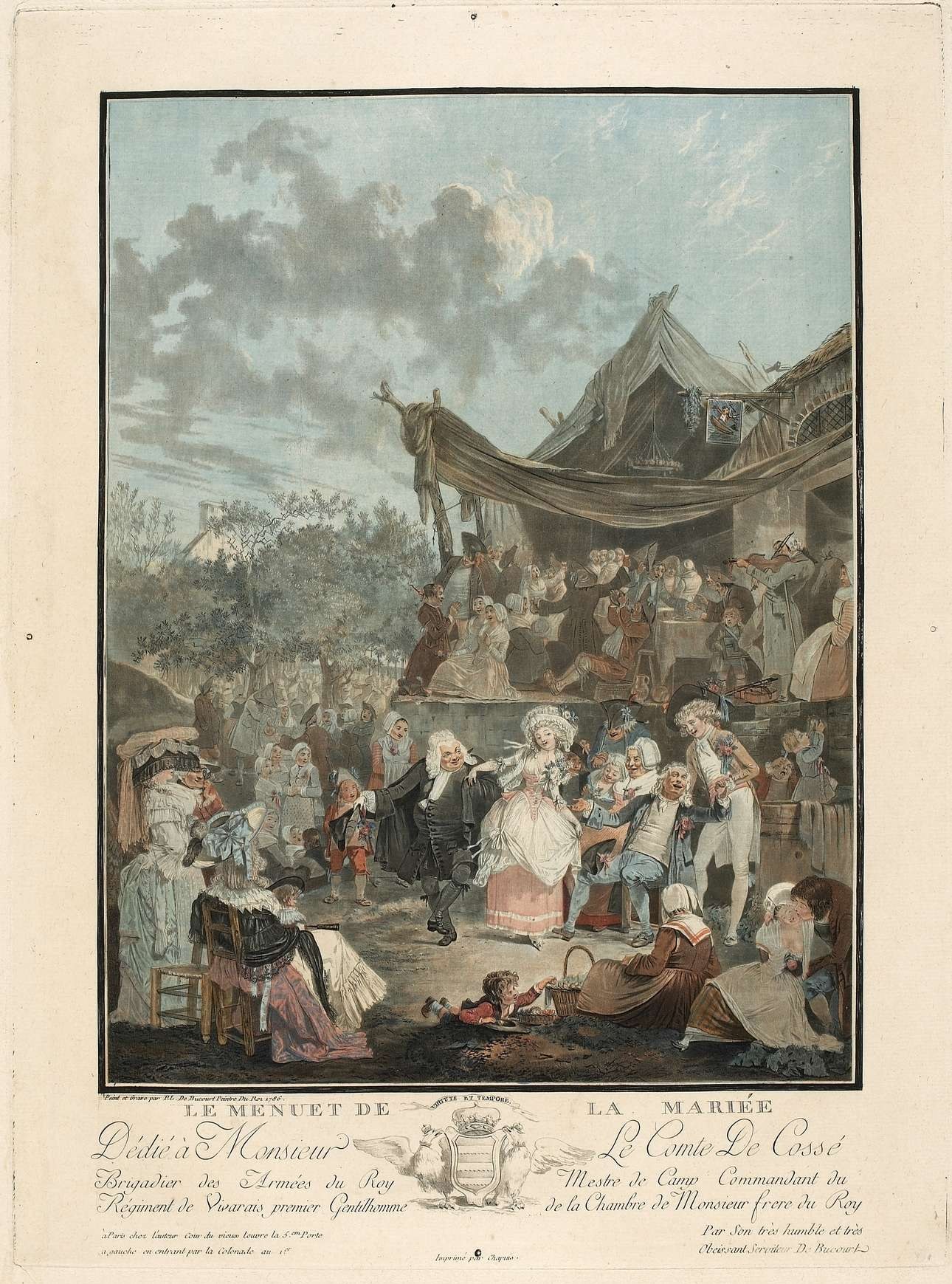
This is one of the finest visual records of the minuet in actual performance, showing the dance not in a dancing master's diagram but in its proper social context—formal, watched, ceremonial. For dancers and historians, it reveals the minuet's grammar of posture, frame, and spatial arrangement with unusual clarity. For social historians, it documents the role of dance in aristocratic ritual and the performance of status through movement.
What you are looking at
A wedding feast occupies a large canvas divided between an upper and lower register. The bride and groom stand at the center of an elevated platform under an elaborate draped canopy, surrounded by seated and standing guests in formal 18th-century dress. The bride wears a pale pink gown with white fichu and an elaborate headdress; the groom is in dark coat with white stockings. Below them, in the foreground, a couple performs a minuet on the ground before the assembled wedding party. The woman wears a pink skirt with white bodice and an ornate powdered coiffure; the man wears a coat and breeches. The setting is a garden banquet ground, with trees visible at left and servants moving about. The light is cool and silvery, with white clouds gathering overhead. The crowd is ordered by rank and gender, with women in pale silks and men in dark coats, all watching the dance below.
The dancing
The dancing couple occupies the visual center of the lower half. Both stand in the formal upright posture required for the minuet, with the woman's right hand held lightly in the man's left at about chest height; their other arms are raised and bent at the elbow in the characteristic frame. The man's weight appears to be on his front foot as he bows slightly toward his partner; the woman's posture is equally formal and erect. Neither figure leans toward the other. The surrounding guests lean forward to watch, their bodies angled inward toward the dancers. The arrangement suggests a single moment frozen in the opening measures of the dance.
The dance depicted
This is unequivocally a minuet, the most formal and codified social dance of the French and European courts in the 18th century. The minuet was danced by a single couple at a time, always in view of the assembled company, and served as a display of status, grace, and courtly accomplishment. The setting—a wedding feast attended by rank-conscious nobility—is the proper context for the minuet. The formal dress, the elevated position of bride and groom watching from above, and the careful geometry of the spectators all confirm that this is a ceremonial performance, not a social dance for general participation. The title announces this explicitly: 'The Bride's Minuet.'
How it was made
This is a hand-colored engraving or etching, as established by the fine line work, the pale tonal washes in the sky and costumes, and the legible text inscribed below the image. The inscription identifies the work, dedicates it to the Comte de Cassé, and credits the artist. The technique allowed wide circulation through prints, making this image accessible to a broad educated public across Europe—important evidence that the minuet was not only an aristocratic performance but also a subject of public interest and instruction. The color adds distinction to a work that could have been distributed in monochrome, suggesting either a luxury edition or a wealthy owner.
About this work
Philibert-Louis Debucourt's print captures a specific ceremonial moment: the bride's minuet at a formal wedding feast in the late 18th century. This is both a genre scene and a dance document, recording not only the visual spectacle of the minuet but the entire apparatus of aristocratic display that framed it—the hierarchy of seating, the attention of the crowd, the bride and groom's watching gaze, and the perfect geometry of the dancers' bodies. The work belongs to a tradition of prints depicting courtly life and formal celebrations that served as both social instruction and entertainment for the French and European bourgeoisie.
As a document of dance history, this engraving is exceptional. It shows the minuet not as an abstraction but as a lived social ritual embedded in ceremony and witnessed performance. The bride's minuet was a tradition at aristocratic weddings—a moment when the newly married woman demonstrated her accomplishment and grace before the assembled company. Debucourt captures the formal discipline, the vertical posture, the controlled arm positions, and the careful distance between partners that defined the minuet throughout its long reign in European ballrooms.
How to look at it
Attend to the formal geometry of the dancers' bodies—the way both partners maintain a perfect upright posture, how the arms are held, the precise distance between them, and the angle of the man's slight bow. This is not a moment of movement or turning, but the stillness of a posed introduction or a balanced moment within the step pattern. Notice too how the entire composition is organized around the dancers: all eyes in the crowd turn toward them, and the bride and groom themselves watch from above, making the minuet a performance of display rather than expression. The engraver has chosen to freeze the dance at a moment of formal presentation, which is exactly when the minuet's rules would be most visible.
The artist
Philibert-Louis Debucourt (1755–1832) was a French engraver and painter known for colorful, detailed prints of Parisian social life. He specialized in genre scenes of aristocratic and bourgeois society, often hand-colored with pale washes. His work is marked by careful observation of costume, gesture, and spatial arrangement. Debucourt was skilled at capturing both the social hierarchy and the vivacity of courtly life, and his prints enjoyed wide circulation among educated patrons. This print sits squarely within his practice of documenting French social ritual and ceremony.
The period
This work dates to the late 18th century, a period when the minuet had already begun its long decline as a living social dance, though it remained the foundation of ballroom training and the marker of aristocratic polish. The print was made during the ancien régime or shortly after, when such wedding ceremonies were still central to aristocratic display. The minuet itself had originated in France in the 17th century and had become the most codified and rule-bound of all European social dances. By the time Debucourt was working, the minuet was giving way to livelier forms like the contredanse and later the waltz, but its cultural authority remained absolute. A bride who could dance the minuet with grace and precision announced her breeding and education.
Where it lives
This work appears to derive from Wikimedia Commons, a digital repository of open-access images. It is a print, likely one of many impressions, and the holding collection is not recorded in the catalogue metadata.
Dance in this work
Questions about this work
Was the bride really expected to dance at her own wedding?
Yes, the bride's minuet was a formal tradition in aristocratic weddings, particularly in France. Dancing the minuet was a public performance of accomplishment and grace, and the bride's execution of it was watched and judged by the assembled company. This print documents exactly that moment.
Could anyone dance the minuet, or was it only for aristocrats?
The minuet was technically accessible to anyone who could afford dancing lessons, but it was strongly associated with aristocracy and wealth. By the 18th century, bourgeois families who aspired to gentility also learned it. This print, dedicated to a comte, shows it in its highest social setting.
What do the dancers' bodies tell us about how the minuet actually looked?
The erect posture, the controlled arm positions, the formal distance between partners, and the absence of any lean or forward momentum show that the minuet was about restraint, symmetry, and visual composure. It was not a dance of speed or passion, but of propriety and precision.
Why is this scene so crowded if only two people are dancing?
The minuet was always performed for an audience. Part of its social function was to display the dancer's accomplishment before witnesses. The crowd, the elevated platform, and the bride and groom's watching gaze all confirm that this is a performance ritual, not a social dance for general participation.
More dance artwork





