49 works in this view — arrow keys or swipe to move between them.
Dance in Art
Le bal paré
Antoine-Jean Duclos / After Augustin de Saint-Aubin
- Source:
- Wikimedia Commons
- Rights:
- Public domain — free to use, share and adapt.
- Recorded as:
- public_domain
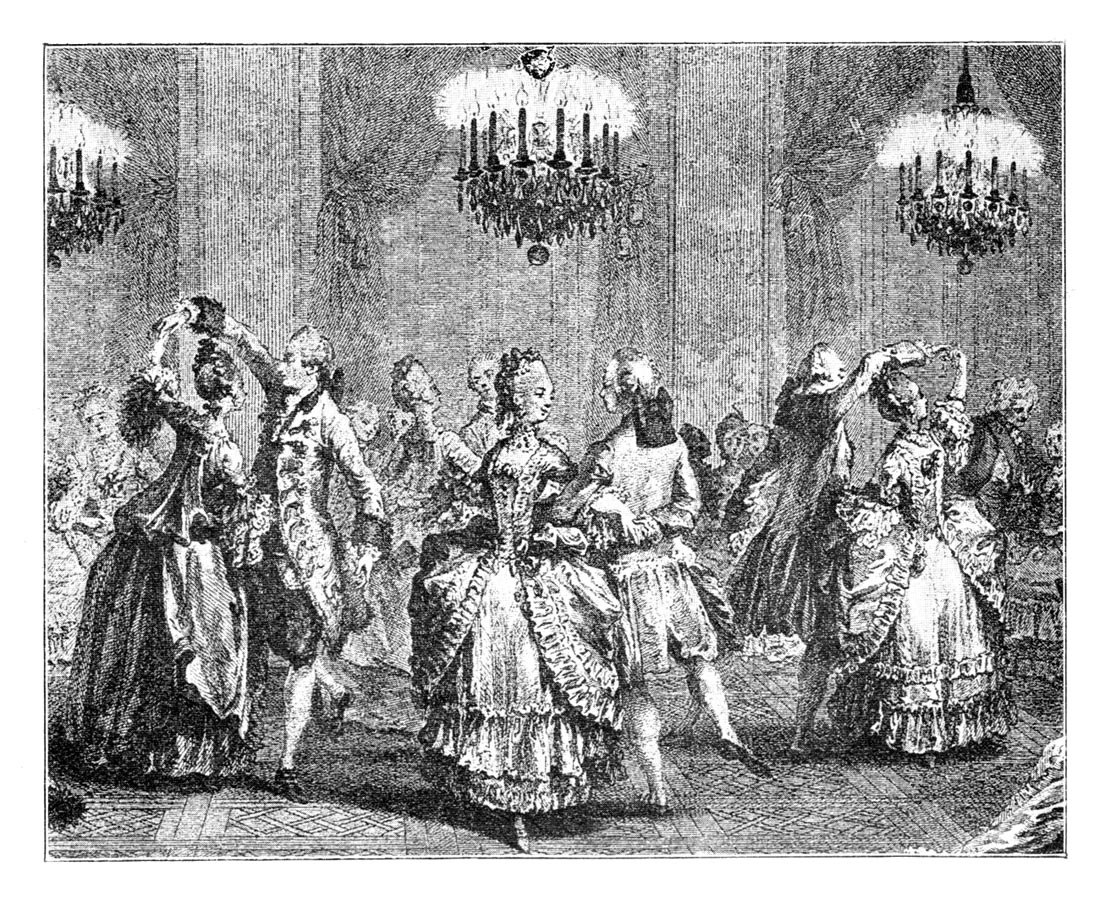
This engraving is one of the most detailed visual records of how the Quadrille and Cotillion were actually performed in the 1770s—showing formation, dress, spacing, and the moment of movement in ways that written descriptions cannot convey. Saint-Aubin was a meticulous observer of Parisian society, and his designs for engravings like this were valued by contemporaries as accurate social documentation. For anyone studying 18th-century dance, ballroom architecture, or the visual culture of the ancien régime, this is an essential image.
What you are looking at
A formal court ball or assembly in a grand interior, lit by multiple ornate chandeliers suspended from a coffered ceiling. The room is lined with tall fluted pilasters and appears to be a palace or aristocratic residence. A large group of figures—approximately 15–20 people—occupies the floor in what appears to be an organized social dance. The figures are arranged in a loose formation suggesting a group dance or cotillion rather than couples in closed embrace. Men wear formal court dress: dark coats, breeches, stockings, and shoes with buckles or heels. Women wear elaborate gowns with voluminous skirts, tight bodices, and considerable ornamentation; several skirts show prominent ruffled or pleated hems and appear to be in motion. The foreground figures, particularly a woman in a prominent skirt, suggest choreographed movement across the floor. The engraving employs strong contrasts of light and shadow to suggest the theatrical illumination of the ballroom, with the chandeliers creating focal points above.
The dancing
The bodies occupy an open formation typical of 18th-century group dances—not in paired closed holds but in positions suggesting lines, sets, or a circular arrangement. Arms are visible in various positions, with some figures gesturing or conducting, suggesting either musical accompaniment or the formal direction of movement. The prominent woman in the foreground has weight distributed across both legs in a stance suggesting active stepping or turning rather than stillness. The posture throughout is upright and dignified, with no flexion of the torso; the movement appears to emanate from the legs and lower body while the upper body maintains formal court carriage. The density of figures and variety of positions suggests a moment captured mid-movement rather than a standing arrangement.
The dance depicted
This is almost certainly a Quadrille, Cotillion, or similar French court group dance of the mid-to-late 18th century. The open formation, the mix of men and women in a single choreographic space, and the formal interior all point to the social ballroom dances that dominated aristocratic assemblies in this period. The term 'bal paré' (decorated or dressed ball) refers to a formal daytime assembly, distinct from evening masked balls, and was a common setting for quadrilles and cotillions. The image captures a moment of active dancing rather than an opening or closing pose, suggesting the artist was documenting the practice and social dynamics of court dance rather than its formal structure. The dance would have been improvised within a known framework, with figures moving through set patterns while music played, making this a document of elite social performance.
How it was made
This is an engraving, likely a line engraving given the fine parallel hatching visible throughout and the precision of the architectural details. The attribution to Duclos as engraver and Saint-Aubin as the original designer suggests this is a reproductive engraving from a drawing or painting—a common practice for documenting court life and fashionable society in 18th-century France. The technique of engraving allowed for wide circulation: multiple impressions could be printed and distributed to a broad educated audience interested in fashion, manners, and social documentation. The level of detail in costume and setting indicates this was made for an audience that valued accuracy and specificity about how aristocratic leisure was conducted. The high finish and formal presentation suggest this may have been part of a series or collection documenting court assemblies.
About this work
Le bal paré is a documentary engraving of an 18th-century French aristocratic ballroom dance, most likely a Quadrille or Cotillion. Made by the engraver Antoine-Jean Duclos after a design by Augustin de Saint-Aubin—a prolific chronicler of Parisian society—the work captures the formal setting, dress, and active movement of elite social dance in the ancien régime. It is not a idealized or theatrical representation but a record of actual practice: the specific architecture, the orchestrated positioning of multiple dancers, and the moment of movement all speak to documentation of how this class actually danced.
This work belongs in a gallery of dance in art because it functions as visual historical evidence. Unlike allegorical or mythological dance scenes, this engraving shows real bodies in real space doing a real social practice. The artist has chosen to freeze a moment of active group movement rather than a formal pose or tableau, suggesting an interest in the lived experience of dance rather than its symbolic meaning. For dancers and historians, this is primary source material about technique, formation, costume, and the integration of dance into aristocratic social life.
How to look at it
Look first at the formation: the dancers are not in closed couples but in an open, linear, or circular arrangement characteristic of group social dances. Notice the variety of arm positions and the forward momentum suggested by the positioning of legs and torsos—this artist has chosen to show movement, not a static line-up. Observe the prominence of the women's skirts: their volume and the visible ruffled hems tell you both about the fashion and about how the skirt would have moved during turning or side steps. Look at the architectural setting—the scale of the room, the chandeliers, the formality of the space—to understand that this was an elite social practice in a controlled, theatrical interior. Finally, note that the engraver has included many faces and rendered the crowd as composed of individuals, not generic dancers, suggesting this may even document a specific assembly.
The artist
Augustin de Saint-Aubin (1736–1807) was a French draughtsman, painter, and prolific chronicler of Parisian social life. He specialized in detailed drawings and prints of court ceremonies, assemblies, and fashionable gatherings, recording the visual culture of the aristocracy and wealthy bourgeoisie with anthropological precision. His works were widely engraved and circulated, making him one of the primary visual documentarians of 18th-century French society. Antoine-Jean Duclos was a skilled engraver who worked frequently from Saint-Aubin's designs, transferring his drawings into the reproductive engravings that gave them wider circulation and audience.
The period
The 1770s were the height of the Quadrille and Cotillion's popularity in European court society. These group dances had emerged in France in the mid-century and quickly became the dominant form of ballroom entertainment among the aristocracy, replacing the older minuet as the primary social dance at formal assemblies. The 'bal paré'—a formally dressed daytime or early-evening assembly—was the standard venue for such dances. Visually, the period saw a surge in printed documentation of court life and fashion, reflecting both aristocratic interest in self-representation and a growing market for images of fashionable society among the educated public. The engraving served as the primary medium for circulating such images, and Saint-Aubin was among the most prolific and respected creators of such documentary prints.
Where it lives
The work comes from Wikimedia Commons, a source that aggregates images from multiple institutions and public collections. The attribution to Saint-Aubin as designer and Duclos as engraver, along with the date of 1773 (with one source noting 1774), indicates this is likely a print from a series or collection of society scenes, possibly sold individually or as part of a bound volume. The holding collection is not recorded in our catalogue.
Dance in this work
Questions about this work
What is a bal paré?
A bal paré was a formal daytime or early-evening assembly in 18th-century aristocratic society, distinguished from masked balls (bal masqué) or evening soirées by its official, decorated character and dress code. Such assemblies were the primary venues for fashionable social dances like the Quadrille and Cotillion. The word paré means dressed or adorned, indicating the formal appearance expected of attendees.
What dance is being shown here?
Most likely a Quadrille or Cotillion, the dominant group dances of the 1770s. Both were performed by sets of dancers moving through prescribed figures while a musician played. The open formation, the mix of men and women, and the moment of active movement all point to one of these group dances rather than a couple dance like the minuet or country dance.
How do we know this is an accurate record of real dancing?
Saint-Aubin was a careful observer who documented Parisian society with precision, and he specialized in capturing specific social events and venues. The architectural detail, the variety of individual faces and figures, and the specific moment of movement all suggest this was drawn from observation rather than imagination. Engravers like Duclos who worked from such designs were valued by their audience for accuracy and fidelity to the original.
What does the costume tell us about the dance?
The women's wide skirts with ruffled or pleated hems would have created visual emphasis on turning, side steps, and the rotation of the hips—movement typical of the Quadrille and Cotillion. The men's fitted breeches and heeled shoes allowed for the precise footwork these dances required. The upright posture visible in both men and women reflects the formal carriage expected in court dance, with movement generated from the legs while the torso remained dignified and still.
More dance artwork





