49 works in this view — arrow keys or swipe to move between them.
Dance in Art
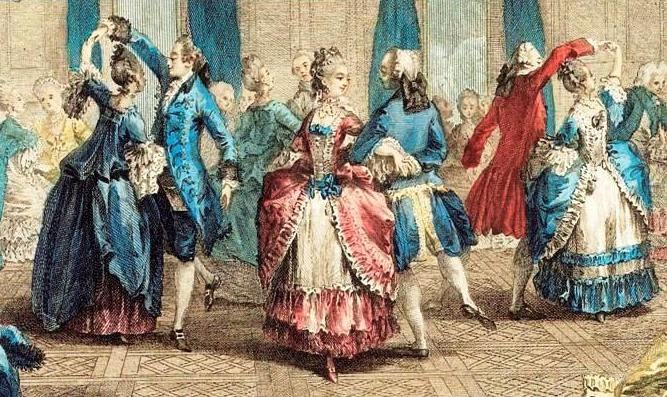
Le bal paré
Antoine-Jean Duclos / After Augustin de Saint-Aubin
- Source:
- Wikimedia Commons
- Rights:
- Public domain — free to use, share and adapt.
- Recorded as:
- public_domain
For historians of social dance and courtly life, this engraving is invaluable documentary evidence of the ballroom as a space, the costume in which dance was performed, and the social rituals that surrounded the actual dancing. It shows us not what the minuet looked like in motion, but the world in which it was danced and the status it conferred. The work exemplifies how 18th-century prints functioned as a form of social instruction: they taught the educated classes how to dress, where to stand, and how to comport themselves in elite social space.
What you are looking at
A formal ball in a grand interior with tall pilasters and draped fabric suggests a palace or noble residence. The scene captures a moment of social interaction during a pause in dancing or during introductions. At least twenty figures, dressed in the height of 1770s fashion, occupy the space in small clusters. In the center, a woman in a striking pink silk gown with red underskirts and elaborate ruffled trim stands in conversation, her posture upright and composed. To her left, a man in dark coat and breeches holds a small dog, and other gentlemen in blue and burgundy coats with white stockings form scattered groups. At the far right, a figure in a vivid red cloak stands prominently. The lighting is warm and even, typical of hand-tinted engravings, with careful attention to the sheen of silk fabrics and the precision of embroidered detail. The floor is rendered in perspective, pulling the eye back into the shallow space of the ballroom.
The dancing
The bodies are arranged in conversational clusters rather than in active dancing formation. The woman in pink occupies the visual center with arms relaxed at her sides, her weight settled and balanced—the stance of someone pausing in social interaction. The gentlemen surround her with upright posture and slightly angled bodies that suggest polite attention. None of the figures show the suspended lift or turned-out positions of formal dance; instead, they stand or walk with the naturalistic carriage of social gathering. The proximities suggest rank and favor: closer figures receive more attention. The overall impression is of decorum and careful social choreography rather than active physical movement.
The dance depicted
This depicts the social world of the formal ball (*bal paré*) of the 1770s French court and nobility, where dance was one activity among many within an evening of social performance. The image captures not the moment of dancing itself but the essential surrounding context: the presentation, flirtation, and negotiation of status that framed the actual dancing. The *bal paré* was dominated by the minuet and by country dances (contredanses), both of which required partners and formal arrangement. The painting records the costume, setting, and social ritual of this world more than the actual choreography of the dances performed within it.
How it was made
This is a hand-colored engraving, created by Antoine-Jean Duclos after a drawing or painting by Augustin de Saint-Aubin. The image shows the fine lines and careful cross-hatching characteristic of 18th-century copperplate engraving, with hand-applied watercolor or gouache providing the delicate tints. The technique allowed for wide circulation of the image in an era before photographic reproduction—such prints were affordable commodities for the educated middle and upper classes, and served as a record of fashionable life and interior design. The precision required by engraving meant that costume details, architectural elements, and social positioning could be rendered with documentary accuracy.
About this work
This is a record of the formal ball as a social institution in pre-Revolutionary France. It documents not primarily the dance itself but the elaborate courtly ritual of which dance was a part: the dress, the interior, the arrangement of bodies according to rank and favor, the moment of negotiation and presentation. The work belongs in a dance collection because it shows what dancing meant in its context—one moment in a highly choreographed social evening, surrounded by the dress, space, and etiquette that gave it meaning. The artist has chosen not to depict the minuet or contredanse in action, but rather the ballroom as a theater of social performance, where dance was both literal and metaphorical.
How to look at it
The viewer should attend to the careful positioning of figures according to rank and attention. Notice that the woman in the central pink gown is literally surrounded by gazes and bodies arranged to honor her—a visual representation of the social choreography that governed the ball. The artist has frozen the moment between dances: the elaborate dress is displayed to best advantage (skirts spread, bodice taut), and the bodies are upright and composed rather than in motion. This tells us that the *bal paré* was fundamentally about display and social negotiation, and only secondarily about dancing. The precision of the engraving's line work allows us to read the fine detail of embroidery, the construction of hairstyles, and the cut of coats—all crucial information for understanding what social status looked like in this world.
The artist
Augustin de Saint-Aubin (1736–1807) was a prolific French draftsman and printmaker known for his detailed drawings of Parisian society and architectural interiors. He was particularly skilled at recording the material culture and social life of the French aristocracy and upper bourgeoisie in the decades before the Revolution. His work served as the basis for many engravings, including this one by Duclos, and his drawings remain an important visual archive of 18th-century French life. Antoine-Jean Duclos was a skilled engraver who translated Saint-Aubin's designs into the fine-lined medium of copperplate engraving.
The period
In the 1770s, the minuet was already in decline as the primary social dance of the ballroom, being gradually supplanted by country dances (contredanses) and the emerging cotillon. Yet the formal ball remained a central institution of aristocratic and upper-class life, and the ritual of the ball—its costume, its choreography of social interaction, its strict hierarchies of precedence—was an essential part of elite identity. This was also the moment when French fashion was at its most elaborate and expensive: the silk gowns, embroidered coats, and carefully arranged hair shown in this print represent the height of luxury and the visual performance of status. The engraving dates to 1773–1774, a moment when the ancien régime was at its most visually confident, less than two decades before its violent dissolution.
Where it lives
The work is held in Wikimedia Commons, a public-domain repository of images. It is catalogued as a print from 1773–1774, though the exact holding collection is not recorded in the available metadata.
Dance in this work
Questions about this work
Is anyone actually dancing in this picture?
No. The image shows the social world of the ballroom, with figures arranged in conversation and presentation, but no one is depicted in the act of dancing. This is typical of many 18th-century ballroom scenes, which often prioritized the costume, interior, and social arrangement over the choreography of the dance itself.
What is the woman in the center wearing and why is it so elaborate?
She wears a pink silk gown with red underskirts, ruffled trim, and what appears to be jeweled ornament at the bodice. This level of elaboration was normal for formal court dress in the 1770s and served as a visible marker of rank and wealth. The cost and complexity of such a gown—the silk, the dyeing, the hand-sewn ruffles and trim—meant that only women of the highest social standing could afford to dress this way.
Why is this a hand-colored engraving and not a painting?
Hand-colored engravings were far cheaper and easier to distribute than paintings, making them an ideal medium for documenting fashionable life and circulating images of it among the educated classes. An engraving could be printed in multiple copies and hand-colored relatively quickly, allowing many people to own a record of court life. The precision of the engraved line also made it ideal for rendering the fine detail of costume and architecture.
More dance artwork





