49 works in this view — arrow keys or swipe to move between them.
Dance in Art
Krimpen kunstwerk menuette
Wikifrits
- Source:
- Wikimedia Commons
- Rights:
- Reusable with conditions: credit the creator; share any adaptation under the same license. Source record ↗
- Recorded as:
- cc by-sa 3.0
The work is significant as public dance heritage—it memorializes the minuet as a cornerstone of European courtly culture and demonstrates ongoing artistic interest in representing historical dance forms. For dance historians, it shows how 18th-century movement survives in visual culture and continues to influence contemporary aesthetic representation. The sculpture's placement in public space (rather than a museum) makes dance history accessible to general audiences.
What you are looking at
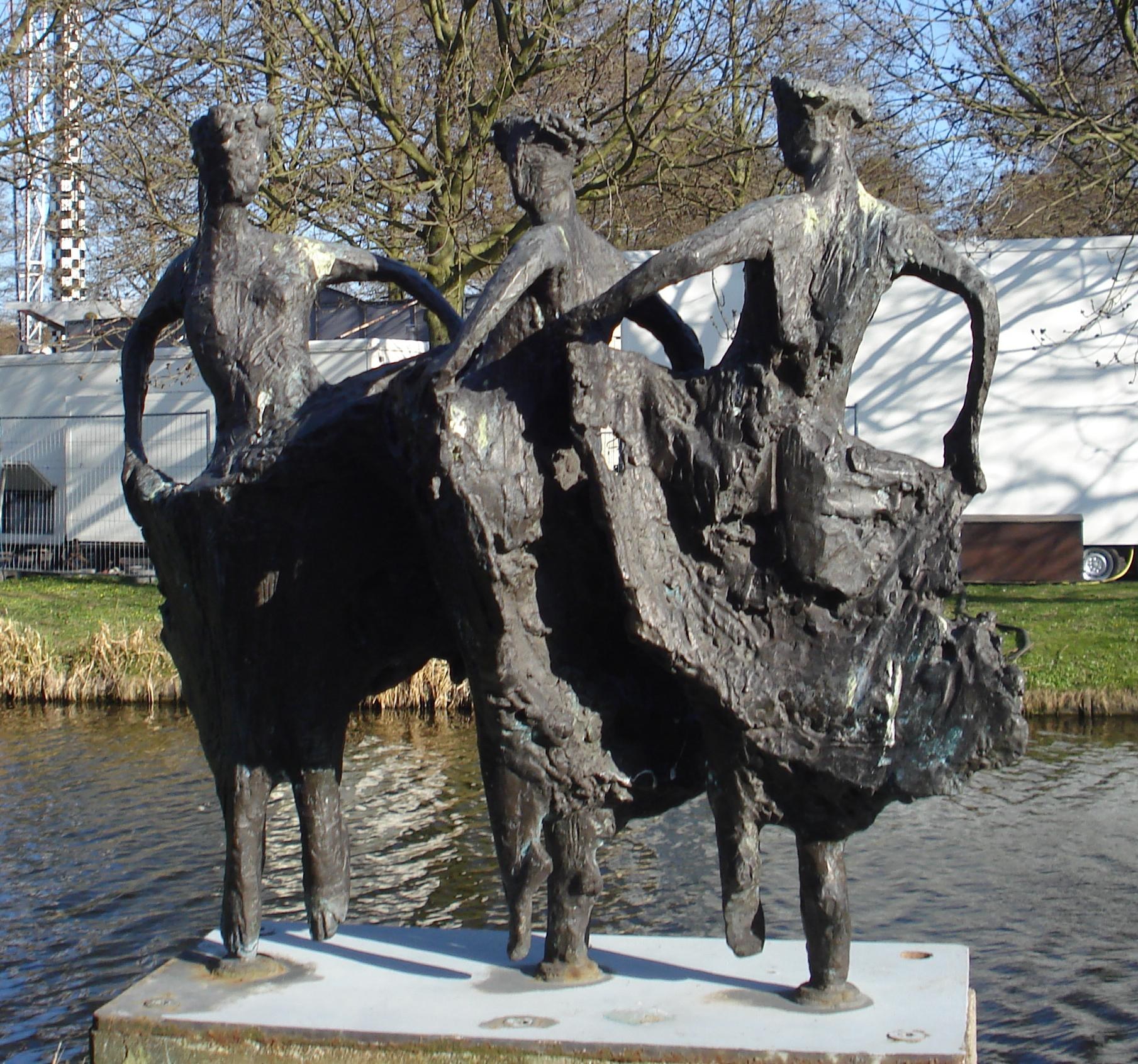
Three bronze figures of approximately life size stand on a white platform at the water's edge in what appears to be a public park or waterfront setting. The sculpture depicts three dancers in elegant period dress—the figures wear 18th-century clothing with extended skirts and fitted bodices. They are arranged in a triangular composition, each figure caught in a moment of turning or swaying motion. The sculpture has darkened with age and weathering; the bronze shows a rich patina of verdigris. Bare tree branches and winter sun cast intricate shadows across the figures and platform. A modern building structure is visible in the background across the water, and metal fencing defines the park boundary. The work is positioned to be viewed from multiple angles around the platform.
The dancing
All three figures maintain upright posture with elongated limbs characteristic of classical dance representation. The figures' arms are extended outward and upward in open positions, suggesting lifted, airy movement. The posture is light and graceful rather than grounded—the artist has represented an ethereal, elevated quality typical of courtly or balletic movement. Each figure appears to be turning or swaying independently, yet they form a unified compositional group. The extended arms and turned-out legs suggest trained, refined movement.
The dance depicted
The dress and gesture strongly suggest a courtly or ballroom context from the 18th century, most likely a minuet or similar baroque court dance. The minuet was a slow, processional dance of great elegance and was central to court culture throughout Europe in this period. The upright posture, extended arms, and apparent swaying movement are consistent with minuet choreography. However, the exact style—whether this depicts a minuet specifically, a general 'menuette' or stylized version of courtly dance, or a romantic-era theatrical interpretation of historical court dance—cannot be determined from the sculpture alone. The title suggests a minuet.
How it was made
This is a cast bronze sculpture, executed in a style suggesting early 21st-century production. The patina and weathering indicate outdoor display for some years. Bronze as a medium allowed the artist to create fluid, extended forms and to capture dynamic gesture in a durable material suitable for permanent public installation. The figurative realism and refined detail suggest professional casting, likely sand-cast or lost-wax process. The work functions as site-specific public art, engaging with the waterfront setting and visible to passersby.
About this work
This is a contemporary public sculpture depicting three dancers in 18th-century dress caught in the graceful, turning movements of a minuet. The work celebrates an historical dance form through representational bronze figures placed in conversation with a modern waterfront landscape. It sits at the intersection of dance history and public art practice—making dance visible and memorable as a cultural heritage object while engaging contemporary viewers in a mixed-period aesthetic (historical figures, modern setting). The sculpture documents the minuet as a subject worthy of commemoration and demonstrates how dance continues to inspire visual artists.
How to look at it
Observe the suspended, uplifted quality the artist has given these figures—the extended limbs and open arm positions create a sense of weightlessness despite the heavy bronze material. Notice how the three dancers relate to one another across the platform: they are independent yet compositionally linked, suggesting the minuet's balance of individual elegance and group harmony. The outdoor setting and weathered patina invite the viewer to consider how historical dance forms persist in contemporary public memory and landscape.
The artist
Wikifrits is a contemporary artist whose practice engages with cultural heritage, public space, and figurative sculpture. This work is documented on Wikimedia Commons and appears to be part of a public collection or commissioning. Limited additional biographical information is available in accessible sources.
The period
The minuet originated in France in the 17th century and became the dominant courtly dance of the 18th century across European aristocratic society. It was highly codified, with specific arm positions, body alignment, and floor patterns taught through dancing masters. By the 19th century, the minuet had become a historical form, preserved primarily in ballet and classical music rather than social practice. Early 21st-century interest in dance sculpture reflects broader heritage and public art movements that seek to make cultural history visible in everyday spaces.
Where it lives
The work is documented on Wikimedia Commons and appears to be a permanent public installation in Krimpen aan den IJssel, Netherlands, based on the title reference. The sculpture is accessible to the public as a site-specific artwork in a waterfront or park setting.
Dance in this work
Questions about this work
What dance is this sculpture showing?
The work is titled 'menuette' (minuet) and the three figures' dress, posture, and gesture are consistent with 18th-century courtly minuet dancing. The minuet was an elaborate social dance of the aristocracy, characterized by graceful, turning movements, upright posture, and refined arm positions—all of which the sculptor has captured.
Why would a contemporary artist create a sculpture of a historical dance?
Dance is a significant part of cultural heritage, and public sculptures preserve and celebrate forms that no longer exist as living practice. By placing minuet dancers in a modern public space, the artist makes dance history visible and memorializes an important courtly tradition. Contemporary art often engages with history in this way.
Is this a historically accurate representation of minuet movement?
The posture and arm positions are consistent with minuet conventions shown in 18th-century prints and descriptions. However, as a stylized artwork rather than a reconstruction based on specific documentary sources, it represents an artistic interpretation of courtly elegance rather than a precise choreographic notation.
More dance artwork





