49 works in this view — arrow keys or swipe to move between them.
Dance in Art
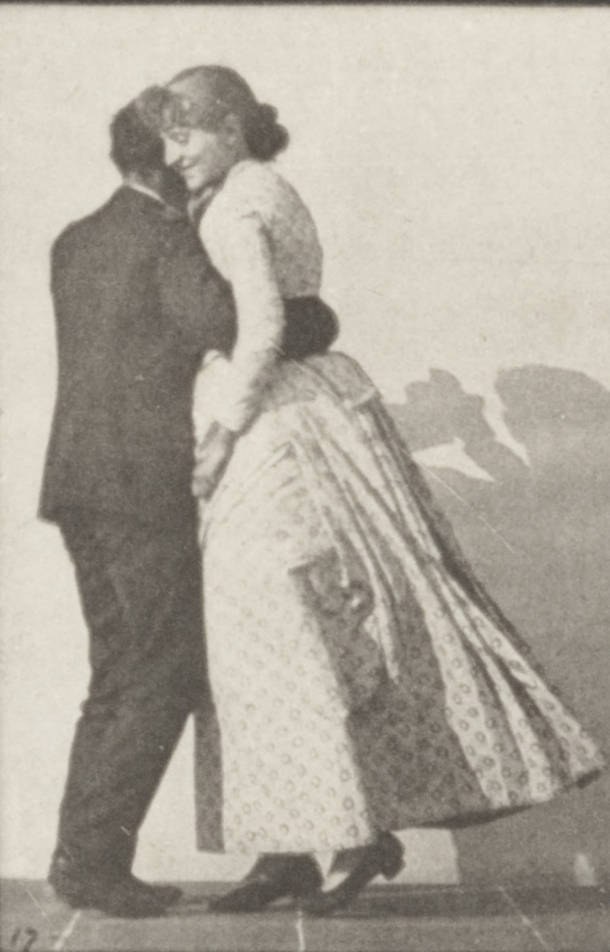
Man and woman dancing a waltz (rbm-QP301M8-1887-197a~17)
Muybridge, Eadweard, 1830-1904
- Source:
- Wikimedia Commons
- Rights:
- Public domain — free to use, share and adapt.
- Recorded as:
- public_domain
This image documents the waltz at a precise historical moment — the point at which ballroom dance had reached global standardization, yet before competitive ballroom codification hardened technique further. For dance historians, it provides rare visual evidence of the closed frame, weight distribution, and dress conventions of authentic Victorian ballroom practice. For visual artists and photographers, it marks the moment when motion photography became precise enough to serve pedagogical purposes, a watershed that eventually transformed how dance was taught, performed, and preserved.
What you are looking at
A man and woman are photographed mid-waltz against a plain background. The man, dressed in dark formal attire (suit jacket and trousers), stands slightly behind and to the left, his torso angled toward his partner. The woman wears a light-colored dress with what appears to be a full skirt, captured as it swings outward from the momentum of the turn. She leans back slightly into the frame, her body aligned with the man's in the characteristic closed position of the waltz. The photograph is rendered in grayscale photogravure, with the figures casting subtle shadows that emphasize the spatial relationship between them. The composition isolates the couple against an uncluttered background, focusing all attention on the mechanics and geometry of the dance hold and weight distribution.
The dancing
The man maintains a firm, upright posture with his right arm extended to support his partner at the frame. The woman's body is held in a slight backward lean, her left arm raised to meet his shoulder, her right hand clasped in his left. Their frames form a closed, rectangular hold characteristic of the waltz — the standard ballroom frame. The woman's skirt is caught mid-swing, billowing outward to show the rotational momentum of the step. Both dancers' weights appear anchored and controlled, with the man leading and the woman responding to the directional impulse.
The dance depicted
This is documentary evidence of the waltz as it was performed in the 1880s — not theatrical or competition dance, but the social waltz of ballrooms and formal occasions. The waltz had by this date become a standard ballroom dance across Europe and America, performed in the closed hold seen here. The photograph captures the characteristic three-quarter time movement mid-rotation, with particular attention to the woman's skirt displacement, which was a significant aesthetic feature of late-nineteenth-century waltz performance. Muybridge's purpose was anatomical and kinetic analysis, not artistic interpretation, yet the image documents authentic ballroom technique of the period.
How it was made
This is a photogravure, a photomechanical process that reproduced photographs as intaglio prints. Muybridge's original motion studies were photographed, then converted to photogravure plates for publication in Animal Locomotion (1887). The photogravure process allowed high-quality halftone reproduction of continuous-tone photography, making it suitable for scientific and instructional circulation. This particular plate is one of a sequence documenting the waltz from multiple angles — Muybridge used sequential photography as a tool for decomposing human movement into its constituent phases. The technique was expensive and prestigious, ensuring that these plates reached a educated audience of physicians, artists, and dance masters.
About this work
This is one of approximately two hundred motion studies of human locomotion and gesture that Muybridge documented between 1884 and 1887, published as the monumental Animal Locomotion in Philadelphia in 1887. Unlike Muybridge's famous animal and nude studies, the waltz studies occupied a specific and valued position: they provided visual instruction in correct ballroom technique for a middle-class audience learning social dance. The image is part of a comprehensive visual archive of Victorian movement, created at the moment when photography could finally capture what the human eye saw only as a blur. These plates became an indirect influence on artists and a direct reference for dance teachers: they were objective records of how people actually moved, against which subjective instruction could be measured.
How to look at it
Attend first to the closed frame: how the bodies align, the angle of the woman's lean, the height and position of the joined hands. Notice the instant chosen — the woman's skirt is billowing outward, indicating a moment of rotation and centrifugal force, not a static pose. Look at the feet: though the resolution prevents absolute clarity, the stance and weight distribution suggest the grounding and control required to lead and follow in a three-quarter-time rotation. The formal dress, the plain background, and the frontal-three-quarter viewpoint reflect Muybridge's scientific method: he stripped away narrative context to show pure movement, as if presenting a specimen for analysis. This is not art seeking beauty; it is documentation seeking truth.
The artist
Eadweard Muybridge (1830–1904) was an English photographer who revolutionized the visual study of movement through sequential photography. Commissioned initially by horse-racing enthusiast Leland Stanford to settle a wager about whether a galloping horse ever had all four hooves off the ground, Muybridge developed a battery of cameras capable of capturing rapid sequential exposures. He extended this technique to human and animal locomotion with scientific ambition and impressive scale. Animal Locomotion (1887) remains one of the most ambitious visual archives of movement ever assembled, comprising 781 photogravure plates. Muybridge's work bridged art, science, and instruction: his plates were consulted by painters seeking anatomical accuracy, by physiologists studying movement, and by dance and athletics instructors seeking authoritative visual models.
The period
The 1880s were a moment of intense curiosity about human movement, driven by new photographic technology and growing scientific rigor. The waltz had long since ceased to be scandalous — by the 1880s it was the standard social dance across Europe and America, performed at balls, assemblies, and formal occasions by middle-class dancers. Simultaneously, ballroom dancing was beginning to be rationalized and codified: by the early twentieth century, standardized competition ballroom would emerge. Muybridge's studies capture social waltz in the interval before this codification — authentic, common, but about to be formalized. In art, the 1880s saw growing interest in capturing transitory moments and unusual viewpoints, partly in response to photography's ability to reveal what the eye could not consciously perceive.
Where it lives
This plate is from Muybridge's Animal Locomotion, published under the auspices of the University of Pennsylvania in 1887. The plates were printed by the Photo-Gravure Company in Philadelphia. This particular image is plate 197 in the published sequence and is held in the USC Digital Library's Eadweard Muybridge Collection.
Dance in this work
Questions about this work
Why did Muybridge photograph people dancing?
Muybridge's commission was to document all forms of human movement — locomotion, gesture, labor, and social interaction. Dance was included because it represented complex, coordinated movement that photography could now decompose into phases invisible to the human eye. The waltz studies also had practical value: they could serve as visual instruction for dancers and ballroom instructors. Muybridge believed that objective visual analysis of movement was scientifically and educationally important.
How does this image compare to other waltz documentation?
Most contemporary images of the waltz were paintings or engravings created for aesthetic or narrative purposes, often emphasizing the spectacle and romance of the ballroom rather than precise technique. Muybridge's photograph is almost clinical by comparison: it isolates the dancers, provides multiple angle studies, and aims at anatomical accuracy. This objectivity makes it invaluable to historians seeking evidence of actual ballroom practice, but it was unusual for its time.
What is a photogravure?
A photogravure is a print made from a photographic image that has been converted into an intaglio plate (a recessed metal surface). The photograph is transferred onto a steel plate, which is then etched and hand-finished. Ink is rolled across the surface, filling the recesses, and printed on paper. This process allowed high-quality reproduction of photographs in quantities suitable for publication and circulation to museums, libraries, and institutions — it was more refined than woodcut or lithography and could capture fine tonal gradation.
Was the waltz always danced in formal dress?
The waltz documented here was a ballroom dance for the middle and upper classes, so yes — formal dress (tailcoat, evening gown, gloves) was mandatory in the contexts where these dancers performed it. Folk and popular versions of waltz-like dances existed across Europe in simpler dress, but the ballroom waltz of the 1880s was a highly codified social ritual accompanied by formal attire and strict etiquette.
More dance artwork





