49 works in this view — arrow keys or swipe to move between them.
Dance in Art
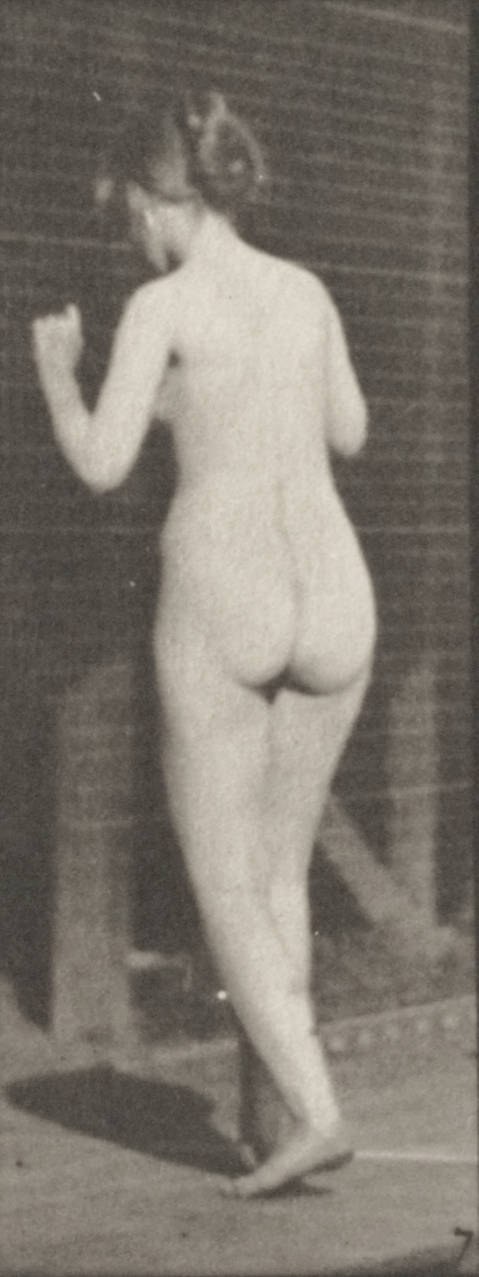
Nude woman dancing a waltz (rbm-QP301M8-1887-195b~7)
Muybridge, Eadweard, 1830-1904
- Source:
- Wikimedia Commons
- Rights:
- Public domain — free to use, share and adapt.
- Recorded as:
- public_domain
This image is foundational to understanding how photography changed dance scholarship and artistic practice. For the first time, a dance movement could be recorded with mechanical precision and studied frame by frame, revealing the body's actual mechanics rather than relying on memory, notation, or the artist's hand. Dancers, choreographers, and anatomists used these plates as reference; artists like Thomas Eakins studied them to improve their figure work.
What you are looking at
A single female figure stands nude against a dark textured background, photographed from behind and slightly to one side. Her body is pale and well-lit against the shadowed ground and wall. She stands in a relaxed contrapposto stance with one leg bearing weight while the other is bent slightly, her arms held softly at her sides and front of her body. The photograph is cropped to show her full figure from head to toe. The grainy quality and monochromatic palette are characteristic of late 19th-century photogravure printing.
The dancing
The dancer's posture is upright but natural, with weight distributed asymmetrically—one leg straight and supporting, the other bent and relaxed. Her arms hang loosely, the hand on her supporting side open and extended slightly forward at waist height, the other arm at her side. Her head is turned and tilted, looking downward and away. There is no rigid balletic alignment; instead, the body settles into a moment of rest or transition between movements, with the spine gently curved and shoulders relaxed.
The dance depicted
The catalogue identifies this as 'dancing a waltz,' but the image shows a single dancer in an isolated pose rather than a moment of social dancing. This is almost certainly a frame from Eadweard Muybridge's *Animal Locomotion* series (1872–1885), a systematic photographic study of human movement. Muybridge would have photographed this woman performing a waltz step-by-step for his chronophotographic records, which were published as plates showing multiple sequential frames. The solitary nude figure suggests this is one selected frame from a longer motion sequence, presented here as a study of the body's natural alignment and weight distribution in ballroom movement rather than as a representation of social dance.
How it was made
This is a photogravure, a relief printing process in which a photograph is transferred onto a copper plate and printed. The technique allowed precise reproduction of photographic detail and was favored for scientific documentation. The fine screen texture and tonal gradations visible in the image are characteristic of the photogravure process. Muybridge's plates were published by the Photo-Gravure Company in Philadelphia in 1887, giving them wide circulation among artists, anatomists, dancers, and students of movement—establishing them as authoritative visual records.
About this work
This is a single frame from plate 195 of Eadweard Muybridge's *Animal Locomotion*, a landmark scientific and artistic study of human movement made between 1872 and 1885. The image captures an anonymous female model mid-waltz, isolated and nude so that her body's mechanics are clearly visible without the distraction of clothing. It belongs in a gallery of dance art because it represents a pivotal moment in visual culture: the moment when photography became a tool for understanding and preserving the ephemeral gestures of dance, and when the nude human figure—traditional in academic art—was repurposed as a study of functional movement rather than beauty or mythology.
Muybridge's work stood at the intersection of Victorian science (the analysis of locomotion for its own sake), ballroom dance culture (waltzes and other social dances were central to 19th-century social life), and photographic innovation. His plates influenced artists, choreographers, and kinesiologists for decades, providing visual evidence of what the body actually does in motion, stripped of the idealization or interpretation that drawing and painting impose.
How to look at it
Observe the asymmetrical weight distribution—how one leg is straight and supportive while the other is bent and free, a posture necessary for the waltz's three-step rhythm. Notice that the head is turned and lowered, not held in the rigid upright carriage of a formal portrait; this suggests a moment of active movement rather than a static pose. Look at the hand positions: one arm extended and open, the other relaxed at the side—this is the structure of a partner dance captured in a solo figure. The viewer should also note the absence of any ballroom setting or costume; the nudity and grid-like background serve the scientific purpose of making the body's mechanics legible.
The artist
Eadweard Muybridge (1830–1904) was a British-American photographer and pioneer of chronophotography—the rapid sequential photography of movement. Born Edward James Muggeridge, he changed his name and reinvented himself several times before settling into photography in California. He is famous for his 1877–1878 study *The Horse in Motion*, which settled a bet about whether all four hooves of a galloping horse leave the ground simultaneously (they do). *Animal Locomotion*, his monumental follow-up, employed a battery of cameras to photograph human and animal subjects moving across a gridded ground. The work was sponsored by the University of Pennsylvania and resulted in nearly 20,000 photographs published across 781 plates. Muybridge lectured internationally and influenced everyone from Thomas Eakins to early filmmakers; his work is foundational to biomechanics and to cinema itself.
The period
In the 1880s, photography was establishing itself as a tool of science and documentation rather than mere art. The waltz, meanwhile, was at the height of its social respectability and dominance—the defining dance of ballrooms across Europe and America, distinct from the scandalous older quadrille and from the emerging ragtime and jazz. Muybridge's decision to document waltz movement (and also other social dances and balletic poses) reflects the period's fascination with rational analysis of the body and with codifying social behavior. Simultaneously, the nude model was central to academic art training and to debates about realism in art; photographing the nude in motion was radical in combining the traditional figure study with modern mechanical documentation.
Where it lives
This plate is part of *Animal Locomotion: an electro-photographic investigation of consecutive phases of animal movements* (1872–1885), published in 1887 by the Photo-Gravure Company, Philadelphia, under the auspices of the University of Pennsylvania. The source here is Wikimedia Commons. The work is known from its filing in the collection as plate 195 ('Dancing a waltz').
Dance in this work
Questions about this work
Is this one photo or many?
This is one selected frame from a sequence. Muybridge photographed each movement—including the waltz—with multiple cameras firing in succession, capturing 12 or more frames of the same motion. This image shows one moment extracted from that sequence and printed as a single plate. Many frames from the same waltz sequence exist in the complete *Animal Locomotion* archive.
Why is the dancer nude?
Muybridge photographed his subjects nude or in minimal clothing so that muscle and bone movement would be clearly visible without the distraction of fabric. This followed the academic art tradition of the nude study but applied it to movement rather than static pose. For a ballroom dance, this meant viewers could see exactly how the spine, hips, and legs aligned during the waltz step.
What does this tell us about how people waltzed?
The asymmetrical weight distribution and the position of the free leg suggest that the waltz was danced with a clear sense of counterbalance and momentum—one side of the body weighted and active, the other lighter and recovering. The turned head and soft arm position show that, contrary to some formal descriptions, the actual lived waltz was not rigidly upright but allowed for natural, flowing arm and head movement.
How was this printed?
This is a photogravure, a printing method in which the photograph was transferred onto a copper plate using photochemical processes and then printed as a relief print. This allowed Muybridge to produce multiple high-quality copies of each frame at a relatively low cost, making the work available to institutions, artists, and scientists worldwide.
More dance artwork





