49 works in this view — arrow keys or swipe to move between them.
Dance in Art
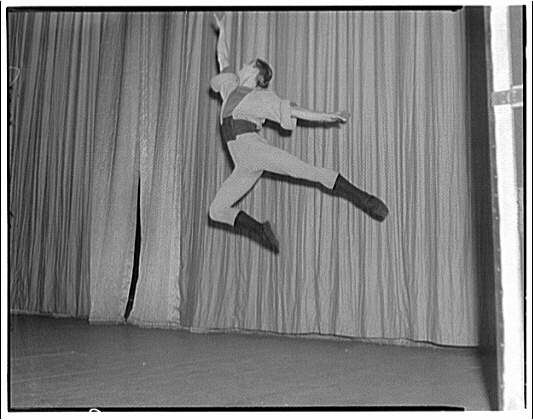
Ballet dancer. Ballet dancer at National Theater II
Unknown artist
- Collection:
- Prints & Photographs
- Source:
- Library of Congress
- Rights:
- Rights vary by item — check the source record before reusing this image. Source record ↗
- Recorded as:
- Library of Congress — no known restrictions (verify per item)
Male ballet dancers were a minority and often marginalized figure in early 20th-century theater, making documentary images of male virtuosity historically significant. The photograph's formal and compositional sophistication—its use of angle, backdrop, and framing to create a modernist study of movement—shows that early ballet photography was not merely documentary but could be formally inventive and aesthetically ambitious. The image is therefore valuable to historians of both dance technique and photographic modernism.
What you are looking at
A male ballet dancer is captured mid-leap against a corrugated metal or industrial wall backdrop, photographed from above at a dramatic angle that emphasizes the height and extension of his jump. He wears light-colored (cream or white) practice clothes — likely a shirt and tights — with dark shoes. His body is fully airborne, legs split in a wide scissor position with one leg extended high and forward while the other stretches back, arms spread in an open, balanced frame. The photograph is a black-and-white image with strong contrast; the corrugated wall surface creates deep vertical striations that frame the figure and accentuate the geometry of his extended body. The lighting is frontal and even, typical of 1920s studio or theatrical photography, and the angle of capture — looking down at the dancer against the tilted wall — creates a vertiginous sense of elevation and gymnastic power.
The dancing
A single male dancer occupies the frame in a grand jeté or similar traveling jump, with the body weight fully committed to the air and the legs in a pronounced split. The arms are open to the sides with a natural carriage, and the head is upright, following the line of the extended body. The position demonstrates considerable flexibility, strength, and ballistic control — the legs achieve near-horizontal extension in both directions, and the torso maintains an upright, dignified line even in the moment of flight. This is a technically advanced position requiring significant training and power, suggesting a professional or advanced student dancer.
The dance depicted
This is a ballet photograph, almost certainly from a professional or institutional context (the catalogue notes the National Theater, likely the National Theatre in an American or European city of the 1920s). The jump depicted—a grand jeté or jeté en avant with pronounced turnout and extension—is a signature ballet vocabulary element used in classical variations and in demonstration of technical virtuosity. The image captures the peak moment of the jump, a convention of ballet photography that emphasizes elevation and control. Male ballet dancers of the 1920s were rare in many venues; this photograph likely documents a professional male dancer or a celebrated guest artist, and the decision to photograph him in a moment of maximum technical difficulty suggests this is a record of virtuosity for promotional or archival purposes.
How it was made
This is a black-and-white photograph, almost certainly a gelatin silver print or similar process, taken in a studio setting with controlled lighting. The photograph is shot from above, with the dancer positioned against an industrial backdrop (corrugated metal or similar), creating compositional dynamism. The use of a high camera angle and the tilted perspective create an abstracted, almost graphic quality; the photographer has chosen to treat the dancer and wall as geometric forms rather than to capture a moment from an audience perspective. This compositional choice—atypical for theatrical documentation—suggests the work was made for an institutional record or artistic experiment rather than as conventional theater photography.
About this work
This is a studio photograph of a male ballet dancer in mid-jump, taken around 1920 and associated with the National Theater. The image is a technical document of classical ballet virtuosity—specifically, the grand jeté, a fundamental jump in the male ballet vocabulary—captured at the moment of maximum elevation and extension. The photographer's choice to shoot from above, against an industrial backdrop, and at an oblique angle transforms the image from simple performance record into something more experimental: a study of the body in space, the geometry of trained movement, and the relationship between human form and built environment. The work dates to the early 20th century, a period when ballet was undergoing rapid professionalization and internationalization, and when photography was becoming a serious tool of artistic documentation. It belongs in a dance archive both as evidence of classical technique and as an artifact of how photographers of the era understood ballet and the male dancer's body.
How to look at it
Look first at the geometry of the jump: the angle between the extended legs, the width of the arm frame, the upright carriage of the torso. These are the marks of trained classical technique. Then observe the photographer's choice of framing: the corrugated wall is not incidental scenery but a compositional element, its vertical lines echoing and constraining the body's lines. The high camera angle makes the jump appear to recede away from the viewer, emphasizing height and distance—a technique that intensifies the impression of elevation. Finally, note the moment chosen: this is the peak of the jump, not the ascent or descent, the instant of maximum suspension when the dancer appears almost weightless. This is a convention of ballet photography, one that celebrates control and the illusion of defying gravity.
The period
The photograph was taken in 1920, a moment of major transition for ballet. Sergei Diaghilev's Ballets Russes (founded 1909) had already revolutionized ballet's aesthetics and elevated the male dancer to a starring role, challenging earlier 19th-century conventions in which male ballet dancers were often secondary to female ballerinas. By 1920, this shift was becoming normalized in professional companies across Europe and America, though institutional theaters varied in how fully they embraced the male dancer. The photograph documents this transition: a male ballet dancer is the sole subject of artistic attention, and his technical virtuosity is presented as worth recording. The 1920s were also a moment of formal experimentation in photography itself, as photographers increasingly treated the camera not as a neutral recording device but as a tool for creating new perspectives and compositions. The high angle, industrial backdrop, and dramatic perspective of this image reflect that modernist impulse.
Where it lives
The photograph is held in the Library of Congress Prints & Photographs collection, catalogued as part of their American cultural record. It is identified as being associated with the National Theater, though the specific context (which National Theater, the dancer's identity, the occasion) is not recorded in the available catalogue data. The source is the Library of Congress.
Dance in this work
Questions about this work
Why is the photographer shooting from above?
The high angle creates the illusion that the dancer is receding upward into the distance, which intensifies the impression of height and elevation. It also transforms the corrugated wall into a compositional element—the vertical lines of the wall frame and emphasize the verticality of the jump. This was a formal choice, not an accident of the camera position.
What jump is this?
This appears to be a grand jeté or jeté en avant, a traveling jump in which the dancer springs from one leg and lands on the other, with the legs extended in a scissor or split position at the peak of the jump. The position shown here—with one leg extended high in front and the other extended behind—is the characteristic shape of the grand jeté, a cornerstone of male ballet technique.
Who is the dancer?
The dancer's identity is not recorded in the available catalogue data. The photograph is catalogued only as 'Ballet dancer' and associated with the National Theater around 1920.
Why photograph a male ballet dancer at all?
By 1920, the male ballet dancer was becoming a legitimate star in his own right, partly due to the influence of Diaghilev's Ballets Russes, which had elevated male dancing to prominence. This photograph is evidence of that shift—a professional male dancer's virtuosity is being documented and preserved as worthy of artistic attention.
More dance artwork





