49 works in this view — arrow keys or swipe to move between them.
Dance in Art
Ballet dancer. Ballet dancer at National Theater I
Unknown artist
- Collection:
- Prints & Photographs
- Source:
- Library of Congress
- Rights:
- Rights vary by item — check the source record before reusing this image. Source record ↗
- Recorded as:
- Library of Congress — no known restrictions (verify per item)
Male ballet technique in the early 20th century was undergoing a renaissance, with jumps and turns becoming showpieces for trained performers. This photograph documents that emphasis and shows how photography was beginning to be used not just to record performance but to isolate and celebrate specific technical moments.
What you are looking at
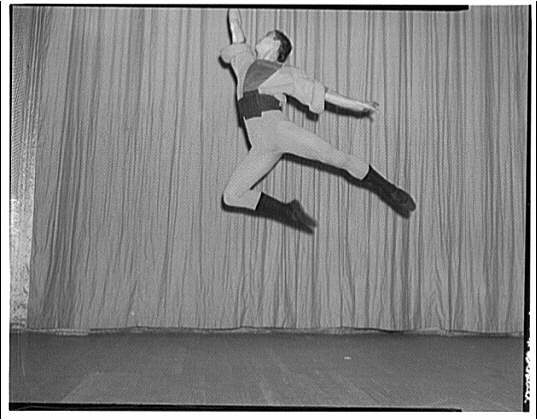
A single male ballet dancer is photographed mid-leap against a corrugated metal backdrop, captured from above in a dynamic aerial view. The dancer wears dark tights and a pale tunic or shirt, his body suspended in a pronounced jump with legs split in a wide vertical scissor position—one leg extended sharply upward, the other stretched below. His arms are spread wide for balance, creating an expansive silhouette. The corrugated metal wall fills the entire background, creating strong linear patterns that emphasize the upward thrust of the leap. The photograph is in black and white with high contrast; the dancer's pale torso stands out sharply against the textured metal. The composition suggests this is either a performance moment or a studio documentation of a male dancer's technical capability.
The dancing
A single male dancer executes a grand jeté or similar aerial jump with exceptional height and split. His legs achieve a pronounced vertical separation, suggesting advanced technical training and considerable elasticity. The arms are held wide in a classical upper-body carriage. Weight is entirely airborne; there is no contact with the ground. The photograph captures the apex or near-apex of the jump, a moment of maximum extension and weightlessness.
The dance depicted
This is almost certainly classical ballet, depicting a male dancer performing a grand jeté or related jump from the classical vocabulary. The split legs, arm carriage, and body alignment are consistent with early 20th-century academic ballet technique. Male dancers were increasingly celebrated for their technical prowess—particularly jumps and turns—during this period, and this image documents that emphasis. The extreme height and split suggest a dancer of considerable ability, likely performing in a professional or semi-professional context.
How it was made
This is a black-and-white photograph, likely gelatin silver print, created in 1920. The overhead angle and strong contrast suggest it was taken in a studio setting with controlled lighting. The corrugated metal backdrop is a deliberate compositional choice that creates visual drama and emphasizes the leap. Photography at this date was still relatively novel as a medium for documenting dance; this image shows the emerging practice of using photography to freeze and celebrate the acrobatic achievements of trained dancers.
About this work
This is a studio photograph of a male classical ballet dancer captured mid-leap in 1920, a moment when male technique—particularly jumps—was becoming an increasingly celebrated aspect of ballet performance. The photograph documents both the dancer's athletic achievement and early 20th-century approaches to dance documentation. It offers visual evidence of how ballet was trained and celebrated in this period, and of photography's emerging role in capturing dance movement.
The image belongs in a gallery of dance imagery because it records a specific technical accomplishment and aesthetic moment: the weightless instant of a perfectly executed classical jump, rendered visible through the photographer's choice of angle and timing.
How to look at it
Notice the photographer's choice to shoot from above, which emphasizes the height of the jump and the geometric split of the legs. The corrugated metal creates a visual grid that makes the dancer's body read as a sculptural form suspended in space. The moment chosen is the apex of the leap—the instant of maximum weightlessness—which was the aspiration of classical technique. The extreme vertical split and the width of the arm carriage are signatures of academic ballet training from this period.
The period
In 1920, classical ballet was consolidating its academic vocabulary after the Russian Imperial system had been codified and exported through the Ballets Russes (founded 1909). Male dancers, particularly in Russia and Europe, were valued for their technical virtuosity—their ability to perform spectacular jumps, turns, and extensions. Photography was increasingly used to document and promote dancers; the overhead studio shot became a recognizable format for capturing the geometry of the leap. This image reflects both the celebration of male technique and the modernist impulse to document movement through new photographic angles.
Where it lives
The photograph is held by the Prints & Photographs collection at the Library of Congress, catalogued as a ballet documentation photograph from 1920. It is identified in the record as depicting 'Ballet dancer at National Theater I,' suggesting it may have been taken during a performance or as promotional documentation for a theater company.
Dance in this work
Questions about this work
Is this from a real performance or a studio shot?
The controlled lighting, overhead angle, and plain corrugated metal backdrop suggest this is a studio photograph, likely taken to document and celebrate the dancer's technique rather than to capture a moment from a staged performance. However, it may have been taken as promotional material in connection with a theater or company.
What jump is he doing?
This appears to be a grand jeté or similar aerial jump from classical ballet vocabulary. The extreme vertical split and the classical arm position are consistent with this jump, though from this angle and without seeing the full sequence it is difficult to be absolutely certain which jump or combination is being performed.
Why photograph from above?
The overhead angle is deliberate and modernist. It emphasizes the height of the jump, the geometric separation of the legs, and the isolation of the body against the linear background. This was an innovative photographic choice that highlights the acrobatic and sculptural qualities of the movement.
More dance artwork





