49 works in this view — arrow keys or swipe to move between them.
Dance in Art
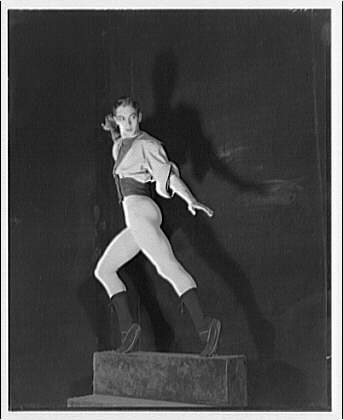
Ballet dancer. Ballet dancer at National Theater I
Unknown artist
- Collection:
- Prints & Photographs
- Source:
- Library of Congress
- Rights:
- Rights vary by item — check the source record before reusing this image. Source record ↗
- Recorded as:
- Library of Congress — no known restrictions (verify per item)
This photograph documents the technical achievement and physical presence of a professional theatrical dancer in the early twentieth century, a period when dance photography was becoming a recognized method of recording and celebrating performance. The image shows not narrative or costumed spectacle but pure movement and bodily capability—the kind of documentation that helped establish dance as a subject serious enough for archival and artistic photography.
What you are looking at
A solo female dancer in a dynamic leap or jump, photographed against a dark, plain background. She wears a light-colored (white or cream) short-sleeved top and dark tights or leg coverings, with dark boots or shoes. Her body is arched mid-air, with one leg extended and the other bent, her arms raised and reaching. The pose suggests powerful upward momentum and control. She appears to be mid-jump, captured at the apex of the movement. The photograph is black and white, creating stark contrast between her lit figure and the featureless dark backdrop. A rectangular platform or stage element sits beneath her, suggesting a theater setting or studio context. The image has the grain and quality of early twentieth-century photography.
The dancing
A single female dancer is shown in a vertical jump with her weight fully airborne. Her body demonstrates strong extension through the torso, with the back arched and the neck extended upward. One leg is long and straight; the other is bent at the knee. Her arms are raised and active, one reaching higher than the other, suggesting a moment of expressive release rather than a controlled classical position. The photograph freezes the moment of maximum height and extension, showing athletic power and dynamic control.
The dance depicted
This appears to be a trained classical or theatrical dancer, likely from a professional ballet or dance company, captured in a moment of solo performance or rehearsal work. The acrobatic quality of the jump—high, extended, with arched back—is consistent with early twentieth-century theatrical dance training. The dynamic pose suggests either a moment from a choreographed dance or a study of movement capability. Without identifying marks or context beyond the photograph, the specific dance or choreography cannot be named, but the technical execution indicates professional classical training.
How it was made
This is a black and white photograph, likely gelatin silver print or similar early twentieth-century photographic process. The technique allows sharp freeze-frame capture of movement at a moment impossible to see clearly in live performance. The stark studio lighting and plain dark background are typical of theatrical and dance photography from the 1920s, designed to isolate and celebrate the dancer's form without distraction. This type of photograph would have been used for publicity, documentation, or archival purposes within theater companies.
About this work
A studio photograph of a solo female ballet or theatrical dancer in mid-leap, captured in stark black and white against a neutral background. The image documents a moment of dynamic movement—an arched jump with extended limbs—showing the physical capability and training of a professional dancer of the 1920s era. The photograph is a study of the body in motion, using the medium's freeze-frame power to isolate a single moment of aerial control and extension. It belongs to the tradition of theatrical dance documentation and the emerging practice of photographing dance as an art form worthy of serious visual study.
How to look at it
Notice how the photographer has chosen the moment of maximum extension and height—the apex of the jump, where the dancer's body is fully airborne and the arc of the back is most pronounced. This is a deliberate choice that emphasizes power and control rather than the beginning or end of the movement. The dark background eliminates all context and focuses attention entirely on the body; the rectangular platform below suggests a stage, but it is minimal and does not distract. The lighting is directional and clean, catching the edge of the body and the light fabric of the top, which creates a strong silhouette.
The period
In the 1920s, theatrical dance in America was flourishing across multiple traditions: classical ballet companies were touring and establishing permanent homes, modern dance was beginning to emerge as an alternative aesthetic, and dance photography was becoming more sophisticated and widespread. Theater companies, particularly the National Theater (mentioned in the catalogue), used photography to document their performers and to create publicity materials for circulation. The stark, isolated style of this photograph is typical of theatrical publicity photography of the period, designed to emphasize the dancer's form and technical prowess rather than narrative or costume spectacle.
Where it lives
This photograph is held in the Prints & Photographs collection of the Library of Congress. It is catalogued as a documentation photograph from the National Theater, dated 1920, and represents the kind of archival material theaters created to record their performers and performances.
Dance in this work
Questions about this work
Is this a specific named dance or choreography?
The photograph does not show costume, scenery, or narrative context that would identify a specific ballet or dance work. It appears to be a technical study or promotional photograph of a trained dancer demonstrating movement capability rather than a documented moment from a staged performance.
What National Theater is this from?
The catalogue record identifies it as from 'National Theater,' but does not specify which theater (location, company affiliation, or current status). Early twentieth-century American theaters of this name existed in several cities, and without additional provenance information, the specific theater cannot be determined.
Why is the background so plain?
The neutral dark background is a deliberate choice in early twentieth-century dance and theatrical photography. By removing all visual context, the photographer focuses the viewer's entire attention on the dancer's body, technique, and extension—making the image a document of physical capability rather than narrative spectacle.
What can we tell about dance training from this pose?
The extension, control, and height of the jump indicate rigorous classical training. The arched back and coordinated arm movement show a dancer trained in theatrical or ballet technique rather than vernacular or social dance forms.
More dance artwork





