49 works in this view — arrow keys or swipe to move between them.
Dance in Art
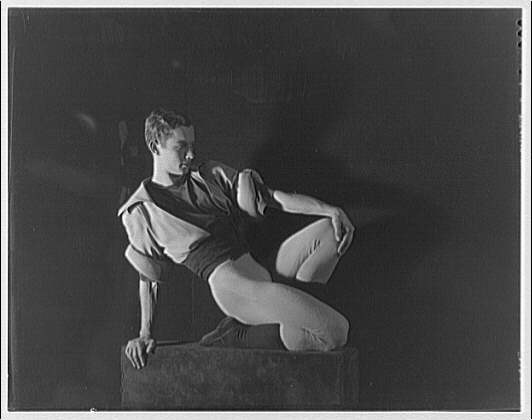
Ballet dancer. Ballet dancer at National Theater II
Unknown artist
- Collection:
- Prints & Photographs
- Source:
- Library of Congress
- Rights:
- Rights vary by item — check the source record before reusing this image. Source record ↗
- Recorded as:
- Library of Congress — no known restrictions (verify per item)
This photograph exemplifies how early twentieth-century artists came to see the dancer's body as a subject worthy of formal, sculptural study—a shift in how dance was represented and understood. It documents a historical moment when ballet had begun to move away from spectacle toward the body as material, and when photography became a tool for serious modernist inquiry into form and movement.
What you are looking at
A solitary dancer is caught in a moment of repose, seated on a low platform or block against a dark background. The figure reclines with legs extended and bent, weight settled on one arm, the body composed in a casual, introspective attitude. The dancer wears a dark sleeveless or short-sleeved top and light-colored shorts or trunks, suggesting rehearsal or performance costume from the early twentieth century. The lighting is dramatic and sculptural, falling across the torso and legs to model the musculature and form, while the face remains in shadow or profile. The composition is intimate and close-cropped, offering no vista or theatrical setting—only the body itself against darkness, as if this is a moment between movements, or a study of the figure at rest.
The dancing
The dancer's frame is open and relaxed, the legs arranged in an unforced position suggesting fatigue or preparation rather than formal technique. One arm supports the upper body while the other rests across the lap. The head is turned away or lowered, the gaze directed downward or into shadow. There is no evidence of a rigid turnout or the upright carriage of classical ballet; instead, the body settles into its own weight. The musculature is pronounced—the work of a trained body—yet the pose itself is casual, almost everyday in its candor.
The dance depicted
The image most likely documents a ballet dancer, given the era (1920), the theatrical costume, and the catalogue identification. However, the pose and setting do not depict a moment within a choreographed work. Rather, this appears to be a study or portrait of the dancer's body at rest, possibly a rehearsal candid or a formal artist study. The lack of pointe shoes visible and the relaxed posture suggest either a male dancer or a female dancer in a non-classical moment. Without inscription or context, the specific dance cannot be named, but the physical intelligence and the convention of intimate photography focused on the dancer's form place this squarely within early modernist documentation of the ballet body.
How it was made
This is a photograph, not a print as the catalogue suggests; the technique is likely gelatin silver or platinum print. The lighting is controlled and directional, consistent with studio portraiture of the 1920s, where the photographer sculpts form through chiaroscuro rather than depicting the dancer in performance space. The image shows the photographer's understanding of the body as sculptural subject—the dramatic side-lighting and dark background are hallmarks of modernist portraiture of the period, influenced by pictorialist and expressionist aesthetics. This is a work intended for serious viewing, not casual documentation.
About this work
This is an early twentieth-century study of a ballet dancer's body at rest, a moment of quiet introspection caught between or after exertion. The image belongs to a broader modernist fascination with the dancer as sculptural form, part of the visual culture surrounding Diaghilev's Ballets Russes and the theatrical avant-garde of the 1920s. The photograph prioritizes the body itself—its musculature, its weight, its casual intelligence—over narrative or choreographic spectacle. It is an artwork about dance practice rather than a depiction of dancing.
How to look at it
Notice the deliberate composition: the photographer has chosen a moment of absolute stillness and settled weight, the opposite of the dynamic elevation and carriage ballet demands. The dramatic lighting models every muscle, suggesting the photographer's deep interest in how the body is constructed. The refusal of frontal pose or direct gaze creates a sense of interiority, as if the viewer is witnessing something unperformed. Look at how the legs rest without forcing turnout, and how the supporting arm bears the body's honest weight—this is the opposite of the theatrical ideal.
The period
By 1920, ballet had undergone dramatic transformation. The Ballets Russes (founded 1909) had challenged academic conventions, and artists from painters to photographers were drawn to the dancer as a subject of modernist investigation. The study of the body in repose or between movements became a standard practice; artists such as Edward Weston and Barbara Morgan would later develop this further. In parallel, the development of faster film stock and portable lighting allowed photographers to capture informal moments, moving beyond the posed studio portrait to something more candid, yet still formally composed. This photograph sits in that transitional space—formally controlled yet capturing a moment of private rest.
Where it lives
The photograph is held in the Prints & Photographs collection of the Library of Congress, sourced as indicated in the catalogue record. It forms part of the institutional archive of early twentieth-century performing arts documentation.
Dance in this work
Questions about this work
Is this a male or female dancer?
The photograph does not reveal this with certainty. The musculature and the pose—neither fully classical nor obviously modern—suggest the body of a trained dancer of either sex. The short costume and the absence of pointe shoes might suggest a male dancer, but 1920s ballet costumes for women were also short, and pointe shoes may not have been worn in this casual moment.
What dance is being performed?
No specific dance is being performed in this image. This is a study or portrait taken outside of choreographic context, showing the dancer's body in repose. It documents the dancer as subject, not as performer of a named work.
Why is the dancer's face hidden?
The averted gaze and shadowed face shift the image's focus from individual identity to the body as form. This is a choice consistent with modernist portraiture of the era, which often treated the figure as a sculptural object rather than as a portrait of a person.
More dance artwork





