49 works in this view — arrow keys or swipe to move between them.
Dance in Art
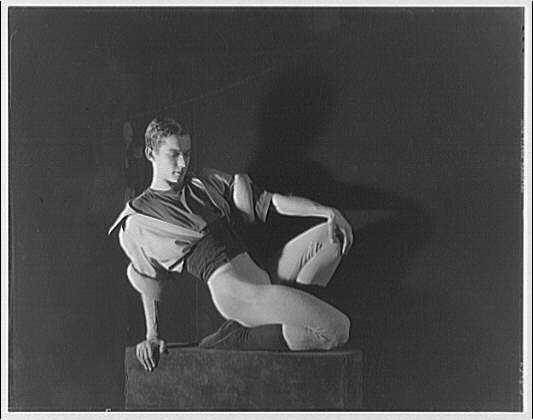
Ballet dancer. Ballet dancer at National Theater III
Unknown artist
- Collection:
- Prints & Photographs
- Source:
- Library of Congress
- Rights:
- Rights vary by item — check the source record before reusing this image. Source record ↗
- Recorded as:
- Library of Congress — no known restrictions (verify per item)
This photograph documents the aesthetic presentation of the male ballet dancer in the early twentieth century, at a moment when male dancers were gaining prominence in European theatre. The formal, sculptural approach to the subject reflects a broader shift in how dance bodies were understood and displayed to the public—not as narrative illustrations but as objects of artistic study.
What you are looking at
A male ballet dancer poses in profile against a dark background, seated on a low cube or platform. His body is arranged in a composed, introspective attitude: his weight rests on one hip, his torso twists slightly, and his gaze is directed thoughtfully away from the viewer. He wears a dark sleeveless tunic or leotard and light-colored tights or hose. His musculature is rendered with careful attention to anatomy. The photograph is a studio portrait in black and white, lit from one side to model the body's form. The darkness of the background isolates the figure, emphasizing his sculptural qualities. The pose suggests a moment of rest or reflection rather than active movement—a study of the dancer's body at repose.
The dancing
A single male dancer, seated with one leg extended and the other bent, his torso upright but twisted at the waist. His arm position is relaxed; one arm rests near his body while the other extends or supports his weight. The pose is balletic in its attention to line and extension, but static—this is not a captured moment of motion but a composed, almost classical study of the male form. The musculature visible in his shoulders, arms, and legs suggests a trained performer.
The dance depicted
This is a photograph of a ballet dancer, likely from a theatrical company given the context of the National Theater. The pose and costume are consistent with early twentieth-century ballet practice, when male dancers were beginning to be presented as sculptural subjects in their own right. The image does not show active choreography but rather a formal study of the male ballet body—a format common in theatrical photography of the 1920s. Without additional context, it is impossible to identify the specific dancer, choreographer, or role.
How it was made
This is a black-and-white photograph, likely a gelatin silver print, a standard commercial photographic medium of the 1920s. The controlled studio lighting, formal pose, and careful composition suggest professional theatrical photography rather than documentary work. The medium allowed for precise rendering of the body's musculature and the play of light across the form, making it ideal for promotional and archival purposes in theatre. Such photographs were often produced as single prints or in limited editions for distribution to critics, audiences, and theatre archives.
About this work
A studio portrait photograph of a male ballet dancer from the National Theater, circa 1920. The subject is posed seated on a platform, his body arranged to display balletic line and anatomical form. This is a formal study in the conventions of early twentieth-century theatrical photography, when dancers (especially men) began to be documented as artistic subjects rather than merely as performers in narrative scenes. The work belongs in a dance archive as evidence of how the male ballet body was presented and celebrated in the interwar period, and as an example of the relationship between photography, publicity, and the construction of the dancer as a public figure.
How to look at it
Observe the precise arrangement of the body: the extension of the leg, the twist of the torso, the placement of the arms. This is not a candid moment but a composed study, following conventions of classical art photography. The lighting models the musculature, emphasizing the trained dancer's form. Notice how the seated position creates a sense of repose and contemplation—this is a portrait of the dancer as a thinking, embodied subject, not merely a moving instrument.
The artist
The photographer is not recorded. The work comes from the Library of Congress Prints & Photographs collection, which holds thousands of theatrical photographs from this period, many by professional studio photographers who worked with major theatres and dance companies. Attribution remains uncertain without additional documentation.
The period
In the 1920s, ballet photography was becoming an established art form. The Russian Imperial Ballet's tours through Europe and America had raised the profile of the male dancer, reversing nineteenth-century traditions that had relegated them to supporting roles. Photographers began documenting dancers as formal subjects. This period also saw the rise of modern dance in Europe and America, with figures like Mary Wigman and Martha Graham presenting radically different bodies and movement vocabularies. Studio photography of the period often emphasizes classical line and anatomical precision, reflecting a tension between traditional ballet aesthetics and emerging modernisms.
Where it lives
The photograph is held in the Library of Congress Prints & Photographs Online Catalog, a major public archive of American visual culture. It is catalogued as relating to the National Theater, though the specific production, dancer, and photographer are not recorded in the current record.
Dance in this work
Questions about this work
Is this a famous dancer or ballet?
The current catalog record does not identify the dancer or provide the dancer's name. Without additional documentation, we cannot establish who is pictured or whether this is a well-known figure of the period.
Why is the dancer seated instead of dancing?
This is a formal studio portrait, not a document of performance. The seated pose was chosen to display the dancer's form and line in a composed, classical manner—similar to how portrait painters and sculptors had long arranged their subjects.
What was the National Theater in 1920?
The catalog lists this as relating to a National Theater, but does not specify which one—this could refer to a theater in the United States or Europe. More context would be needed to identify the institution and the production context.
More dance artwork





