49 works in this view — arrow keys or swipe to move between them.
Dance in Art
Ballet dancer. Ballet dancer at National Theater IV
Unknown artist
- Collection:
- Prints & Photographs
- Source:
- Library of Congress
- Rights:
- Rights vary by item — check the source record before reusing this image. Source record ↗
- Recorded as:
- Library of Congress — no known restrictions (verify per item)
This photograph documents a moment of transition in early 20th-century ballet, when the classical tradition was being reexamined and reformed through modernist principles. For dance historians and practitioners, it offers evidence of how the body was trained, posed, and presented in this period, and how theatrical photography functioned as a tool for documenting dance practice.
What you are looking at
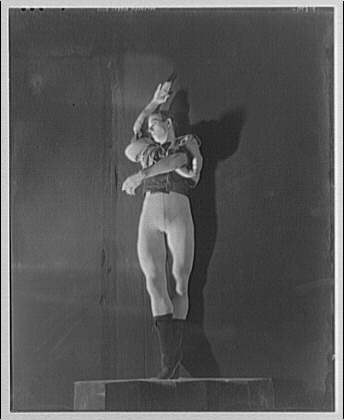
A solo female dancer stands centered on a low stage platform against a dark background, captured in a moment of balletic poise. She wears a pale, fitted tunic or leotard with long sleeves and dark leg coverings or tights that extend to boots or heeled shoes. Her posture is upright and formally composed, with her arms held in a controlled position across her torso—the left arm bent and the right arm extended or positioned at her side. Her head is tilted slightly upward in a classical attitude. The lighting is theatrical and directional, creating a strong shadow on the wall behind her that emphasizes the solidity of her form. The composition is austere and focused: a single figure isolated against darkness, emphasizing the disciplined geometry of the body and the formal vocabulary of ballet technique.
The dancing
The dancer stands in a classical upright alignment with engaged posture characteristic of early 20th-century ballet training. Her arms appear to be in a controlled position, neither relaxed nor dramatically extended, suggesting either a pose held between movements or a deliberate moment of formal presentation. The weight appears centered and grounded through the legs, with the body held in strict vertical alignment. There is no indication of movement through space; this is a held position, the body arranged for presentation rather than captured mid-motion.
The dance depicted
This is a theatrical ballet photograph, most likely documenting a classical or transitional ballet work from the early 20th century. The formal, isolated presentation and the pale costume suggest either a solo from a classical full-length ballet or a study photograph made for documentation or publicity. The costume—a plain tunic rather than an ornate romantic or classical tutu—suggests either a modern or avant-garde work, or a modernist restaging of classical material. Without more specific context, the work cannot be narrowed to a particular ballet or choreographer, though the date and theatre attribution suggest it may document a work staged at a Central European theatre during a period of ballet modernization.
How it was made
This is a gelatin silver or comparable photographic print, almost certainly a professional studio or stage photograph made for promotional or archival purposes. The formal studio lighting, centered composition, and theatrical backdrop are consistent with theatrical documentation photography of the 1920s. The print quality and tonal range suggest a well-executed studio negative, likely made by a theatre photographer or commercial portrait studio. The photograph was preserved within the Library of Congress collections, indicating it had sufficient institutional or documentary value to warrant acquisition.
About this work
This is a formal stage photograph documenting a solo female ballet dancer, likely from a production at a Central European National Theater around 1920. The image represents the documentary practices of early 20th-century theatrical photography, when studios and theatres routinely photographed performers in costume to create archival records and promotional materials. The stark, frontal presentation and the modernist simplicity of the costume suggest a work created during a period of ballet reform and experimentation, when classical vocabulary was being rethought through contemporary aesthetics.
The photograph's value lies in its status as a material record of how ballet was performed, costumed, and presented to audiences in the early postwar years. The formal pose and theatrical framing tell us something about the aesthetics of the period—the emphasis on clarity of line, the centering of the individual body, and the use of costume as a vehicle for modernist reduction rather than romantic ornament.
How to look at it
Look first at the formal frontality of the pose: the dancer is presented to the camera as an object of study, not as a figure moving through narrative action. This is a held position, a moment of stillness that asks you to read the body's alignment and the costume's geometry. Notice the shadow cast on the wall behind—it emphasizes the solidity of the form and the directional lighting of the stage. The simplicity of the costume and the neutral background direct all attention to the body itself: its posture, its proportions, the clarity of its line. This is how early 20th-century ballet photography worked: not to capture motion, but to document the body's formal arrangement in space.
The period
This photograph dates to approximately 1920, a period of significant upheaval and renewal in European ballet. The Russian Imperial Ballet had been dispersed by revolution; Diaghilev's Ballets Russes was at the height of its influence in Western Europe, collaborating with modernist artists and choreographers; and regional European theatres were experimenting with ballet reform and the integration of ballet with other theatrical forms. The modernist costume visible here—plain, unadorned, emphasizing the geometry of the body rather than spectacular decoration—reflects the influence of contemporary art movements and the period's interest in stripping ballet down to its essential formal vocabulary.
Photography itself was becoming an established medium for theatrical documentation, replacing hand-drawn illustrations as the primary method of recording performers and costumes. This photograph is part of that broader shift toward photographic evidence as a form of cultural memory.
Where it lives
This is a gelatin silver print in the Library of Congress Prints & Photographs Online Catalog, part of their extensive holdings of theatrical and performance photography. It was catalogued as a documentary record of theatrical production, likely acquired either directly from a theatre archive or through a collection of performance materials.
Dance in this work
Questions about this work
What ballet is this from?
The catalogue record does not identify a specific ballet, only that it documents a ballet dancer at the National Theater IV, presumably in Berlin or another German-speaking city. The costume and style suggest a work from the early 1920s, possibly a classical work in modern dress or a new work created during the modernist reform of ballet in this period.
Who is the dancer?
The photographer and dancer are both unidentified in the catalogue record. The image was preserved as a theatrical document rather than a portrait, so identifying information was apparently not retained.
Why is the pose so formal and still?
This is a studio or stage photograph made for documentation and promotion, not a candid capture of performance. The dancer is posed deliberately to show the body's alignment and the costume clearly—standard practice for theatrical photography of the period. It is a study image rather than an action photograph.
What does the costume tell us?
The simple tunic costume, without tutu or ornament, reflects modernist influences on ballet design in the 1920s. It suggests either a work by a progressive choreographer, a new staging of classical material in contemporary dress, or a work influenced by German expressionism or other avant-garde movements of the period.
More dance artwork





