49 works in this view — arrow keys or swipe to move between them.
Dance in Art
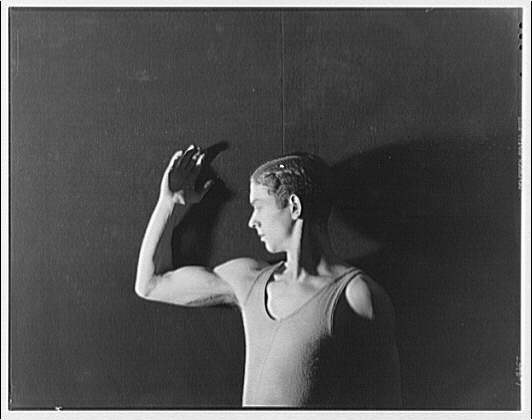
Ballet dancer. Ballet dancer at National Theater VII
Unknown artist
- Collection:
- Prints & Photographs
- Source:
- Library of Congress
- Rights:
- Rights vary by item — check the source record before reusing this image. Source record ↗
- Recorded as:
- Library of Congress — no known restrictions (verify per item)
This photograph offers visual evidence of how male dancers' bodies were being presented and valued in the early 1920s, at a moment when ballet was beginning to move away from the 19th-century subordination of the male dancer to spectacle and narrative. The modernist photographic treatment—the bare torso, the psychological intensity, the abstract framing—shows a dance photographer thinking of the male body as worthy of artistic attention in its own right, not as a support for a female lead.
What you are looking at
A shirtless male dancer stands in profile against a dark, featureless background, his body caught in a moment of concentrated effort or emotional intensity. His right arm is raised and bent, the hand drawn up toward his head in a gesture that suggests strain, introspection, or the physical exertion of a demanding choreographic phrase. His torso is fully exposed, emphasizing the musculature and line of the body. The photograph is cropped tightly around the figure, eliminating any spatial context—no floor, no wings, no other dancers are visible. The lighting is stark and directional, casting a sharp shadow on the wall behind him that reinforces the sculptural quality of his form. The image has the grainy quality and monochromatic palette of mid-20th-century black-and-white photography.
The dancing
A single male dancer, barefoot and bare-chested, holds his body in a vertical line with one arm raised and flexed near his head. The posture suggests neither the turned-out placement of classical ballet nor the grounded, flexed positions of modern dance, but rather an intermediate or transitional moment. His weight appears centered; his free arm hangs at his side. The exposure of the torso—unusual in theatrical ballet of 1920—draws attention to the articulation of the spine and ribcage as active instruments of movement.
The dance depicted
The catalogue identifies this as a ballet dancer at the National Theater VII, dated 1920. The bare torso, the austere lighting, and the emotionally charged arm gesture suggest either a modernist rethinking of classical ballet or early modern dance influenced by the avant-garde movements of the 1910s–1920s. The pose does not conform to the codified positions of academic ballet; it reads instead as a moment of psychological or physical intensity. Without further documentation, the specific choreography cannot be identified, but the image suggests a dancer working in a transitional moment between classical tradition and modernist experiment.
How it was made
This is a black-and-white photograph, likely gelatin silver print or similar photographic process common to the 1920s. The close framing, dramatic side-lighting, and emphasis on the body's musculature suggest the work of a photographer alert to modernist aesthetics and the expressive potential of the human form. The tonal range and grain are consistent with studio photography of the early 20th century. The image was printed in the Library of Congress Prints & Photographs collection and may have been originally produced as a documentation photograph or as fine-art studio work.
About this work
This photograph documents a male ballet dancer in an unidentified moment from performance or rehearsal at the National Theater VII around 1920. The image is striking for its modernist framing and its exposure of the male dancer's torso—a departure from the tutus and tights convention of classical ballet. The stark lighting and tight composition transform the dancer's body into a sculptural object, emphasizing line and musculature over narrative or spectacle. The raised arm and concentrated expression suggest emotional content or physical demand. The work sits at a moment of transition in early-20th-century dance, when Russian Imperial traditions, Diaghilev's Ballets Russes, and emerging modernist aesthetics were all reshaping what ballet could express and how it could look.
How to look at it
Attend to the moment of suspension captured: the arm raised, the facial expression concentrated or introspective, the body neither at rest nor in dynamic motion, but held in a state of expressive tension. This is not the exuberant leap of classical ballet's virtuosity display, nor the grounded, weight-centered posture of emerging modern dance. It is a threshold moment—a gesture of reaching, striving, or internal intensity. Notice how the photographer has used isolation and close framing to make the male body itself the subject, not the spectacle or narrative the body might ordinarily serve. The shadow on the wall is not incidental; it emphasizes the three-dimensionality of the form and the intensity of the theatrical lighting.
The period
In 1920, ballet was undergoing radical change. Sergei Diaghilev's Ballets Russes (founded 1909) had already begun to break from Imperial Russian tradition, collaborating with avant-garde artists and choreographers including Vaslav Nijinsky and George Balanchine. The male dancer, long sidelined in 19th-century classical ballet, was being repositioned as a central figure—Nijinsky's roles demanded extraordinary technical and expressive range. Simultaneously, early modern dance pioneers in the United States and Europe (Isadora Duncan, Mary Wigman, Laban) were developing new movement vocabularies that rejected classical ballet's turned-out positions and codified arm movements. A photograph like this, with its austere modernist framing and its exposure of the male torso as a site of expressive power, reflects this ferment. The National Theater VII in the caption may refer to a Scandinavian or Central European venue—the specific identification remains uncertain.
Where it lives
The photograph is held in the Library of Congress Prints & Photographs Online Catalog. It was catalogued with minimal metadata: no photographer attribution, no specific performance or choreographic identification, and no accession date beyond the estimated year 1920. It may have been acquired as documentary material or as an artist's proof.
Dance in this work
Questions about this work
Why is the dancer shirtless?
The bare torso was unusual for theatrical ballet in 1920 and signals either an experimental or modernist choreography, or a photograph taken in rehearsal rather than performance. In classical ballet, male dancers wore jackets, tunics, or other upper-body costume. The exposure of the body here suggests the photographer and subject were emphasizing the body as a vehicle for expressive line and musculature, an aesthetic aligned with early modern dance and modernist photography.
What does the arm gesture mean?
Without the full choreographic score, the meaning is ambiguous. The raised, flexed arm suggests strain, reaching, introspection, or emotional intensity. It is not a codified ballet port de bras; instead, it reads as a moment of psychological or kinetic urgency. The photographer has chosen to document or create this specific moment, emphasizing the expressive content of the gesture rather than the technical virtuosity it might ordinarily display.
Who is the dancer?
The catalogue record does not name the dancer. The venue—National Theater VII—may provide a lead for researchers with access to Scandinavian or Central European theater archives, but the identity remains unknown from the photograph alone.
Is this a performance photograph or a studio photograph?
The stark background, controlled lighting, and tight framing suggest a studio or photographic session rather than documentation from a stage performance. However, the emotional intensity and specificity of the pose suggest it may document an actual choreographic moment, captured by a photographer with artistic intent rather than routine documentation.
More dance artwork





