49 works in this view — arrow keys or swipe to move between them.
Dance in Art
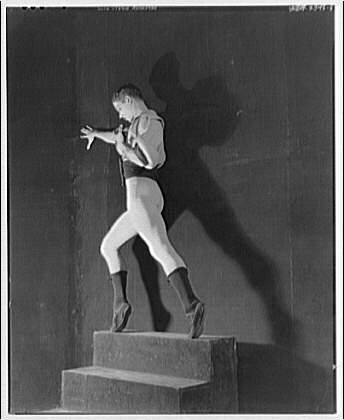
Ballet dancer. Ballet dancer at National Theater VIII
Unknown artist
- Collection:
- Prints & Photographs
- Source:
- Library of Congress
- Rights:
- Rights vary by item — check the source record before reusing this image. Source record ↗
- Recorded as:
- Library of Congress — no known restrictions (verify per item)
This photograph documents a crucial moment in the history of dance photography: the point at which photographic technology and aesthetic ambition converged to create a new way of seeing dance. The image shows how early twentieth-century photographers and dancers understood the body as form, architecture, and drama simultaneously. For historians of ballet and dance documentation, it provides evidence of how performances and performers were promoted and immortalized during the interwar period.
What you are looking at
A single ballet dancer captured in a dramatic moment of elevation, photographed against a dark background. The dancer stands on two stacked rectangular platforms or blocks, creating height and architectural framing. She is photographed in profile, her body angled forward and upward in a pose suggesting power and extension. Her dark hair is pulled back, and she wears what appears to be a short tunic or dance costume. The lighting is stark and theatrical, casting a deep shadow of the dancer's silhouette against the backdrop—a compositional choice that emphasizes form and creates a modernist aesthetic. The photograph has the grainy quality and tonality of early twentieth-century gelatin silver printing.
The dancing
The dancer's body is extended in a controlled, powerful line. Her weight appears to be on both feet as she stands on the platforms, with her torso lifted and inclined forward from the hips, creating a sense of dynamic tension. Her arms are positioned at shoulder height or slightly lower, held with classical precision. The pose suggests a moment between movements—neither purely static nor fully in motion, but suspended in a moment of readiness or completion. The positioning of the figure on the elevated platforms draws attention upward and outward, creating a sense of aspiration and verticality characteristic of classical ballet line.
The dance depicted
This is a theatrical ballet photograph, likely from an early twentieth-century production at a European national theater. The costume, body alignment, and technical precision visible in the pose all indicate classical ballet training in the Cecchetti or similar continental tradition. The elevated platforms are a theatrical device, not part of standard ballet technique, suggesting this is a studio or promotional photograph designed to dramatize the dancer's presence and skill. The pose itself—an arabesque or related extension held with squared shoulders—is foundational to classical ballet vocabulary. Without identifying marks or signatures visible, the specific dancer and production cannot be determined, but the image documents a moment of early modernist dance photography where technical precision and theatrical drama were equally important.
How it was made
This is a black-and-white photograph, most likely a gelatin silver print or similar photographic process from around 1920. The grain structure, tonal range, and printing quality are consistent with professional studio photography of that era. The dramatic lighting—side or back-lit to create the strong shadow—and the careful staging on platforms indicate this was a controlled studio session rather than documentation of a live performance. The photograph demonstrates an understanding of how photography could isolate and dramatize the dancer's form, a practice that became central to dance documentation in the early twentieth century.
About this work
This is an early twentieth-century promotional or documentary photograph of a classical ballet dancer, taken at or associated with a national theater. The image captures a moment of technical display, with the dancer elevated on platforms that serve both practical and symbolic purposes—to showcase the extension and line of the body, and to place the dancer literally above the viewer. The stark, modernist photographic approach—with its emphasis on shadow, silhouette, and architectural framing—marks a transition in how dance was being documented and celebrated in the 1920s. Photographs like this one served multiple functions: they documented performers and productions, they were used for promotion and publicity, and they were collected by institutions as records of theatrical history.
How to look at it
Attend first to the silhouette: the dark outline of the dancer's body against the gray background creates a reading of pure form, independent of personality or narrative. Notice how the platforms lift the dancer and force the viewer's eye upward—this is a compositional strategy to convey aspiration and technical mastery. Look at the precise alignment of the dancer's shoulders, spine, and legs: every line speaks to years of classical training. The photograph asks you to see the body as architecture, and the moment captured is one of absolute control and display, not caught movement but deliberate presentation.
The period
In the 1920s, ballet was undergoing rapid transformation across Europe. The Ballets Russes (founded 1909) had revolutionized classical ballet by integrating modernist design, music, and choreography, and this ferment attracted intense interest from visual artists and photographers. Simultaneously, photographic technology was advancing, and photographers were experimenting with new ways to capture movement and form. Early dance photography often emphasized the body as a sculptural object, using dramatic lighting, posed positions, and framing devices to create images that were as much about visual modernism as documentary accuracy. This photograph reflects that aesthetic: the platforms, the severe lighting, and the precise classical pose all work together to present the dancer as both athlete and art object.
Where it lives
This photograph is held in the Prints & Photographs collection of the Library of Congress. It is catalogued as relating to a National Theater (likely European, given the era and style), but the specific theater, production, dancer, and photographer are not recorded in the available catalogue information.
Dance in this work
Questions about this work
Who is the dancer in this photograph?
The catalogue record does not identify the dancer or photographer. The image is associated with a National Theater and dated to 1920, but without additional documentation or inscription on the print itself, the specific individual cannot be determined from the photograph alone.
Why is the dancer standing on platforms?
The platforms serve both practical and aesthetic purposes: they increase the apparent height and reach of the dancer's body, allowing the photographer to emphasize extension and line. They also ground the composition and create a sense of elevation and aspiration—a visual metaphor for the discipline and achievement of classical ballet. This is a studio or promotional device, not part of the choreography itself.
What does the pose tell us about ballet technique?
The pose demonstrates classical balletic alignment: square shoulders, engaged core, extended leg, and controlled arm placement. It reflects training in the formal academic traditions of ballet (likely Cecchetti or a similar method current in European theaters in 1920). The held position emphasizes strength and control rather than the illusion of weightlessness or fluidity, which marks a shift toward more sculptural, angular approaches to classical form.
Is this a photograph of a performance or a studio shot?
This is almost certainly a studio or promotional photograph rather than documentation of a live performance. The controlled lighting, dark backdrop, elevated platforms, and posed position all indicate a deliberate setup designed for the camera. Such photographs were common in the 1920s as both promotional materials and official records of dancers and productions.
More dance artwork





