49 works in this view — arrow keys or swipe to move between them.
Dance in Art
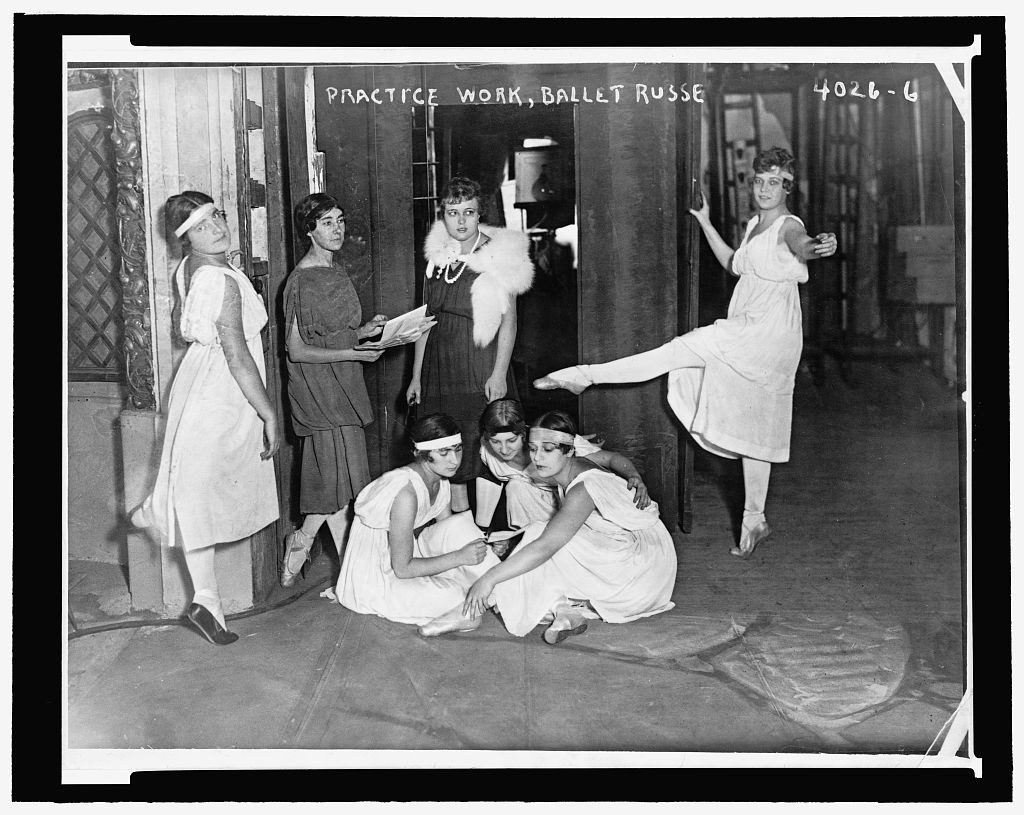
Ballet rehearsals, New York City, ca. 1916: Ballet Russe
Unknown artist
- Collection:
- Prints & Photographs
- Source:
- Library of Congress
- Rights:
- Rights vary by item — check the source record before reusing this image. Source record ↗
- Recorded as:
- Library of Congress — no known restrictions (verify per item)
This photograph documents the Ballets Russes' American practice at a pivotal moment in modernist dance history, when the company was establishing itself in New York and reshaping what ballet could be. It is a primary record of pedagogical method and choreographic process—the studio work that historians rarely see. The image is valuable evidence of how the company trained dancers and developed new work, and of the gender composition, youth, and physical discipline of early twentieth-century classical ballet.
What you are looking at
A black-and-white photograph captures a moment of choreographic instruction or rehearsal within what appears to be a studio or performance space. The image is composed as a frieze: seven young women in various states of movement and repose occupy the frame. On the left, two figures stand upright in profile—one wearing a light draped tunic and headband, the other in darker clothing holding what may be notes or a score. At center-right, a woman in a white dress extends one leg in a high arabesque or attitude, her body in an elegant line; immediately below her crouch three younger dancers in matching white tunics and headbands, huddled together on the floor in what appears to be a moment of rest or instruction. At far right stands another figure in a white dress, captured mid-gesture with an arm extended. The floor is bare; the background shows dark walls and doorways. The lighting is even and documentary, characteristic of studio photography.
The dancing
The bodies display the formal posture and vocabulary of early twentieth-century classical ballet. The standing figure at right shows the turned-out frame and lifted carriage expected of ballet training; her extended leg reaches toward a high, open line. The arabesque or attitude position is held with apparent ease. The three crouching dancers below display the flexible, supple spines of trained young dancers, their bodies collected and compact. The two standing observers at left suggest a teaching moment or choreographic direction—one possibly holding choreographic notation. Overall, the poses and alignment indicate dancers trained in the classical academic tradition, with attention to turnout, line, and épaulement.
The dance depicted
This is a Ballet Russe rehearsal or practice session, as confirmed by the caption. The Ballets Russes, under Sergei Diaghilev, revolutionized ballet in the early twentieth century by combining classical technique with modernist aesthetics and visual innovation. The image shows the human infrastructure of that enterprise: the young dancers in training, the moment of instruction and correction, the casual and intimate working space where technique is refined and choreography developed. The headbands and simple tunics are practical rehearsal wear; the absence of pointe shoes visible in this photograph suggests either a technique class or a compositional rehearsal rather than a full performance run-through.
How it was made
This is a gelatin silver print (photograph), almost certainly a documentary or archival record made for the Ballets Russes itself. The even lighting, documentary clarity, and composition as a compositional study suggest it was taken by or for the company's own documentation purposes. The photograph's survival in the Library of Congress indicates it was preserved as part of a systematic institutional record. Photography was the ideal medium for capturing the lived reality of rehearsal—the moment of teaching, correction, and collaboration that performance photographs do not reach. The accessibility and reproducibility of the photographic print made it useful for distribution among dancers, directors, and company records.
About this work
This is a documentary photograph of a Ballet Russe rehearsal in New York City around 1916, capturing the pedagogical and compositional work that lay behind the company's public performances. The image records a specific moment of choreographic instruction or practice, with seven dancers at different stages of engagement—some executing technique, others observing or waiting. It belongs in a gallery of dance art because it documents not the finished spectacle but the creative labor that produced it: the teaching of classical technique, the development of new work, and the quotidian working relationships between dancers and choreographers. The photograph is a rare glimpse into the working methods of the Ballets Russes during its most influential period in America, showing how the company trained its dancers and developed its repertory in the intimate space of the studio rather than the public theater.
How to look at it
Attend to the variety of positions and activities within a single frame: the casual coexistence of waiting, instruction, and execution. Notice the posture and line of the standing figures, which demonstrate the classical training these dancers possessed. The composition—a kind of frieze or relief—suggests the photograph was made as a study of the social and physical dynamics of the studio rather than a formal portrait. The casual dress and unpolished setting emphasize the working reality of rehearsal, not the glamor of performance.
The artist
The photographer is not recorded. The image bears the identifying marks of documentary photography from the Ballets Russes archive, suggesting it may have been taken by a company photographer or a photographer retained for publicity and archival purposes. The practice of systematic photographic documentation of rehearsal was itself part of the Ballets Russes' modern approach to dance as an art form worthy of preservation and study.
The period
In 1916, the Ballets Russes was in its seventh season and had established New York as a major center of its operations. Diaghilev's company had pioneered a synthesis of classical ballet technique with contemporary visual art, music, and experimental choreography; by 1916, this aesthetic was well established and influential in American artistic circles. The photograph dates to a period of intense creative activity, when the company was regularly creating new ballets and engaging with American artists and audiences. In the broader context of modernism, the early twentieth century saw photography emerging as a documentary medium and an art form in its own right; the systematic archival photography of performance and rehearsal was part of a larger modernist commitment to capturing and preserving the ephemeral art of dance.
Where it lives
The photograph is held by the Library of Congress, Prints & Photographs Online Catalog, as part of the American Memory collections or a related archive. It bears the accession notation 4026-4. The caption on the photograph itself—"PRACTICE WORK, BALLET RUSSE"—was added contemporaneously or shortly after the image was made, indicating the photograph was identified and documented as part of a systematic record of the company.
Dance in this work
Questions about this work
Why is this a photograph and not a painting or drawing?
Photographs were ideal for documenting rehearsal because they captured the lived moment without the delay and interpretation of drawn or painted media. The Ballets Russes used photography to record its working methods and to distribute images of its dancers to company records, publicity, and historians. This is a documentary photograph made for archival purposes, part of the company's systematic self-recording.
What are the dancers wearing, and why?
The dancers wear simple tunics and headbands—practical rehearsal wear that allows freedom of movement and makes the body visible to the teacher or choreographer. These are not costumes but working clothes, similar to what dancers still wear in studios today. The absence of pointe shoes and elaborate costume suggests this is a technique class or compositional rehearsal rather than a full dress rehearsal.
What was the Ballets Russes doing in New York in 1916?
By 1916, Diaghilev's Ballets Russes had established New York as a major center of its operations, touring regularly and developing audiences for experimental ballet and contemporary art. The company was creating new ballets, collaborating with American artists, and reshaping how ballet was understood and practiced in America. This photograph documents the studio work that supported those public performances and artistic innovations.
Who is the photographer?
The photographer is not identified in the available record. The image appears to be a work of company documentation, possibly made by a photographer retained by the Ballets Russes for archival and publicity purposes. The systematic preservation of such photographs as part of the company's records suggests they were valued as documentation of artistic practice.
More dance artwork





