49 works in this view — arrow keys or swipe to move between them.
Dance in Art
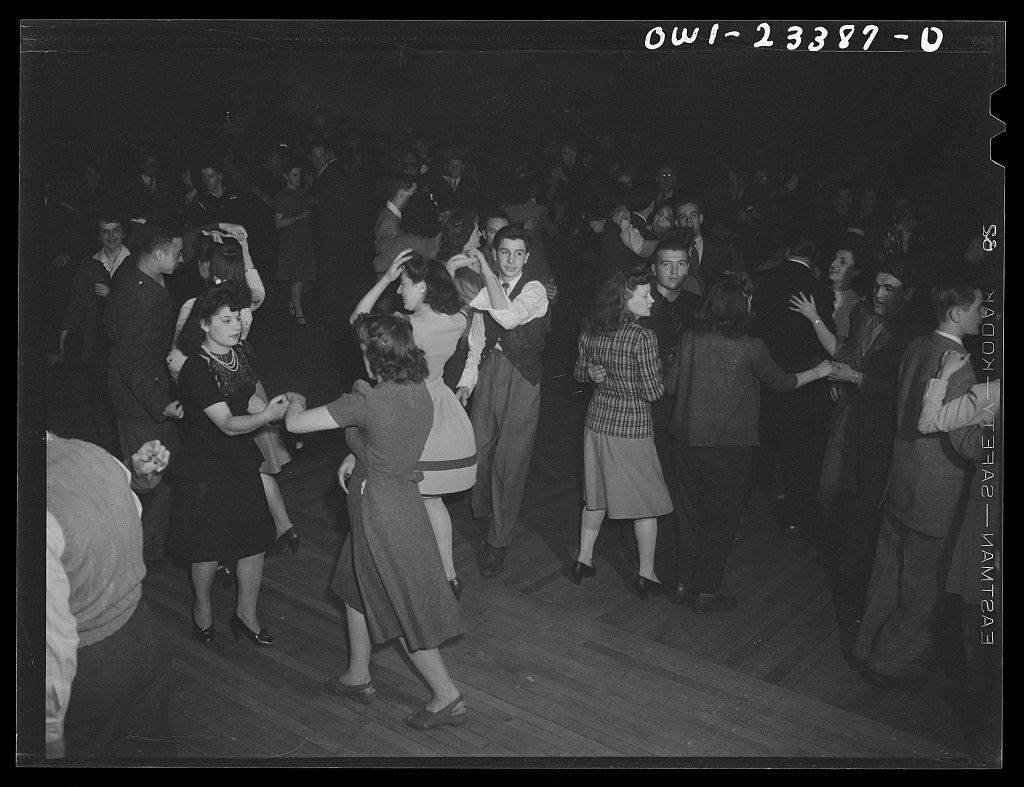
Buffalo, New York. Swingshift dance held weekly at the Main-Utica ballroom from midnight to four a.m.
Unknown artist
- Collection:
- Prints & Photographs
- Source:
- Library of Congress
- Rights:
- Rights vary by item — check the source record before reusing this image. Source record ↗
- Recorded as:
- Library of Congress — no known restrictions (verify per item)
This photograph provides rare documentary evidence of vernacular swing dancing in the industrial heartland during World War II, showing how the dance functioned as a social and leisure practice for working-class Americans rather than as performance art. It demonstrates the scale of swing's popularity and its integration into wartime social life, particularly for shift workers whose schedules required unusual hours of recreation. The image is a primary historical document of how ordinary people danced in ordinary spaces.
What you are looking at
A crowded ballroom scene captured in black and white, densely packed with dancers and onlookers occupying what appears to be a wooden dance floor. The photograph captures a moment of social dancing in progress, with multiple couples scattered throughout the frame in various stages of motion. The lighting is dim and even, typical of indoor ballroom conditions, creating sharp contrasts between figures and shadows. Men in suits and women in day dresses and skirts—some with bold patterns like checks, others plain—fill the frame from foreground to background. The density of bodies and the casual positioning of many figures suggest this is an active, popular venue rather than a formal or staged performance. Some dancers are in closed hold; others stand conversing or watching. The wooden floor and the sheer number of people visible suggest a working-class or mid-class social space rather than an elite ballroom.
The dancing
Dancers appear in a mix of closed holds and open positions. In the center-right, a couple holds in what resembles a standard ballroom frame, though the woman's posture and the man's leading position suggest a swing or jazz-inflected style rather than classical ballroom technique. Most figures show relaxed, social posture rather than the rigid frame of formal dance instruction. Several people stand at the periphery watching or waiting, with casual arm positions. The mix of body angles, some dancers turned away from the camera, others facing it, captures the multidirectional energy of a crowded social dance floor rather than the unified orientation of a staged performance. Women's skirts show mid-calf length, consistent with 1940s daywear.
The dance depicted
This is a swing dance or jitterbug social scene, almost certainly East Coast Swing given the era and setting. The catalogue identifies this as a "swingshift dance," a working-class social dance event held during wartime hours (midnight to 4 a.m.) to accommodate factory workers on swing shifts. The close holds, the relaxed posture, and the crowded, casual nature of the scene—with people dancing, socializing, and watching simultaneously—are characteristic of American swing dancing in the early 1940s. The photograph documents a form of popular social dancing that was both a leisure activity and a wartime social outlet for industrial workers. The style shown is vernacular swing rather than competition lindy hop.
How it was made
This is a black-and-white photograph, likely taken with available light or flash photography. The grain and tonal quality suggest it was captured with documentary or journalistic intent rather than studio lighting. The even exposure and sharp focus across the crowded scene indicate professional or semi-professional photographic technique. The image's character and archival provenance suggest it was made as part of a documentary project, possibly a government or journalistic record of wartime American social life. Photographs like this were circulated in newspapers and periodicals, making them accessible to a broad public audience unlike studio dance photographs.
About this work
This is a documentary photograph of a swing dance social event held in Buffalo, New York in 1943, specifically a "swingshift dance" scheduled from midnight to 4 a.m. for factory workers. The image captures the social energy and working-class character of wartime American swing dancing—not competition or theatrical dancing, but the everyday vernacular practice of a generation. It is a record of how industrial workers in a major manufacturing city used swing dancing as social and leisure time during the intensive labor demands of World War II. The photograph documents a specific dance practice in a specific historical moment: the democratization of swing as a popular social form across class and workplace lines.
For dance historians and archivists, this image is significant precisely because it does not document a named dance company, a famous ballroom, or elite practitioners. Instead, it captures swing as a lived social practice—the crowded, casual, energetic form in which most Americans experienced this dance. It shows the scale and popularity of swing dancing during the war years and provides visual evidence of how the dance was actually performed by ordinary people in working-class venues.
How to look at it
Observe the range of embrace positions visible across the frame: some couples are in close holds, others in open positions or hand-hold only. Notice how many people are not actively dancing but standing, watching, or conversing—this is social dancing, not performance. Look at the density of the crowd and the mix of body angles; this captures the spontaneous, self-directed quality of swing dancing in a real social setting. Pay attention to the women's dress: day clothes adapted for dancing (skirts, blouses, some with pattern), not costumes. The photograph captures a moment of energy and motion but also of the social gathering itself—the dancing is one activity among many happening in this space.
The period
Swing dancing emerged in the 1930s as a form of popular social dancing, accelerating in popularity during the early 1940s as American industrial production ramped up for World War II. Swing was simultaneously a vernacular social practice (danced by millions in ballrooms, dance halls, and at social events) and a commercial entertainment form (featured in big-band performances and film). The specific phenomenon of "swingshift dances"—scheduled to accommodate factory workers on overnight shifts—reflects the intensive 24-hour production schedules of wartime manufacturing. This photograph dates to a moment when swing dancing was at peak popularity and accessibility, before the postwar decline of the big-band ballroom culture. The image also reflects contemporary documentary photography practices: government agencies and news organizations were systematically recording American wartime life, labor, and leisure.
Where it lives
This photograph is held in the Library of Congress Prints & Photographs Online Catalog, where it is catalogued as a documentary image from the New York area. The accession number OWI-23389-0 indicates it likely originated from the Office of War Information (OWI), a government agency that documented American wartime society. Such photographs were made for public circulation in newspapers, magazines, and government publications, reaching a broad contemporary audience.
Dance in this work
Questions about this work
What is a swingshift dance?
During World War II, factories operated 24 hours a day to produce military equipment and supplies. Workers on the "swingshift" (typically 4 p.m. to midnight or midnight to 8 a.m.) had irregular hours and limited access to evening entertainment. Swingshift dances were social dance events scheduled at unusual hours—in this case midnight to 4 a.m.—to give these workers a place to socialize and dance. They were popular, working-class venues that reflected the demands of wartime industrial labor.
Is this lindy hop?
This is swing dancing, but almost certainly East Coast Swing or a related vernacular style rather than the competitive lindy hop associated with elite swing dancers and performance contexts. The photograph shows social swing dancing as practiced by ordinary people in a working-class ballroom. The holds, postures, and casual social context suggest everyday swing rather than the more technically refined or performance-oriented lindy hop of competition dancers.
Why was swing dancing so popular in the 1940s?
Swing was energetic, social, accessible (requiring only a partner and music, not formal training), and perfectly suited to the big-band music that dominated popular radio and recordings. During wartime, it offered working-class people an outlet for leisure and socializing during intense periods of industrial labor. Swing dancing was also racially coded as African American and youth-centered, making it feel modern and transgressive to white working-class dancers, which added to its appeal.
Who took this photograph and why?
The accession number indicates this was likely made by or for the Office of War Information, a U.S. government agency that documented American wartime life. Government photographers systematically recorded how Americans worked, lived, and recreated during the war years. This image was part of that documentary project, intended for circulation in newspapers and magazines to communicate what American wartime society looked like to a broad public.
More dance artwork





