49 works in this view — arrow keys or swipe to move between them.
Dance in Art
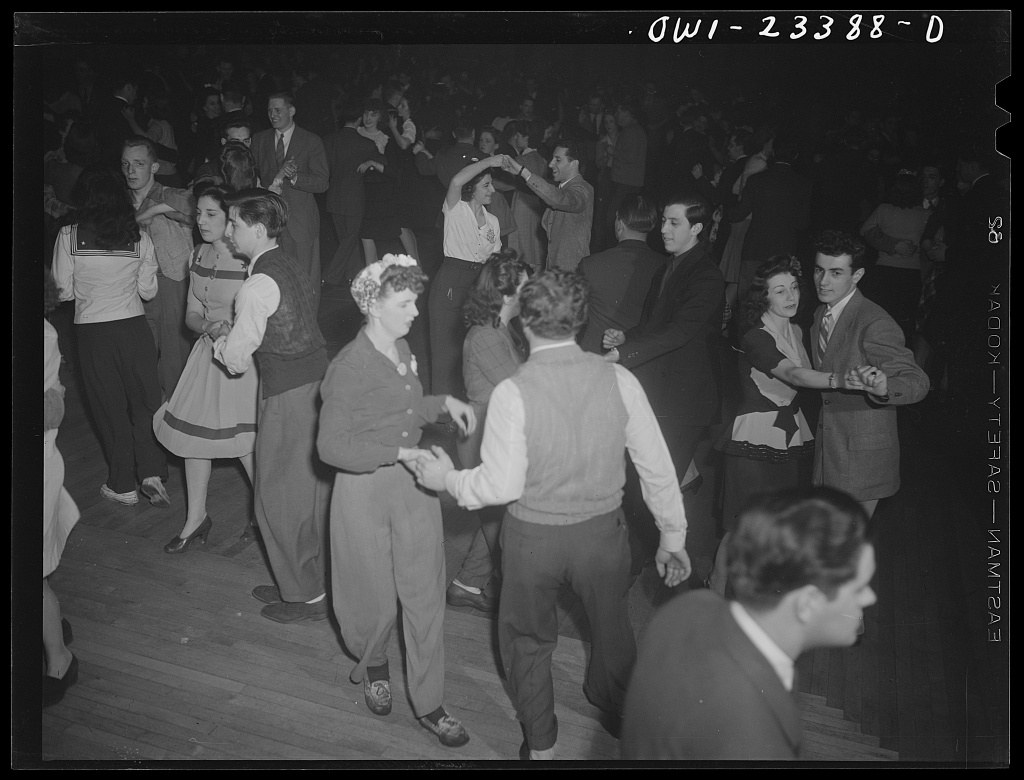
Buffalo, New York. Swingshift dance held weekly at the Main-Utica ballroom from midnight to four a.m.
Unknown artist
- Collection:
- Prints & Photographs
- Source:
- Library of Congress
- Rights:
- Rights vary by item — check the source record before reusing this image. Source record ↗
- Recorded as:
- Library of Congress — no known restrictions (verify per item)
This photograph is primary source evidence for how swing was actually danced in a specific American community in 1943—not as choreographed theater or as described in instruction manuals, but as lived social practice. The swing-shift dance was a particular response to wartime labor conditions, and this image documents the integration of dance into working-class industrial life. For historians and dancers, it provides direct visual testimony to the technical execution, the social conventions, and the cultural resilience of swing dancing during the war years.
What you are looking at
A crowded ballroom scene photographed in black and white, capturing a swing-shift dance in progress at the Main-Utica ballroom in Buffalo, New York. The photograph is taken from above, showing dozens of couples and individual dancers packed onto a wooden dance floor, with spectators lining the edges and standing in clusters throughout the space. The lighting is dim but sufficient to make out the figures clearly. Couples in the foreground are caught mid-movement: a woman in a dark dress with light collar dances with a man in a light-colored shirt and dark trousers; another couple nearby shows a woman in a patterned dress executing what appears to be a turn or spin. The dancers range across the full depth of the frame, creating layers of activity. The atmosphere is one of energetic social dancing, with people of varying ages visible, some standing and watching, others actively dancing. The wooden floor and the density of the crowd suggest this is a working-class or popular venue, and the lateness of the hour (the dance ran midnight to 4 a.m.) may account for the intensity and informality of movement.
The dancing
Couples are predominantly in closed or semi-closed ballroom holds, with partners facing each other. The nearest couples show women in the standard follow position with one arm extended and the other on their partner's shoulder or back; men lead with extended arms and upright posture. Several dancers are captured mid-step or mid-turn, with visible weight shifts and leg extension. The footwork is not entirely clear from this overhead angle, but the positioning and body angles suggest the directional changes and momentum typical of swing-era social dance. A few figures appear to be standing out, watching, which was customary at such venues. The overall impression is of competent social dancers executing established figures rather than freestyle improvisation.
The dance depicted
This is almost certainly swing dancing, most likely East Coast Swing or Lindy Hop as danced in the American industrial northeast in 1943. The swing-shift context—dances held midnight to 4 a.m. to serve war industry workers on night shifts—is historically documented. The closed and semi-closed holds, the partner positioning, the turning figures visible in the frame, and the overall social context all align with swing as the dominant social dance of the era. The mix of ages and the casual integration of spectators watching from the sidelines are characteristic of swing venues. The photograph documents swing not as a theatrical or performance form but as a living social practice in a specific working-class community during World War II.
How it was made
This is a black-and-white photograph, likely taken with flash photography given the even illumination across a large interior space with dim ambient light. The overhead framing and the depth of field suggest a documentary or journalistic approach rather than a posed studio portrait. The photograph's archival quality and its preservation in the Library of Congress Prints & Photographs collection indicate it was taken as part of systematic documentary coverage, possibly by a WPA photographer or similar government documentation program. The documentary nature of the image—capturing an actual social event rather than arranging dancers for the camera—gives it direct evidential value for how swing was danced in this specific context.
About this work
This photograph documents a swing-shift dance in wartime Buffalo, a working-class social event held to serve the schedules of munitions and manufacturing workers. It is not a performance, not a lesson, and not a pose for the camera, but an actual dance in progress captured as evidence of how Americans danced during World War II. The image shows swing dancing as a lived social practice, embedded in the rhythms of wartime labor and urban working-class culture. It belongs in a gallery about dance because it records the form, the hold, the figures, and the social context of a major American dance tradition at a crucial historical moment.
How to look at it
Notice the variety of figures visible simultaneously: some couples are in the middle of a turn, others are traveling across the floor in a straight line, others are stationary for a moment. The overhead angle is crucial—it reveals the floor pattern, the spacing, and the directional flow of the dance in ways that a ground-level view could not. Look at the arm positions and body angles to see how partners communicate direction and lead. Notice also the spectators: the social dance of this era was not purely participatory, and the presence of people watching and waiting to dance is part of the cultural context. The density and casualness of the scene—no obvious music stand or bandstand visible, people in varied dress rather than formal wear—tell you this is a neighborhood or workplace social venue, not an upscale ballroom.
The period
Swing dancing reached its peak popularity in the United States in the early 1940s, and it was already integrated into working-class social life and youth culture. The swing-shift dance was a specific wartime phenomenon: as factories ran 24-hour production schedules to supply the war effort, workers on night shifts (the 'swing shift') needed entertainment and social outlets at unconventional hours. Ballrooms and dance halls organized dances during these off-hours to meet the demand. In visual arts and photography, the 1940s saw increased documentary interest in American working-class life, partly through New Deal programs like the WPA that had established traditions of social documentation photography. This image likely emerges from that documentary impulse, capturing vernacular American culture at a moment of national mobilization.
Where it lives
The photograph is held in the Library of Congress Prints & Photographs Online Catalog, indicating it is part of a major archival collection. The catalogue number OWI-23398-D suggests it may be from the Office of War Information (OWI) collection, a government documentary program active during World War II. This context indicates the photograph was taken as part of systematic documentation of American life during the war, likely by a professional photographer working under government commission.
Dance in this work
Questions about this work
What is a swing-shift dance?
A swing-shift dance was a social event held during unconventional hours—in this case midnight to 4 a.m.—to serve workers on night shifts at factories and munitions plants. During World War II, American factories operated around the clock to supply the war effort, and ballrooms would organize dances for workers coming off the night shift. It was a way to provide recreation and socialization for a population with disrupted schedules.
How can you tell this is swing dancing and not another dance?
The closed and semi-closed partner holds, the turning figures, the upright frame, and the directional changes visible in the photograph are all consistent with swing dancing (East Coast Swing or Lindy Hop) as practiced in this era. The social context—a casual ballroom for working-class dancers—also aligns with swing's popularity as a participatory social dance in the 1940s, rather than with more formal ballroom styles or theatrical traditions.
Who took this photograph?
The photograph's catalogue number and archival location suggest it was taken by a photographer working for the Office of War Information or a related government documentary program. The artist is not named in the available record, but the systematic nature of the documentation and the technical quality suggest a professional photographer rather than an amateur.
What does the overhead angle tell us?
The overhead framing reveals the spatial relationships between couples, the floor patterns of movement, and the density of the crowd in ways that a side or ground-level view could not. It shows how dancers organized themselves on the floor and how multiple couples moved simultaneously in a shared space. This perspective was useful for documentary photographers who wanted to capture the scope and energy of a social event.
More dance artwork





