49 works in this view — arrow keys or swipe to move between them.
Dance in Art
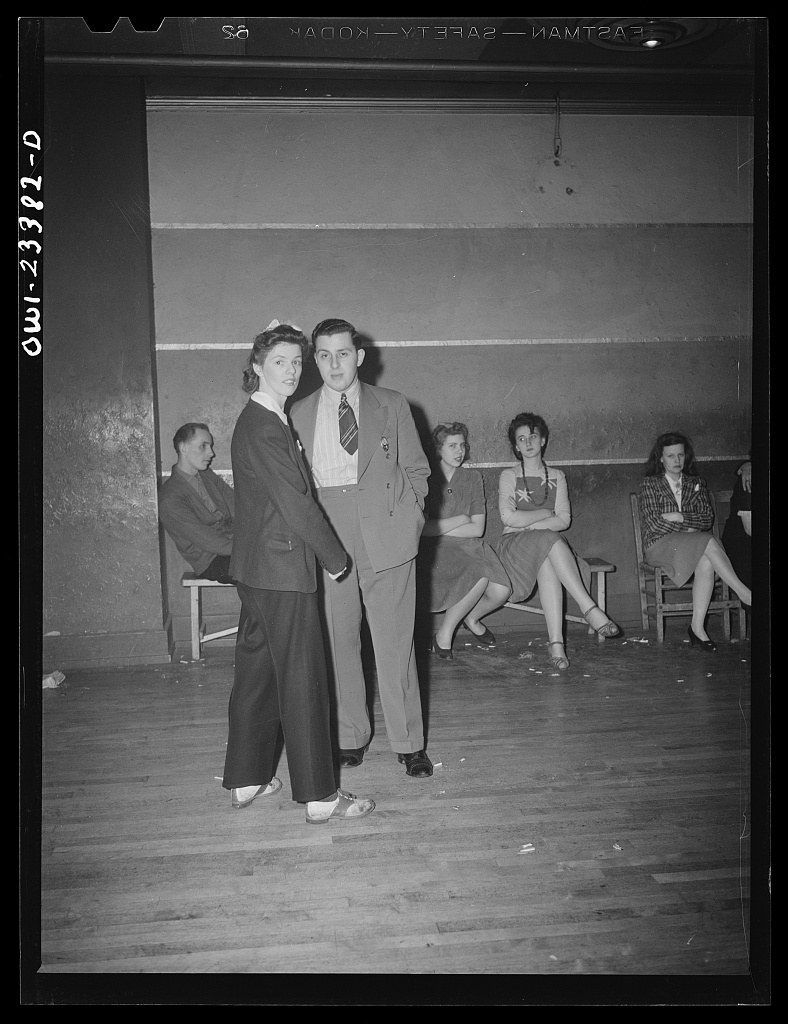
Buffalo, New York. Swing shift dance held weekly at the Main-Utica ballroom from midnight to four a.m.
Unknown artist
- Collection:
- Prints & Photographs
- Source:
- Library of Congress
- Rights:
- Rights vary by item — check the source record before reusing this image. Source record ↗
- Recorded as:
- Library of Congress — no known restrictions (verify per item)
Swing dancing during World War II was not a niche practice—it was the mainstream social dance of American working people. This photograph is evidence that swing was danced in everyday wartime contexts by ordinary citizens, not just in famous jazz clubs or theatrical settings. It shows the gender dynamics, the open partnership style, and the watched/watching culture of social swing dancing at a specific historical moment.
What you are looking at
A black-and-white photograph captures a swing dance in progress at the Main-Utica ballroom in Buffalo, New York, during a swing shift dance event held between midnight and four a.m. In the center foreground, a couple executes a swing move: the man, dressed in a light-colored suit jacket and tie, leads while the woman in a dark jacket and light-colored trousers responds to his lead. Her body is angled away from his, captured mid-movement. In the background, five seated figures—men and women in 1940s dress—watch from wooden chairs arranged along the wall. The setting is a simple wooden dance floor with plain walls, typical of a working-class wartime dance venue. The fluorescent or bare overhead lighting is harsh and even, characteristic of institutional or commercial dance halls of the era.
The dancing
The lead dancer (man) faces the camera directly, his upper body upright and controlled, left arm extended. The follow dancer (woman) is positioned to his right, her body angled away in a classic swing position, her left arm raised and connected to his lead. Both dancers appear to be mid-turn or mid-step; the woman's weight is clearly shifted and mobile. The five seated onlookers sit with attentive posture, watching the couple. The dancers maintain the characteristic open position of swing, with space between their bodies and extended arm connections rather than the closed ballroom hold.
The dance depicted
This is unambiguously swing dancing, most likely Lindy Hop or a related East Coast Swing variant popular in American dance halls during the 1940s. Swing was the dominant social dance of the swing era (late 1930s–1940s), and a wartime swing shift dance would have been a standard recreation for factory workers and military-adjacent populations. The photograph documents vernacular swing as it was danced in working-class settings, not in theatrical or competition contexts. The open position, the woman's responsive body alignment, and the lead-follow dynamic are all characteristic of social swing dancing of this period.
How it was made
This is a gelatin silver print photograph, identifiable by its tonal range, grain structure, and the archive reference number printed on the film edge. The harsh overhead lighting and direct documentary approach suggest this was made by a professional press or government photographer, consistent with the Library of Congress Prints & Photographs collection attribution. The black-and-white medium was standard for news and documentary photography of the 1940s and allowed for rapid reproduction and distribution. The straightforward frontal composition and lack of artistic posing indicate this was captured as a documentary record of wartime social life rather than as fine art.
About this work
This photograph documents social swing dancing in a wartime American dance hall—a major democratic leisure practice of the 1940s. The Main-Utica ballroom's swing shift dances were night-time social events for workers on rotating factory schedules during World War II, when such dances served as community gathering points and romantic opportunities. The image captures both the dancers themselves and the audience dynamic, showing swing as a participatory social practice rather than a performance art. It is a primary historical document of how ordinary Americans danced during the war years and how swing functioned as vernacular culture in working-class urban settings.
How to look at it
Watch the woman's body alignment: she is angled away from her partner, a key feature of swing's open frame that allows for rapid footwork and spins. Notice the spatial relationship between the dancers—they are connected primarily through the extended arm lead, not through a close hold, which is what distinguishes swing from ballroom dances like the waltz. Observe the seated onlookers: they are not passive; they are waiting their turn to dance, part of the social rhythm of the dance hall. The harsh overhead lighting and documentary framing were typical of 1940s press and government photography, which prioritized information over artistic composition.
The artist
The photographer is not identified in the catalogue record. The photograph carries an archive reference number on the film edge (OWI-23922-D) suggesting it may have been taken by a photographer working for a government agency such as the Office of War Information (OWI), which employed photographers to document American home-front life during World War II. Such photographs were often made without individual artist attribution and were treated as documentary records rather than authored artworks.
The period
The swing era (roughly 1935–1946) coincided with the Great Depression's end and World War II. Swing dancing was the popular music and dance form of the era, performed in dance halls, ballrooms, and nightclubs across America. During the war, swing served as a morale booster and social outlet for industrial workers and military personnel. The photograph dates to 1943, the height of American wartime industrial production, when swing shift factory work and swing dancing were deeply intertwined in working-class urban culture. Swing dancing was also beginning to be documented by government photographers as part of the visual record of American life during the war.
Where it lives
This photograph is held by the Library of Congress Prints & Photographs Online Catalog (LOC). The archive reference number OWI-23922-D suggests it was part of the Office of War Information collection, a major government photographic documentation project during World War II. It circulated as a documentary record and historical document rather than as fine art, which explains the straightforward documentary style.
Dance in this work
Questions about this work
What is a swing shift dance?
Swing shift dances were social events held in dance halls and ballrooms for workers on rotating night factory shifts, particularly during World War II. They were typically held late at night (midnight to 4 a.m. in this case) to accommodate workers' schedules. These dances served as crucial social and recreational outlets for industrial workers and military-adjacent populations, combining the era's most popular dance (swing) with wartime community building.
Is this Lindy Hop?
Very likely. The open-frame position, the woman's angled stance, and the extended arm lead are all characteristic of Lindy Hop or closely related East Coast Swing variants. However, the photograph does not show enough detail of the footwork to be completely certain. During the 1940s, 'swing dancing' was a broad category that included several related styles, all danced to jazz and big-band music in social settings.
Who danced at the Main-Utica ballroom?
The catalogue record identifies this as a 'swing shift dance held weekly,' which indicates it was organized for factory workers, many of them women who entered the industrial workforce during World War II. The photograph shows a diverse group of onlookers, suggesting the dance hall served a cross-section of Buffalo's working-class population.
Why is this a photograph and not a painting or drawing?
By 1943, photography was the dominant medium for documentary and news imagery. Government agencies like the Office of War Information used cameras to record American home-front life. Photography's directness and reproducibility made it ideal for documentary purposes. This photograph is part of a larger archival project to visually document how Americans lived and socialized during the war years.
More dance artwork