49 works in this view — arrow keys or swipe to move between them.
Dance in Art
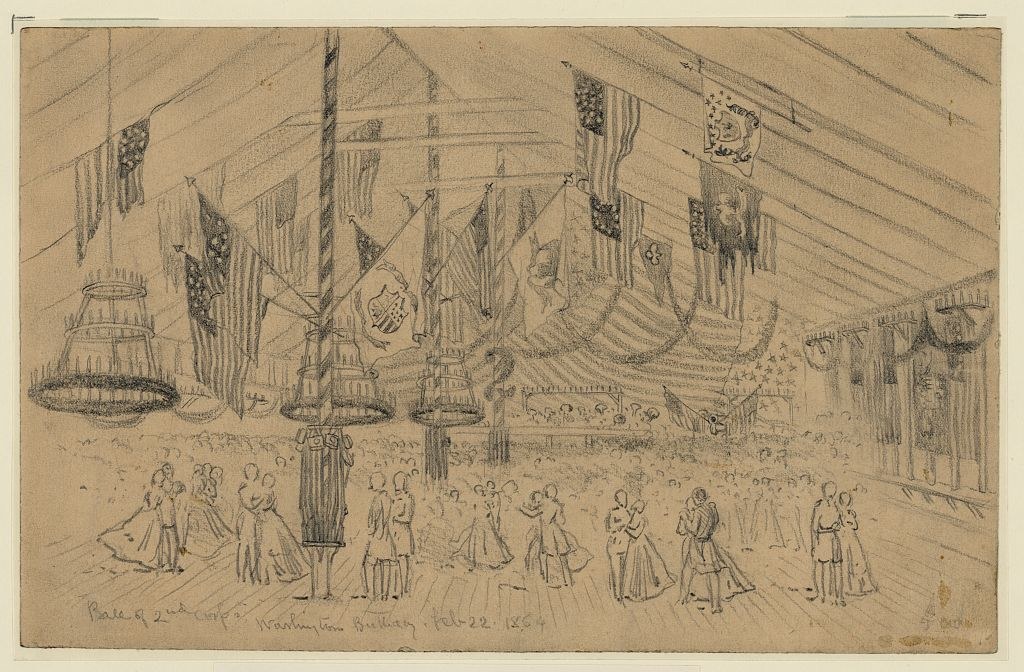
Ball of 2nd Corps--Washington's birthday
Unknown artist
- Collection:
- Prints & Photographs
- Source:
- Library of Congress
- Rights:
- Rights vary by item — check the source record before reusing this image. Source record ↗
- Recorded as:
- Library of Congress — no known restrictions (verify per item)
This sketch provides rare visual evidence of how the American military during the Civil War maintained ballroom dancing traditions as a social practice, integrating it into military life during wartime. For dance historians, it documents the persistence of formal European ballroom conventions in mid-nineteenth-century American military society, and the gendered social dynamics of officer culture. For military and social historians, it records the logistics and aesthetics of morale-building during the Civil War.
What you are looking at
A large indoor celebration in what appears to be a tent or temporary structure, with a vaulted canvas ceiling supported by poles and crisscrossed by ropes and hanging bunting. Numerous American flags and patriotic bunting drape from the ceiling and walls. The floor is crowded with figures in period dress—men in military uniforms and civilian coats, women in full-skirted dresses typical of the 1860s—distributed across the space in small clusters and pairs. Chandeliers or hanging lamps illuminate the scene. The composition suggests a formal military ball or celebration, with dancers and socializers mingling throughout. The sketch captures the energy and informality of the moment, with figures at various distances creating spatial depth.
The dancing
The figures are rendered in quick, economical lines that convey stance and silhouette rather than anatomical detail. Many stand in pairs or small groups; some appear to be in closed ballroom hold or social proximity. The women's dresses show full skirts typical of 1860s fashion. The men wear what appear to be military dress coats. The gestures suggest conversation and social interaction as much as active dancing, with bodies oriented toward one another and arms loosely positioned. The drawing style captures the informality and flux of a social gathering rather than the precision of a choreographed performance.
The dance depicted
This depicts a formal social dance, most likely a waltz, quadrille, or other ballroom dance typical of American military society in 1864. The title and date indicate this was a Washington's birthday celebration held by the 2nd Army Corps during the Civil War, suggesting officers and enlisted men in a moment of leisure and morale-building during wartime. The mixed social grouping and the scale of the gathering suggest multiple dances and social forms happening simultaneously. The close quarters and informal clustering indicate this was a working soldier's dance rather than a civilian ballroom event, with the emphasis on participation and social bonding.
How it was made
This appears to be a pencil sketch on paper, executed with rapid, confident line work that prioritizes composition and narrative over fine detail. The artist has used light shading to suggest form and space, particularly in the ceiling and chandeliers. The sketchy, unfinished quality suggests this may be a field sketch or study made on or near the occasion it depicts, rather than a finished work intended for exhibition. The technique allows the artist to capture the energy and scale of the scene efficiently, and the informal finish is consistent with military or journalistic documentation of the period.
About this work
This is a pencil sketch documenting a formal ball held by the 2nd Army Corps during the American Civil War to celebrate Washington's birthday, likely in early 1864. The work captures an important moment in the social history of the Civil War—a rare instance of celebration and leisure within military camp life. The scale of the gathering, the patriotic decoration, and the formal dress suggest an officer-level event intended to maintain morale and unit cohesion. The sketch is valuable as a historical record of how soldiers and officers of the period understood formal social dancing and celebration, and as a document of the material conditions of wartime entertainment.
How to look at it
Observe the distribution of figures across the space: some appear to be in active movement or dance position, while others stand in conversation. Note the women's full skirts, which would have been central to the visual spectacle of dancing at this period. Look at the ceiling decoration—the flags and bunting would have framed any dancer's movement and created a patriotic visual environment. The artist has chosen to show the event as a space rather than to focus on individual dance steps, which tells you that the cultural significance lay in the gathering itself as an assertion of American normalcy and social order during wartime.
The period
During the American Civil War, military balls and formal dances were used as tools to maintain officer morale and unit cohesion, and to assert social continuity in the face of mass violence. The practice reflected the class position of the officer corps and their claim to civilian gentility despite their role in the war. Ballroom dancing in this period was governed by rigid conventions derived from 18th-century European court culture, transmitted through dancing masters and printed instruction manuals. The 1860s saw the waltz at the height of its popularity in American and European ballrooms, though quadrilles and other figures remained standard. The presence of women at a military ball of this scale suggests that the 2nd Corps was encamped near civilian settlements or that officers' wives and local women were brought in for the occasion.
Where it lives
This sketch is held in the Library of Congress Prints & Photographs collection. The catalogue record provides only the title, date, and location; the artist and medium are not recorded in the archive. The sketch's presence in the Library of Congress suggests it was either created as a journalistic or documentary record, or was collected as historical material after the war.
Dance in this work
Questions about this work
What was the 2nd Army Corps?
The 2nd Army Corps was a major Union infantry unit in the Eastern Theater of the American Civil War, commanded at various times by Major Generals Israel Richardson, Darius Couch, and Winfield S. Hancock. It was one of the most celebrated units in the Army of the Potomac and fought at Gettysburg, Antietam, and other major battles.
How did soldiers during the Civil War get women to dance with?
Military balls typically drew women from nearby towns and settlements, and officers' wives. In cases where the army was encamped near populated areas for extended periods, local women would attend. In some cases, soldiers in camp dances danced with each other, with some taking the female role.
What dances would have been done at a military ball in 1864?
The waltz was the most fashionable dance of the period, but quadrilles, lancers, cotillions, and other figure dances were also standard. Military balls often included a mixture of forms, allowing both skilled dancers and novices to participate.
Why did the Civil War army celebrate Washington's birthday?
Washington's birthday (February 22) was a major patriotic holiday in the 19th century, observed in both North and South. Military units, especially in the Union Army, held formal celebrations to assert loyalty to the Union and to boost morale during the long winter encampments.
More dance artwork