49 works in this view — arrow keys or swipe to move between them.
Dance in Art
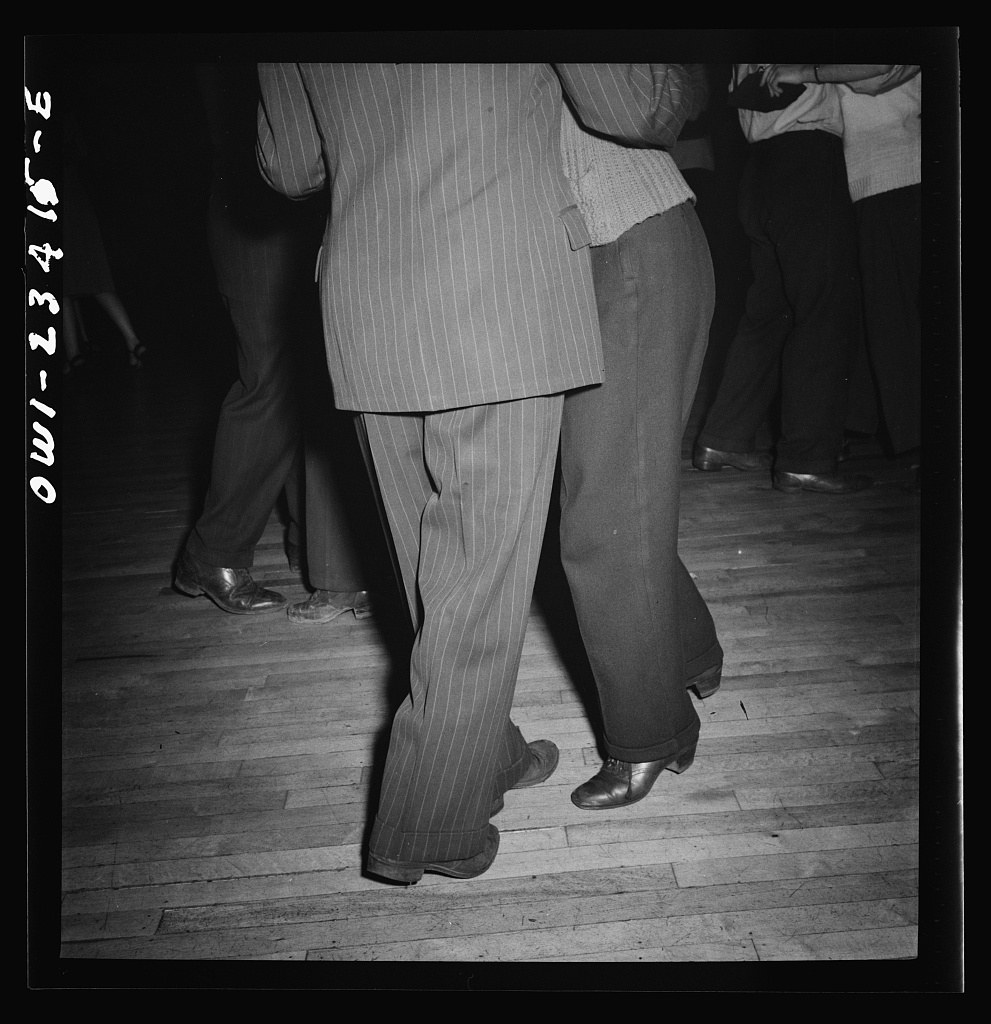
Buffalo, New York. At the swingshift dance held weekly from midnight to four a.m. at the Main-Utica ballroom
Unknown artist
- Collection:
- Prints & Photographs
- Source:
- Library of Congress
- Rights:
- Rights vary by item — check the source record before reusing this image. Source record ↗
- Recorded as:
- Library of Congress — no known restrictions (verify per item)
This photograph is a rare documentary record of how swing dancing was actually executed on a public floor by non-professionals during its peak era. Rather than theatrical representation or competition footage, it shows the vernacular practice—the weight, the footwork, the crowding, the social context—that defined swing for ordinary dancers. For historians of American dance and social life, it is evidence of how the body moved, what the dance felt like to execute in real time, and who participated.
What you are looking at
A black-and-white photograph captures a dance floor at the Main-Utica ballroom in Buffalo during a swing-shift dance. The image focuses on the lower bodies and feet of multiple dancers in motion. The central figure wears a light-colored pinstriped suit with wide-legged trousers; their partner wears dark stockings and a dark shoe. The wooden dance floor stretches across the frame, marked by the dancers' positions and the geometry of their stance. Other dancers are visible at the edges—one in dark trousers at left, figures in dark clothing at the top of the frame—suggesting a crowded venue. The photograph is framed at torso and foot level, emphasizing the dancers' lower bodies and footwork rather than their faces or upper bodies. The flash photography casts sharp shadows and creates high contrast, characteristic of documentation shot in the early 1940s.
The dancing
The primary couple occupies the center of the frame in what appears to be a closed or semi-closed ballroom hold, with weight distributed across both feet in a forward-moving position. The man's pinstriped suit and wide trousers suggest a relaxed, social posture rather than the stiff formality of competition. The woman's stance indicates she is following, her weight shifted to accommodate the lead. The footwork visible suggests a traveling step pattern—the feet are separated and the bodies angled in a way consistent with a forward-progressing swing or jazz-influenced social dance. The composition privileges the mechanical action of the dance—where feet go and how bodies traverse the floor—over the dancers' facial expressions or torso work.
The dance depicted
This photograph documents swing dancing or jazz-influenced ballroom social dancing as practiced in an industrial American city during World War II. The swing-shift context—midnight to four a.m., weekly at a public ballroom—indicates this was working-class recreation, likely drawing factory workers and their partners. The style visible here is Lindy Hop or East Coast Swing adapted for crowded floor dancing, characterized by the traveling two-step and the weight-forward momentum visible in the dancers' positioning. The relaxed suit and the social ballroom setting suggest vernacular American swing rather than competition or theatrical choreography. The photograph is documentary evidence of how ordinary people danced together in the early 1940s, when swing was the dominant popular dance.
How it was made
This is a gelatin silver photograph, likely taken with flash photography given the sharp contrast and strong shadows visible on the wooden floor. The printing is from the Library of Congress Prints & Photographs collection and bears a catalogue reference number on the negative. The flash technique allowed the photographer to capture fast-moving bodies in an interior venue with limited ambient light, freezing the moment sharply enough to see foot position and stance detail. The framing choice—shooting from torso down—suggests this was documentary work focused on capturing the dancing itself rather than the dancers as individuals, consistent with New Deal-era photography projects that documented American social life and labor.
About this work
This photograph documents a swing or jazz ballroom dance at the Main-Utica ballroom in Buffalo in 1943, captured during one of the venue's weekly late-night swing-shift dances. The image prioritizes the mechanics of social dancing—footwork, weight transfer, and body positioning—over the individual dancers, using close framing and flash photography to record how ordinary Americans moved together during the swing era. The pinstriped suit, wide trousers, and wooden ballroom floor place it firmly in wartime urban American social dance, a moment when swing was the dominant popular form and public ballrooms were centers of working-class recreation.
How to look at it
Attend to the footwork and weight distribution visible in the positioning of the dancers' feet and legs. The man's forward step and the woman's responsive positioning show the fundamental mechanics of lead and follow in swing dancing. Notice the space between the partners' bodies—this is not a tight standard ballroom hold but a more relaxed social one, adapted for a crowded floor. The wide trousers and the angle of the bodies reveal the traveling pattern and the momentum of the dance. The fact that the photographer chose to shoot from the knees down is itself significant—it prioritizes movement and footwork over expression, implying that the story of the dance is in how the body travels through space.
The artist
The photograph is uncredited. It was acquired by the Library of Congress Prints & Photographs collection, likely as part of a systematic documentation project of American life during the 1940s. The framing and technique suggest a photographer trained in documentary practice, but without signature or artist attribution in the record, the maker remains unknown.
The period
Swing dancing reached its cultural peak in the early 1940s, even as World War II reshaped American labor and leisure. The midnight-to-four-a.m. timing of this dance reflects wartime industrial shift work; such venues became crucial social spaces for workers whose schedules did not align with daytime society. Swing was simultaneously mainstream popular culture—broadcast on radio, danced in films—and lived social practice in ballrooms, dance halls, and juke joints. Buffalo, as an industrial center, would have supported numerous such venues. The photograph documents swing not as performance or art form but as the ordinary recreation of working people.
Where it lives
The photograph is held by the Library of Congress Prints & Photographs Online Collection. It bears a catalogued reference number on the film negative. It is likely part of a larger documentary project from the 1940s, possibly a WPA or Office of War Information initiative, though this has not been confirmed in the available record.
Dance in this work
Questions about this work
How do I know this is swing dancing and not another ballroom style?
The traveling step, the forward-moving body position, the weight distribution, and the relaxed (rather than stiffly formal) posture all point to swing or East Coast Swing rather than standard ballroom forms like waltz or foxtrot. The social ballroom context and the early 1940s date support this; swing dominated American social dance during this period. The wide trousers and the angle of the bodies show the kind of momentum and propulsion characteristic of swing rather than the vertical carriage of classical ballroom.
Why is the photograph framed at knee level rather than showing the whole dancers?
This framing choice—focusing on footwork and lower body—was deliberate documentary practice. It emphasizes the mechanics of the dance: where feet go, how weight transfers, how bodies move through space. By cropping out faces and upper bodies, the photographer makes the movement itself the subject, not the individuals or their expressions. This approach was common in 1940s social documentation.
What does 'swing-shift dance' mean?
A swing-shift dance was a social dance held at times aligned with industrial night-shift work. The midnight-to-four-a.m. timing at Main-Utica was designed for factory workers whose shifts fell outside normal business hours. Such dances were crucial venues for working-class socializing, particularly during World War II when industrial production ran around the clock. They represent a specific moment in American labor and leisure history.
Is this a professional or amateur dance?
This is amateur social dancing—vernacular swing executed by ordinary people on a public dance floor, not professional dancers or choreography. The relaxed posture, the crowded floor, the social ballroom context, and the working-class timing all indicate this is how swing dancing was practiced by non-professionals as popular recreation and courtship.
More dance artwork





