49 works in this view — arrow keys or swipe to move between them.
Dance in Art
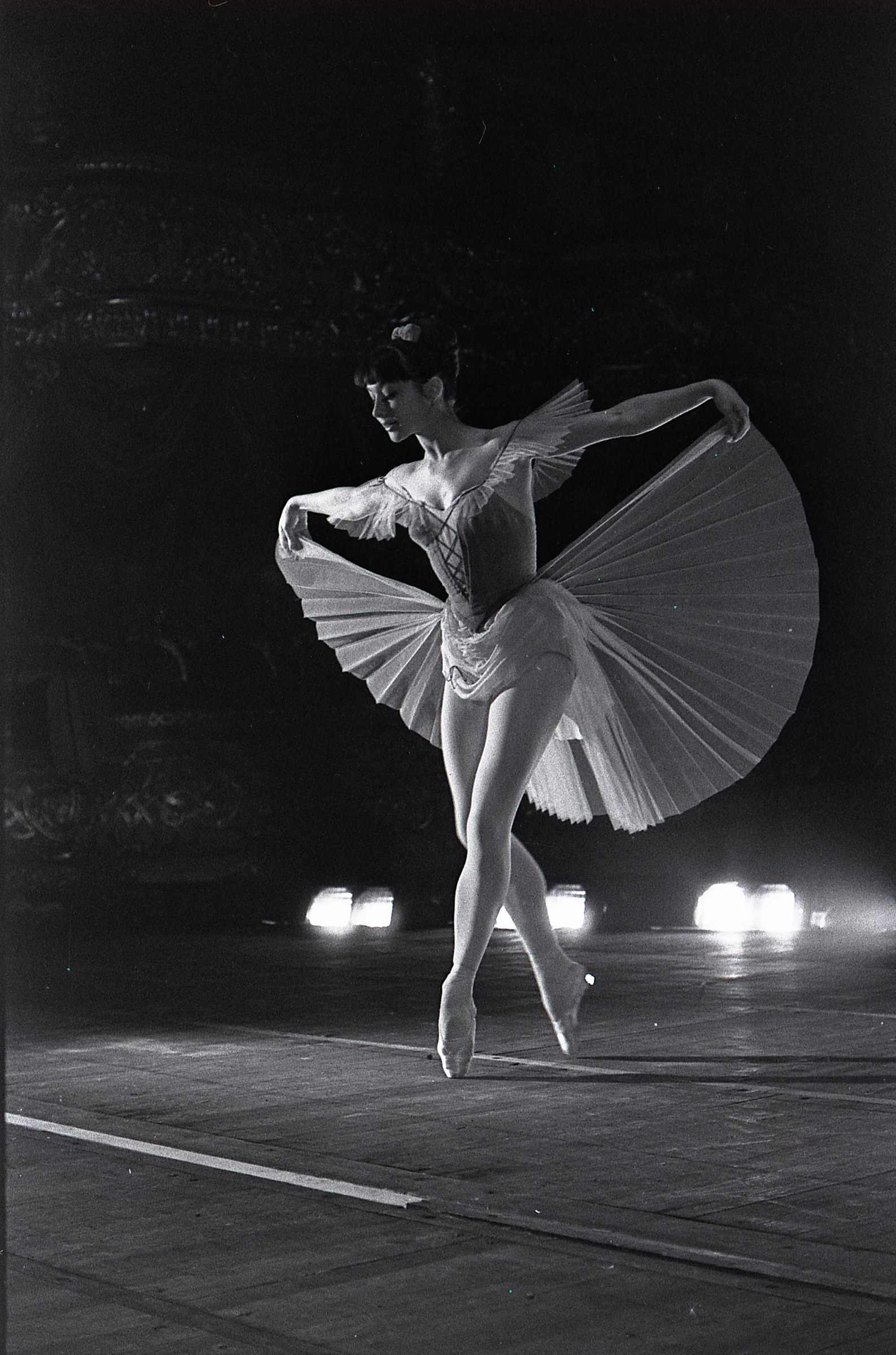
Ekaterina Maximova's "Mazurka".
Unknown artist
- Collection:
- Prints & Photographs
- Source:
- Library of Congress
- Rights:
- Rights vary by item — check the source record before reusing this image. Source record ↗
- Recorded as:
- Library of Congress — no known restrictions (verify per item)
Ekaterina Maximova was one of the leading prima ballerinas of the Soviet Bolshoi Ballet, and this photograph documents her performance of a classical solo during the height of her career. The image is valuable for showing how classical ballet vocabulary was being performed and presented in Soviet theatre during the 1960s, and as a portrait of a major 20th-century dancer in the act of performance.
What you are looking at
A solo female dancer in classical ballet costume performs against a dramatically lit black background. She stands on pointe in a balletic pose, her body rising from the stage floor which is marked by a thin white line. She wears a white tutu of moderate length and a fitted bodice with short sleeves; her dark hair is pinned up in the classical style. Her right leg is extended in a controlled arabesque or attitude position, while her left arm reaches forward in a graceful arc. The lighting is theatrical and precise, catching the luminosity of her costume and skin while the background recedes into deep shadow. Small spotlights or floor lights are visible at the bottom edge of the frame, suggesting a professional theatre setting. The composition isolates the dancer as a solitary figure, emphasizing the technical precision and ethereal quality of her movement.
The dancing
A single female dancer on pointe, her weight supported on her left leg while her right leg extends in what appears to be an arabesque or attitude derrière. Her torso is held in strict vertical alignment, the hallmark of classical ballet training. Her arms are positioned in port de bras, with one arm reaching forward and outward in a lyrical curve. Her head is held with the refined carriage expected in classical technique—not lowered but lifted and turned slightly to follow the line of her arm. The pose suggests a moment of sustained extension rather than dynamic movement, capturing a held position within a choreographed phrase.
The dance depicted
This is a classical ballet performance, most likely from a formal theatrical production. The dancer's execution—the turned-out hip position, the lifted supporting leg, the precise épaulement, and the ethereal arm carving through space—are unmistakably Russian Imperial or Soviet classical ballet technique. The pose and costume are consistent with romantic or classical-era ballet vocabulary. The title references Mazurka, which suggests this may be a solo from a ballet featuring character or divertissement material (such as *Swan Lake*, *The Sleeping Beauty*, or a standalone choreographic piece), though the dancer's classical vocabulary and formal presentation suggest a theatrical context rather than a social dance recreation.
How it was made
This is a black-and-white photograph, likely taken during a live theatrical performance or a dedicated studio session. The high contrast and dramatic lighting are characteristic of mid-20th-century theatre photography, where photographers worked with available stage lights to capture performers. The technical quality—sharp focus on the dancer's upper body and face, careful composition, and controlled exposure—indicates professional documentation, possibly for archival or promotional purposes. The photograph's grain and tonal range are consistent with film stock from the 1960s.
About this work
This is a documentary photograph of a classical ballet performance by a Russian or Soviet dancer, likely Ekaterina Maximova, capturing a single moment of sustained elegance in a solo known as 'Mazurka.' The image exemplifies the aesthetic principles of Russian Imperial ballet—technical precision, spiritual uplift, and the illusion of weightlessness—and documents both the dancer's artistry and the theatrical apparatus that surrounded such performances. As a mid-century photograph of a major ballet artist, it serves as a record of Soviet dance practice and the enduring appeal of classical ballet technique in the latter half of the twentieth century.
How to look at it
Attend to the moment the photographer chose: not a dramatic jump or sharp turn, but a moment of stillness and extension that reveals the dancer's line and her command of the ballet vocabulary. The dramatic sidelighting emphasizes the three-dimensionality of the pose—the extension of the working leg, the lift of the torso, the carving of the arms through space. Notice how the theatrical lighting creates an almost sculptural effect, isolating the dancer and drawing attention to the geometry and grace of her body. The white line of the stage floor and the small ground lights anchor the figure in theatrical space while the darkness around her creates an almost dreamlike, timeless quality.
The period
The photograph dates to 1968, a period when Soviet ballet was at the height of its international prestige and influence. The Bolshoi Ballet was actively touring the West, and Soviet training methods had become a global standard. Classical ballet technique itself was undergoing subtle evolution during this period, influenced by choreographers like George Balanchine and by the introduction of contemporary movement into classical vocabularies. In theatrical photography, this period saw increasing sophistication in stage documentation, with photographers developing techniques to capture the lighting and spatial dynamics of live performance.
Where it lives
This photograph is held in the Prints & Photographs collection of the Library of Congress. It is a professional theatrical photograph, likely created as documentation of a Bolshoi Ballet performance or rehearsal.
Dance in this work
Questions about this work
Who was Ekaterina Maximova?
Ekaterina Maximova (1939–2009) was one of the foremost prima ballerinas of the Soviet Bolshoi Ballet, renowned for her technical brilliance, dramatic expressiveness, and long partnership with dancer Vladimir Vasiliev. She was a major figure in Soviet ballet during the Cold War and performed extensively on international tours.
What is a 'Mazurka' in ballet?
A mazurka is a character dance in ballet based on the Polish folk dance of the same name. It is a lively, syncopated dance traditionally performed in ballet divertissements or as a character solo. The dance appears in classical ballets like *Swan Lake* and *The Sleeping Beauty*. In a theatrical context, it showcases a dancer's ability to perform character technique alongside classical technique.
What does the pose in this photograph tell us?
The sustained arabesque or attitude position shown here demonstrates the dancer's control, line, and understanding of classical ballet vocabulary. The stillness of the pose—rather than a moment of dynamic movement—allows the viewer to assess the dancer's technique: the turnout of the hip, the lift of the supporting leg, the carriage of the upper body, and the quality of the port de bras.
More dance artwork





