49 works in this view — arrow keys or swipe to move between them.
Dance in Art
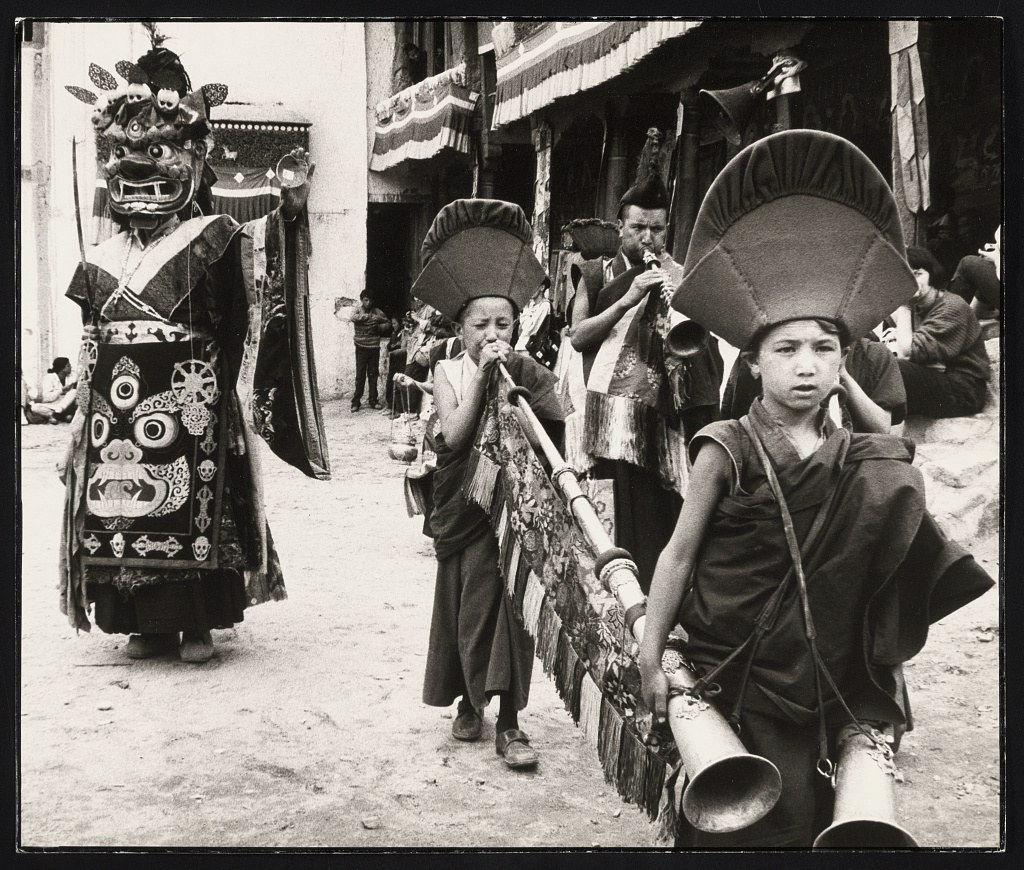
Dance ceremony in the courtyard of a monastery with lamas dancing traditional dances
Unknown artist
- Collection:
- Prints & Photographs
- Source:
- Library of Congress
- Rights:
- Rights vary by item — check the source record before reusing this image. Source record ↗
- Recorded as:
- Library of Congress — no known restrictions (verify per item)
Tibetan lama dances represent one of the world's most distinctive ritual performance traditions, yet they are often absent from dance histories focused on theatrical genres. This photograph is direct evidence of how these dances were actually performed—the scale of the masks, the use of sound and instruments, the participation of young initiates, and the architectural setting all emerge from the image. For historians of sacred dance and for those seeking to understand non-Western performance traditions, this is primary source material.
What you are looking at
A procession moves through a narrow courtyard lined with traditional Tibetan architecture. The photograph captures a moment of ceremonial movement, with figures in dark robes and distinctive tall headdresses processing along a dusty ground. At the left, a large mask or ceremonial head dominates—a fierce deity figure with elaborate ornamentation, round eyes, and an ornamental headdress, worn or carried by a figure whose body is obscured by an elaborate costume covered in circular motifs and decorative elements. In the center and right foreground, younger figures in burgundy robes and matching tall, fan-like headdresses play long horns; their mouths are actively engaged with the instruments, and their bodies are upright and formal. The headdresses are substantial structures, rising high above the dancers' heads in a distinctive shape. Behind them, other robed figures process, some visible only partially in the darker recesses of the covered walkway. The light is bright but directional, creating strong shadows that emphasize the three-dimensionality of the scene and the depth of the space. The composition is candid but clearly documents a significant ceremonial moment.
The dancing
The dancers stand in an upright, formal posture throughout, their bodies aligned vertically. The horn players maintain an engaged but stationary stance, their arms raised to bring the long instruments to their mouths, their frames open and shoulders back. There is no evidence of rapid footwork or traveling movement in the visible dancers; the procession moves as a unit with dignity and deliberation. The figures wearing the large headdresses demonstrate balance and control, supporting the substantial weight of the costume elements. The choreography appears processional and meditative rather than dynamic—bodies move together as a ritual group rather than as individual performers, and the focus is on the collective movement and the ceremonial objects.
The dance depicted
This is a Tibetan Buddhist monastic dance ritual, most likely a form of ceremonial lama dance associated with religious festivals and temple practices. The masked figure represents a wrathful deity, a central element of Tantric Buddhist ritual. The young monks playing the long horns (possibly dungchen or similar temple instruments) are performing their role within a larger ceremonial sequence. Tibetan monastic dances function as ritual actions—part meditation, part theater, part invocation—rather than secular entertainment. The formality of the posture, the use of religious objects and masks, and the procession through sacred space all indicate this is performative ritual with deep spiritual significance. The horns, headdresses, and masks are not decoration but essential liturgical elements.
How it was made
This is a black-and-white photograph, likely taken in the mid-to-late twentieth century based on the film grain and tonal range visible in the print. The photograph appears to be a documentary record—a straightforward, observational capture of an actual ritual event rather than a composed studio image. The print quality and the photographic conventions suggest this was made by a journalist or ethnographic photographer. Photography allowed access to ritual events that painting or drawing could not as readily capture, and photographic documentation of Tibetan religious practices became increasingly important in the twentieth century as a record of cultural traditions.
About this work
This photograph documents a ceremonial dance ritual performed by Tibetan Buddhist monks in a monastery courtyard. The image captures a formal procession of religious dancers and musicians, featuring a masked deity performer and horn-playing monks in full ceremonial dress. The work is significant as a documentary record of an actual religious ritual—not a reenactment or artistic interpretation, but evidence of how Tibetan monastic dance functioned as spiritual practice and liturgical performance. The photograph belongs in a dance archive as a key example of sacred-ceremonial dance practice outside the European theatrical tradition, and as testimony to a form of dance deeply embedded in religious cosmology and monastic life.
How to look at it
Observe the stillness and verticality of the dancers' posture—this is not movement-based performance but presence-based, where the act of wearing and inhabiting ritual costume and masks is itself the dance. Notice the hierarchy and formal arrangement: the large masked figure commands attention, and the horn players occupy a distinct role as musicians-performers. Look at the faces of the young monks visible in the image; their concentration and formality speak to the seriousness of their participation. The photograph captures not a moment of climactic movement but a sustained state—the procession is deliberate, and the power lies in repetition and ritual structure rather than kinetic surprise.
The artist
The photographer is not recorded in the catalogue. The image comes from the Library of Congress Prints & Photographs collection, suggesting it may be from a news archive or systematic ethnographic documentation project. The style and composition suggest professional documentary practice rather than casual tourism photography.
The period
This photograph was taken in 1988, a significant moment in Tibetan history. The late 1980s saw renewed openness to documentation and limited tourism to Tibetan monasteries following China's relaxation of certain cultural restrictions. By 1988, many Tibetan religious practices had been suppressed or interrupted for decades; this photograph may document a revival or reinstatement of ritual practices. In the global dance world of the 1980s, Western interest in non-Western performance traditions was growing, and photographic documentation of such practices was becoming more systematic and valued as anthropological record.
Where it lives
The photograph is held in the Library of Congress Prints & Photographs Online Catalog. It is catalogued as documentary photography from a 1988 expedition or documentation project. The minimal catalogue record suggests the work was acquired as part of a larger collection rather than as an individually significant artifact.
Dance in this work
Questions about this work
What are the tall headdresses the young dancers are wearing?
These are ceremonial headdresses specific to certain Tibetan Buddhist ritual roles. They are constructed from felt or fabric and stiffened into a distinctive tall, fan-like shape. They are not costume decoration but liturgical objects that signify the wearer's role in the ritual performance. The headdresses are worn by initiates or young monks during specific ceremonial dances and require balance and control to wear.
What is the masked figure?
The large masked figure represents a wrathful deity—a manifestation of enlightened power in Tibetan Buddhism used to invoke protection and dispel obstacles. The masks used in lama dances are considered sacred objects, not theatrical props. The wearer becomes a vehicle for the deity during the ritual performance. The elaborate ornamentation and fierce expression are intentional and cosmologically significant.
How is this different from theatrical dance?
Tibetan monastic dances are primarily ritual and spiritual practices rather than entertainment. They are performed in sacred space, by initiated participants, as part of religious ceremonies and festivals. The purpose is not to tell a story or demonstrate technique but to enact ritual and invoke spiritual presence. The performers may or may not have received systematic training in codified technique; what matters is their role as ritual practitioners.
Why were so few details recorded about this photograph?
The minimal catalogue record is typical of documentary and ethnographic photographs, especially those acquired en masse into institutional collections. The focus was on the subject matter—the ritual event itself—rather than on the photographer's identity or artistic intent. The photograph was likely valued as evidence or record rather than as a work of artistic creation.
More dance artwork





