49 works in this view — arrow keys or swipe to move between them.
Dance in Art
Tablita Dance [D]
Unknown artist
- Collection:
- Prints & Photographs
- Source:
- Library of Congress
- Rights:
- Rights vary by item — check the source record before reusing this image. Source record ↗
- Recorded as:
- Library of Congress — no known restrictions (verify per item)
This photograph documents Pueblo ceremonial tradition at a moment when such practices were being actively recorded by external observers, making it valuable as historical evidence of early 20th-century Pueblo cultural life. It also exemplifies the particular limitations of still photography as a medium for capturing dance—the image shows participants and context but cannot convey the movement, rhythm, and embodied knowledge that constitute the actual Tablita Dance. For dance historians and Indigenous communities, it raises important questions about how photography has served both to preserve and to flatten the documentation of living ceremonial traditions.
What you are looking at
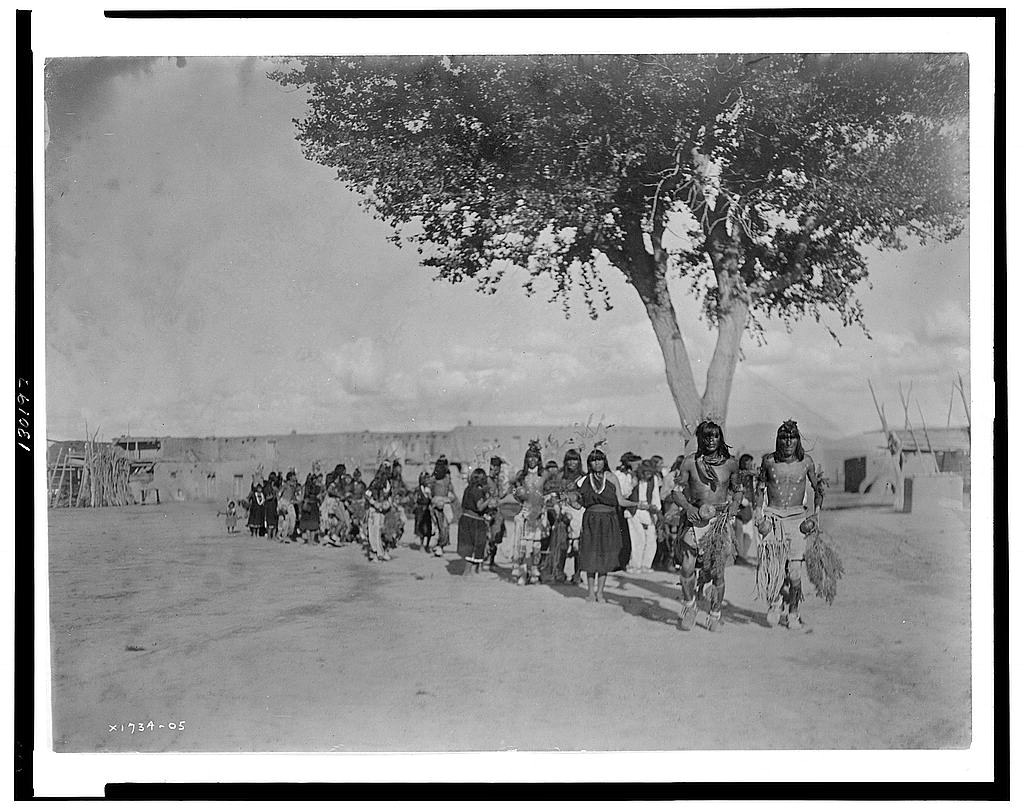
A large group of Native American figures gathers in bright sunlight beneath a spreading tree with dense foliage, set in an arid landscape with sparse buildings visible in the distance. The composition is anchored by the tree's strong vertical trunk and expansive canopy, which casts sharp shadows across the sandy ground. In the foreground, several figures in traditional dress stand prominently—two tall figures in elaborate regalia with feathered headdresses and decorated clothing dominate the right side, while behind them stretches a crowd of men, women, and children in various states of traditional and transitional clothing. The photograph captures what appears to be a gathering or ceremony, with figures arranged both standing and in motion, suggesting ongoing activity rather than a posed tableau. The image quality, grain, and black-and-white rendering are consistent with early 20th-century documentary photography.
The dancing
The two foreground figures on the right display upright, formal posture with arms at their sides, facing toward or moving through the gathered crowd. Their bearing is stiff and ceremonial rather than dynamic. The assembled group behind them shows varied stances—some standing at rest, others appearing to shift or turn. The overall arrangement suggests processional or gathering movement rather than coordinated dance steps, though the crowd's loose formation and the positioning of the prominent figures hint at structured ceremonial progression. No apparent partner holds or intimate groupings are visible.
The dance depicted
The catalogue identifies this as a Tablita Dance, a Pueblo ceremonial dance tradition. The image shows what appears to be a communal or ceremonial gathering rather than the dynamic mid-movement moment typical of action photography. The Tablita (or Tab-i-ta) is traditionally a women's dance in Pueblo cultures, though this photograph shows a mixed-gender assembly. The upright posture of the two prominent figures and their decorated regalia—particularly the distinctive headdresses—are consistent with Pueblo ceremonial dress, but the static quality of the composition and the gathering format suggest this may document the assembly or preparation for a dance event rather than its active performance.
How it was made
This is a gelatin silver print from an early 20th-century photograph, rendered in black and white with the characteristic grain and tonal range of documentary photography from that era. The outdoor daylight setting and sharp shadows indicate it was taken in natural sunlight, and the wide field of view suggests a fixed camera position rather than close-range work. The medium allowed for detailed documentary record-keeping of ceremonial life at a scale and with an evidential weight that painted or drawn images could not match, though it also imposed the stillness and framing limitations of the photographic process onto inherently dynamic ceremonial events.
About this work
This is a documentary photograph of a Pueblo Tablita Dance gathering, likely made during the early 1900s at or near a pueblo community. The image captures the assembled participants and prominent ceremonial figures in their regalia, providing visual record of community gathering practices and traditional dress. As a photograph rather than a sketch or painting, it represents the wave of early 20th-century ethnographic documentation that began to record Native American ceremonial life in direct visual form, though the still frame necessarily arrests the movement that constitutes the actual dance.
The work matters as both a historical record and a visual artifact of a specific moment in documentary practice—a time when photographers were beginning systematic visual capture of Indigenous ceremonial practices. It shows how external documentation shaped the visual archive of Native American dance, and raises questions about the gap between a photograph of assembled participants and the living, moving practice of the dance itself.
How to look at it
The viewer should note the contrast between the two prominently placed figures in full regalia and the looser, less formally dressed crowd behind them—this may indicate different roles or statuses within the ceremonial gathering. Attend to the formal posture of the central figures and the way the crowd is distributed in space; this arrangement may reflect the actual structure of the ceremony or may be shaped by the photographer's positioning and framing. The bright sunlight and sharp shadows create visual drama but also flatten the dimensionality of the scene; the photograph's documentary clarity masks the fact that we are seeing a moment of stillness extracted from a dynamic, moving ritual.
The period
The photograph dates to 1905, a period of intense anthropological and ethnographic documentation of Native American cultures, often framed within colonial frameworks of preservation and salvage. Early 20th-century photography was being employed systematically by the Bureau of American Ethnology and private collectors to create a visual archive of Indigenous practices. This was simultaneously a moment of significant cultural suppression—the U.S. government had banned many Native American religious and ceremonial practices during this period—making such photographs complex documents that both record living tradition and exist within contexts of surveillance and control.
In the broader history of dance documentation, this photograph predates film technology that would have allowed motion capture, and represents an era when still photography was the primary visual tool for ethnographic recording. The image thus belongs to a transitional moment in how dance could be documented and circulated.
Where it lives
This print is held by the Library of Congress in the Prints & Photographs Online Catalog, as a piece of documentary photography likely made during the early systematic documentation of Native American ceremonial life.
Dance in this work
Questions about this work
Is this actually a Tablita Dance, or just a gathering?
The catalogue identifies it as a Tablita Dance photograph, but the image itself shows assembled participants rather than active dance movement. It may document the gathering before, after, or during a ceremonial event, or the photographer may have captured a moment of processional movement rather than the dance's most visibly dynamic phase. This ambiguity reflects a broader limitation of still photography for dance documentation.
Why are men visible if Tablita is traditionally a women's dance?
Pueblo ceremonial dances are community events with multiple participants and roles, and men may be present as musicians, singers, or ceremonial participants even in dances with women at the center. The photograph shows a communal gathering rather than a moment of only the principal dancers in action.
How does this compare to later dance photography?
Early ethnographic photographs like this one necessarily show static moments and fully clothed participants in outdoor daylight. They differ sharply from the studio dance photography and motion studies that emerged later, which used controlled lighting and often captured movement more dynamically. This image represents a transitional moment in how dance was being visually recorded.
What do the headdresses and regalia tell us?
The elaborate feathered headdresses and decorated clothing visible on the prominent figures are consistent with Pueblo ceremonial regalia and mark those individuals as having significant roles in the ceremony. The varied dress of others in the crowd suggests different levels of ceremonial participation or perhaps different generations' relationship to traditional dress.
More dance artwork





