49 works in this view — arrow keys or swipe to move between them.
Dance in Art
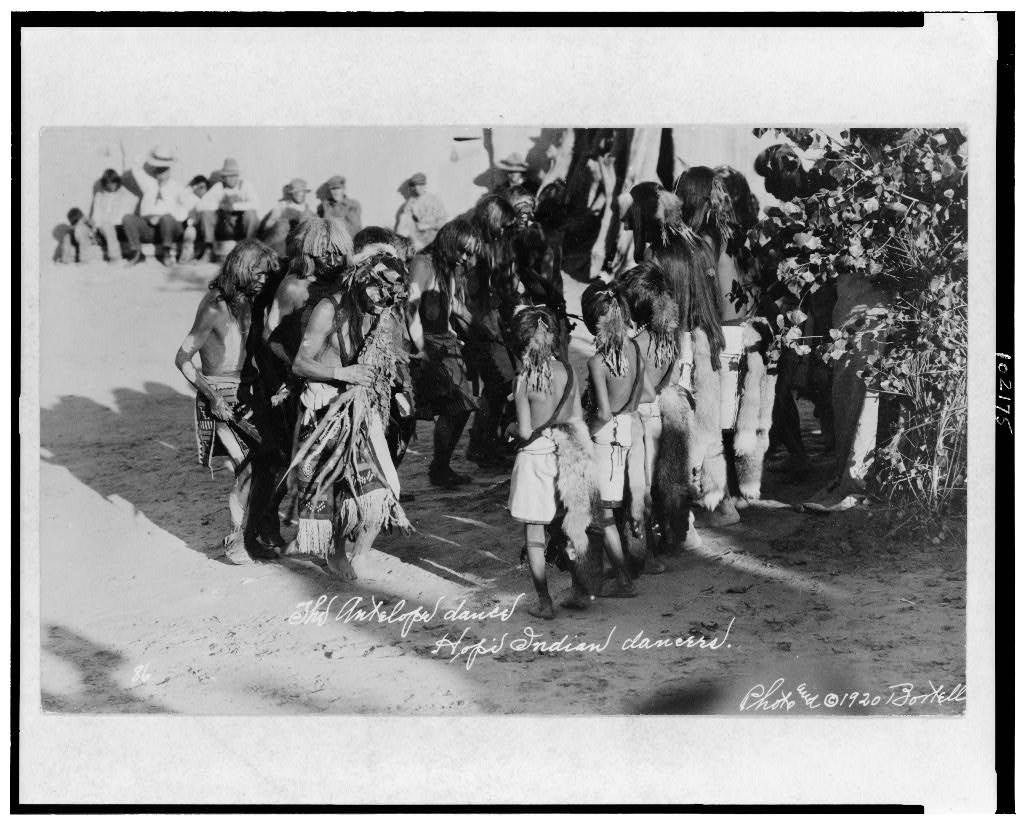
The Antelope dance--Hopi Indian dancers
Unknown artist
- Collection:
- Prints & Photographs
- Source:
- Library of Congress
- Rights:
- Rights vary by item — check the source record before reusing this image. Source record ↗
- Recorded as:
- Library of Congress — no known restrictions (verify per item)
This is primary visual evidence of a living Native American ceremonial dance tradition at the moment before mid-20th-century suppression and revival movements. For dance historians and Hopi cultural practitioners, it documents the specific costuming, grouping, body positions, and social framing of a major ceremonial dance. The photograph is one of relatively few detailed visual records of Hopi dance from the early reservation period.
What you are looking at
A group of Hopi dancers performs outdoors in daylight, photographed from ground level. The foreground shows four figures in traditional costume: two shirtless men with long dark hair wearing decorated kilts or loincloths with geometric patterns, and two figures in lighter garments. Their bodies are positioned in active, forward-leaning postures suggesting rapid movement or a moment of high energy. Behind them, a larger crowd of spectators sits and stands on the ground, some wearing hats typical of early 20th-century dress, watching the performance. The setting appears to be desert or open ground, with sparse vegetation visible at the right edge of the frame. The photograph is taken in bright sunlight, casting strong shadows that emphasize the musculature and movement of the dancers' bodies.
The dancing
The four lead dancers occupy the center of the composition in a loose group formation rather than in rigid line or couple holds. The men are bare-chested with defined physiques, their bodies angled forward and slightly crouched, suggesting speed, vigor, or mimicry of animal movement. The overall impression is of dancers in mid-stride or mid-gesture rather than in a stable position. Their arms and legs are not clearly frozen in a single moment but appear to show the energy of continuous movement. The witnesses sit passively in the background, creating a clear performative boundary between dancers and audience.
The dance depicted
The catalogue identifies this as the Antelope dance of the Hopi people. This is a ceremonial or kachina dance central to Hopi culture and agriculture, typically performed as part of larger ceremonial cycles. The photograph shows the characteristic elements: male dancers portraying the antelope through movement and mimicry, their bodies bare to show athletic prowess and connection to the animal being honored. The costume elements visible—geometric patterned kilts and body paint or decoration—are consistent with Hopi kachina dance regalia. The forward-leaning, energetic posture reflects the mimetic and ritualistic character of the dance, which was believed to bring blessings related to hunting, fertility, or seasonal cycles.
How it was made
This is a black and white photograph, printed or reproduced on paper. The photograph employs sharp focus and strong contrast, with clear detail in both the dancers and the background crowd, suggesting careful framing and exposure control typical of documentary photography of the 1920s. The notation on the image—handwritten captions and what appears to be a Library of Congress or archive mark—indicates this is a print from a professional photographic collection, likely part of a systematic documentation project rather than a casual snapshot. The photographic medium allowed the capture of multiple figures in motion simultaneously and provided a degree of evidential authority that made it valuable for ethnographic and historical documentation.
About this work
This photograph documents the Hopi Antelope dance as it was performed in 1921, capturing a moment of public ceremonial performance witnessed by a gathered audience. The image is valuable as a record of early 20th-century Native American dance practice, showing the costuming, body movement, and social context of a sacred dance that remains central to Hopi cultural life. The photograph preserves details of movement, regalia, and performance context that would otherwise be known only through written description or memory. It represents an important moment in the documentation of American Indian dance traditions, at a time when such dances were still widely practiced within their original cultural contexts, before the later intensification of both anthropological interest and restrictive government policies.
How to look at it
The photographer chose to capture the dancers in active movement rather than in a posed or static moment, which conveys the intensity and energy of the performance. Pay attention to the forward tilt and muscular engagement of the dancers' bodies—this is not balletic or upright carriage, but a crouched, animal-mimetic posture. Notice how the spectators frame the scene: they establish this as a performance with an audience rather than a solitary or private ritual, suggesting the Antelope dance as a public, witnessed event within Hopi community life. The bright sunlight and sharp shadows emphasize the bare skin and musculature of the male dancers, which was an intentional aspect of the performance's visual and spiritual power.
The period
In 1921, Hopi ceremonial dances were still widely practiced on the Hopi mesas in Arizona, despite decades of pressure from U.S. government policies aimed at cultural assimilation, particularly through boarding schools and restrictions on religious practice. The early 1920s represented a period of intensifying anthropological and ethnographic documentation of Native American cultures, driven partly by a sense of urgency that traditional practices were disappearing. Simultaneously, the Bureau of Indian Affairs and Christian missionaries were actively working to suppress or restrict many ceremonial practices. This photograph likely belongs to either a government documentation project, an academic ethnographic endeavor, or the collecting practice of non-Native photographers and collectors who sought to record indigenous practices. In the broader context of American art and photography, this period saw the rise of ethnographic photography as both scientific documentation and artistic practice, though often with problematic power dynamics between photographer and subject.
Where it lives
The photograph is held in the Prints & Photographs collection of the Library of Congress. It appears to be part of systematic documentation, as indicated by the handwritten notations and archival mark. The specific photographer is not recorded in the available catalogue information.
Dance in this work
Questions about this work
What is the Antelope dance and why did Hopi people perform it?
The Antelope dance is a ceremonial kachina dance central to Hopi spirituality and cosmology, traditionally performed as part of larger seasonal and agricultural cycles. The dance honored the antelope and was believed to bring blessings related to hunting, fertility, and the health of the community. Male dancers took on the role of the antelope through mimetic movement, costume, and ritualized behavior, making the spiritual or animal power physically present in the community.
Why are the dancers shirtless and what does the costume tell us?
The bare chest displayed the dancers' physical strength and connection to the animal being honored, which was spiritually and culturally significant. The geometric-patterned kilts and other regalia are characteristic of Hopi kachina dance costume. This costume tradition carries generations of cultural meaning and was worn in specific ritual contexts to embody or invoke spiritual power and the qualities of the beings represented.
When was this photograph taken and by whom?
The photograph was taken in 1921, but the specific photographer is not identified in the Library of Congress catalogue record. It is likely part of a systematic documentation project, either governmental, academic, or by a private collector, though more detailed research would be needed to establish the exact origins and commissioning of the image.
Is this dance still performed today?
Yes, the Antelope dance remains part of Hopi ceremonial practice today, though its performance and the circumstances of its documentation have changed significantly since 1921. The dance was suppressed during the boarding school era and faced ongoing pressure from government policies, but Hopi communities have maintained and revived these traditions. Photographs like this one are now valued by Hopi cultural practitioners as records of their own heritage.
More dance artwork





