49 works in this view — arrow keys or swipe to move between them.
Dance in Art
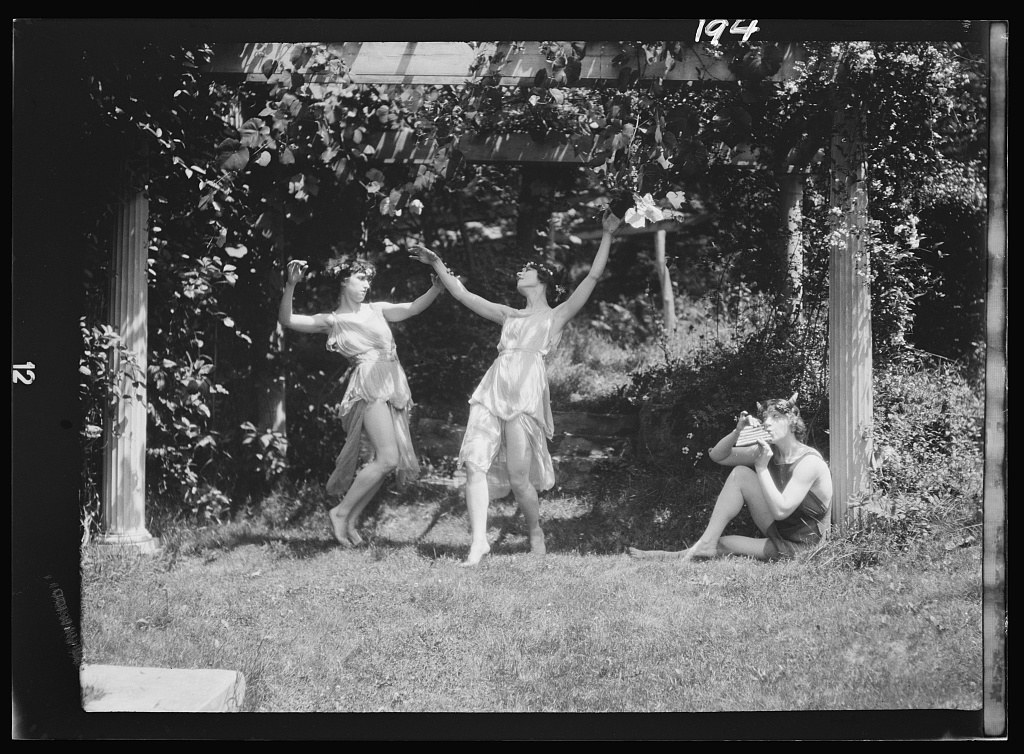
Unidentified dancers, possibly Elizabeth Duncan dancers
Unknown artist
- Collection:
- Prints & Photographs
- Source:
- Library of Congress
- Rights:
- Rights vary by item — check the source record before reusing this image. Source record ↗
- Recorded as:
- Library of Congress — no known restrictions (verify per item)
This is evidence of the aesthetic and physical practice of Isadora Duncan's revolutionary school at a crucial moment—the early 1910s, when her influence was reshaping modern dance globally. The photograph shows what Duncan dancers actually looked like in motion, which is essential to historians trying to understand what distinguished this new dance from both classical ballet and the emerging modern dance techniques of Graham, Limón, and others. For dancers today, it is a window into a founding vision of dance as a practice of freedom, natural expression, and the democratic body—ideas that remain contested and generative.
What you are looking at
Three young women in diaphanous white tunics perform outdoors on a grass lawn, framed by classical stone columns and dense foliage. The setting evokes an ancient Greek or Roman garden sanctuary. Two figures in the center are captured mid-leap or flight, arms raised and bodies suspended with apparent weightlessness, their tunics billowing around them. A third figure sits or reclines to the right, watching the action. The photograph is taken in bright natural light that illuminates the white fabric and creates strong shadows, emphasizing the sculptural quality of the bodies. The composition creates a sense of freedom and naturalism, with the dancers' movement flowing seamlessly into the overgrown garden setting.
The dancing
The two central figures display an ethereal, upward-striving quality: their bodies are extended vertically, arms reaching overhead in unison, suggesting coordinated flight or ecstatic elevation rather than grounded balletic technique. The tunic drapery falls loosely around their legs, which appear to be in motion but are not turned out in classical ballet positions. Their torsos are long and relatively unarmored, with no visible corsetry. The seated figure on the right provides a static counterpoint, suggesting a moment of rest or observation within a longer sequence. The overall impression is of natural, released movement rather than technical precision.
The dance depicted
This appears to be Isadora Duncan-influenced movement or possibly an actual Elizabeth Duncan dancers performance, as the catalogue suggests. The aesthetic is unmistakably that of the Duncan school: the simple white tunic (the iconic reform dress), the bare or lightly shod feet (though not fully visible here), the emphasis on vertical lift and arm reaching, the apparent spontaneity, and the integration of the dancers with a natural landscape rather than a stage proscenium. The absence of the rigid turnout and controlled épaulement of classical ballet, combined with the uplifted, airborne quality, points to the modern dance revival that Duncan pioneered in the early 1910s. The grouping suggests not a narrative ballet but rather an expression of joy, freedom, or aspiration through the body.
How it was made
This is a black-and-white photograph on silver gelatin paper, a standard commercial photographic medium of the period. The sharp focus and bright contrast suggest it was taken in strong daylight with a fairly fast film or long exposure. The photograph was likely made for documentation, publicity, or artistic record—photography was the primary way modern dance pioneers like Duncan and her students could circulate images of their work to international audiences. The outdoor setting and naturalistic framing suggest this was not a staged studio portrait but rather a genuine documentation of a rehearsal or performance moment, lending it the character of evidence.
About this work
This photograph documents a moment of early modern dance practice or performance, almost certainly connected to the Duncan school or directly to Isadora Duncan's students in the early 1910s. The image captures the revolutionary aesthetic that Duncan brought to dance: the rejection of ballet's rigid training, the celebration of natural movement and classical drapery, and the use of landscape and light as integral to the dancer's expression. The photograph is a primary document of a pivotal moment in dance history when a new language of the body was being forged in deliberate opposition to the academic tradition that had dominated European and American dance for centuries. It shows not virtuosity in the old sense, but a new kind of virtuosity: the liberation and eloquence of the human form moving freely.
How to look at it
Observe the moment the photographer chose: not a peak of vertical extension, but a sustained upward reach, bodies still in the act of rising. Notice how the drapery is not arranged but moves with the body, falling naturally from shoulder and arm. The symmetry of the two leaping figures and the watchful third suggests this may be a set sequence or study rather than free improvisation, yet it reads as utterly unforced. Attend to the columns and foliage framing the dancers: they are not props but partners in the composition, suggesting that the Duncan dancers understood their bodies as part of a continuous natural world, not set apart on a stage. The photograph's documentary clarity—not posed, not retouched—was itself a statement about the authenticity of this new dance.
The artist
The photograph is uncredited, which was common for documentary and publicity photographs of the era. If it documents Elizabeth Duncan dancers (Isadora's sister), it would have been made within or by the school's own apparatus for documenting and promoting their work. Elizabeth Duncan founded her own school in Berlin in 1904 and maintained it through the 1910s and 1920s, creating her own lineage of the Duncan technique distinct from, though related to, Isadora's own performing practice. Schools and movement pioneers of this period frequently commissioned or produced photographs for circulation in newspapers, journals, and to students and patrons.
The period
In 1911, Isadora Duncan was at the height of her international influence and notoriety. Having performed in Paris, Berlin, and across Europe to acclaim and scandal, she had established schools in Berlin and Paris to train dancers in her method. Her sister Elizabeth, though less famous, was running her own successful school in Berlin. This was the era of the Ballets Russes (founded 1909) and the beginnings of organized modern dance as a distinct form. Photography itself was becoming a serious medium for artistic documentation and publicity; the work of photographers associated with dance schools and artists' movements was circulating widely in journals like *The Craftsman* and European avant-garde publications. The image's outdoor setting and classical references were entirely in keeping with the Duncan school's philosophy of returning dance to an imagined ancient Greece, mediated through contemporary art nouveau aesthetics.
Where it lives
The image is held in the Prints & Photographs division of the Library of Congress and is catalogued as documentary photography, likely acquired as part of a broader collection of early modern dance materials or as a work of artistic or historical interest. The notation number (194) suggests it is part of a series or file. The photograph's destination in a library rather than a museum archive indicates it was valued primarily as a document of a historical moment rather than as an object of unique aesthetic authority.
Dance in this work
Questions about this work
Is this Isadora Duncan herself?
The catalogue identifies these as 'possibly Elizabeth Duncan dancers,' which suggests they are members of Elizabeth Duncan's school rather than Isadora herself. Elizabeth ran her own school in Berlin from 1904 onward and trained a company of dancers in the Duncan method. Without additional documentation, we cannot identify the specific performers, but the aesthetic—the tunics, the outdoor setting, the upward-striving movement—is distinctly Duncan.
Why are they dancing outdoors?
The Duncan school deliberately rejected the artificial theatricality of the opera house stage. Dancing outdoors in gardens or natural light was part of their philosophy of returning dance to its origins in nature and ancient Greece. The photograph may document an actual performance or rehearsal, or it may be a artistic documentation session created to capture the dancers against a landscape backdrop that expressed their aesthetic values.
What is that white dress?
The simple white tunic was the signature costume of Duncan dancers. It was a deliberate reform: a rejection of the corset, pointe shoes, and tutus of classical ballet in favor of a loose, draped garment inspired by ancient Greek vase paintings and sculpture. The tunic allowed free movement of the torso and legs and symbolized Duncan's vision of dance as a natural, unarmored expression of the human body.
How do we know this is from 1911?
The catalogue record dates it to 1911. The aesthetic—the style of the tunic, the photographic technique, the outdoor setting—is consistent with Duncan school practice in the early 1910s. However, without additional documentation or signatures, we rely on the archival record for the precise date.
More dance artwork





