49 works in this view — arrow keys or swipe to move between them.
Dance in Art
Unidentified dancers, possibly Elizabeth Duncan dancers
Unknown artist
- Collection:
- Prints & Photographs
- Source:
- Library of Congress
- Rights:
- Rights vary by item — check the source record before reusing this image. Source record ↗
- Recorded as:
- Library of Congress — no known restrictions (verify per item)
This photograph is rare visual evidence of how the Duncan method was practiced and transmitted in the 1910s, particularly in the pedagogical context rather than on a concert stage. It documents a moment before the consolidation of modern dance as a formal discipline, when expressive dance was still being defined through practice, landscape, and the bodies of young women learning to move without the constraints of classical training. For historians of dance, pedagogy, and the visual culture of modernism, it offers concrete evidence of what Duncan-style movement actually looked like and how it was documented.
What you are looking at
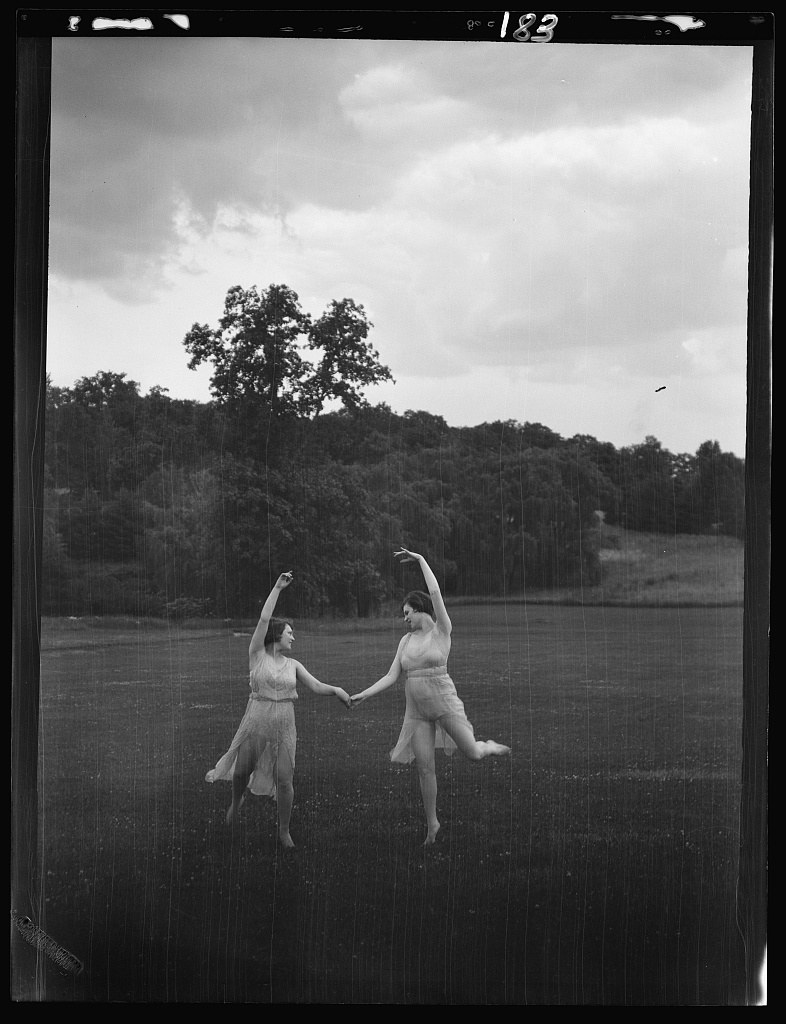
Two young women in light, draped tunics dance barefoot in an open field under a cloudy sky. They face each other with their hands joined, bodies angled away from each other in a suspended moment of motion. Behind them, dense woodland rises along the field's edge, with a single large tree commanding the middle distance. The photograph is taken from ground level looking slightly upward, emphasizing the dancers against the sky. The light is diffuse and cool, characteristic of overcast conditions or early film stock, giving the scene a dreamlike quality. The landscape is rural and undeveloped, suggesting this was taken in a natural setting far from the city, and the composition suggests a deliberate staging rather than documentary capture.
The dancing
Both dancers are in profile, bodies leaning back from the hips while their joined hands create a pivot point between them. Their free arms are raised and curved overhead in mirror image—a symmetrical, balletic frame. Their legs are extended, suggesting a step or lift; their posture is upright and controlled rather than heavy. The positioning suggests a turn or rotational movement around their joined hands, with the dancers' weight distributed between their connected arms and their feet. The bodies are young, lithe, and deliberately posed, indicating trained dancers rather than casual movement.
The dance depicted
This appears to be a work of early modern expressive dance, most likely from the Isadora Duncan or Duncan school tradition, which was dominant in the 1910s. The catalogue attributes it to possibly Elizabeth Duncan dancers, which would place it in the pedagogical and performative circle around Duncan's revolutionary approach to movement. The barefoot execution, the simple draped costume, the use of natural landscape, and the emphasis on symmetry and free, lyrical arm movement are all hallmarks of Duncan-style dance. The composition—two figures in a connected, abstract relationship rather than a mimetic or narrative pose—suggests interpretive or free dance as opposed to classical ballet technique. The image documents not a specific named dance but rather the aesthetic and ideological commitments of the Duncan method: rejection of pointe shoes and corsetry, emphasis on natural movement and emotional expression, and use of open outdoor space.
How it was made
This is a black-and-white photograph, printed from a negative on paper stock. The image shows the grain and tonal range characteristic of early 20th-century silver gelatin printing. The care taken in composition—the framing against sky and landscape, the timing of a suspended moment—indicates this was a deliberate studio or documentary photograph rather than a snapshot, likely taken by a photographer hired to document the dancers or the school. The soft focus and atmospheric quality suggest either early film stock or deliberate diffusion in printing. Photographs of this kind served dual purposes in the Duncan movement: as documentation of performances and practice, and as promotional or pedagogical material circulated among students and interested audiences.
About this work
This photograph documents two dancers in what is almost certainly the Isadora Duncan method or a closely related school of early modern expressive dance, circa 1911. The image captures the aesthetic revolution Duncan initiated: bare feet, simple draped garments, the landscape as partner rather than backdrop, and movement that valued emotional and physical freedom over technical virtuosity. The two-figure composition and the symmetrical, abstract relationship between the bodies suggest a study or lesson rather than a stage work, and the outdoor setting reflects Duncan's belief that dance belonged in nature and in daylight, not in the artificial conventions of the theatre. The catalogue identifies the dancers as possibly from the Elizabeth Duncan school—Elizabeth was Isadora's adopted daughter and a dancer and teacher in her own right—which places this image within the educational and performative network that disseminated Duncan's ideas through the early 20th century.
How to look at it
Notice the suspension in the movement: the dancers are frozen at a moment of dynamic tension, with bodies leaning back and arms raised, suggesting the turn or rotation is happening around the pivot of their joined hands. The symmetry is key—this is not naturalistic, unstudied movement, but carefully composed and balanced, suggesting both training and intention. The landscape behind them is not accidental scenery but integral to the composition, placed so the dancers occupy the foreground while the woodland and single prominent tree frame them. The light is diffuse and soft, which was both a technical constraint of early photography and an aesthetic choice that suited the Duncan movement's emphasis on softness and lyricism over sharp, angular definition. A viewer should ask: what is the relationship these two dancers are enacting through their connected bodies? Is this a lesson, a duet, a study of balance and trust?
The period
In 1911, Isadora Duncan had already revolutionized dance in Europe and America through her rejection of classical ballet technique and her advocacy for natural movement, emotional expression, and the human body freed from constraint. The Duncan schools—including the one founded by her adopted daughter Elizabeth—were spreading her method internationally as both performance and pedagogy. This was the era before modern dance as a formal genre had a name or institutional structure; dancers like Martha Graham, Lois Fuller, and Ruth St. Denis were still defining their practices in relation to or reaction against Duncan's influence. The photograph participates in the broader modernist turn toward authenticity, nature, and the body as the primary instrument of expression. In visual art, the early 1910s saw growing interest in documenting movement and the human figure in nature, a concern shared across photography, painting, and the emerging avant-gardes. The outdoor setting and the philosophical commitment to naturalness evident here align with contemporary primitivism and back-to-nature movements in European and American culture.
Where it lives
The photograph is held in the Prints & Photographs division of the Library of Congress and was sourced from LOC holdings. The catalogue record notes only that the dancers are unidentified but possibly affiliated with Elizabeth Duncan's school or company. No photographer is recorded.
Dance in this work
Questions about this work
Why are they dancing outdoors?
Outdoor performance and practice were central to the Duncan method's philosophy. Isadora Duncan believed dance should happen in natural light and open space, freed from the artificial conventions of the theatre stage. This aligned with broader modernist ideas about authenticity and nature. Outdoor settings also became a signature of promotional photography for Duncan schools.
Why are they barefoot?
Bare feet were fundamental to Duncan's rejection of ballet. The pointe shoe and the turned-out legs of classical ballet represented, to Duncan, an artificial distortion of the natural human body. Bare feet were her declaration of freedom from that tradition and a return to what she saw as authentic human movement.
What are they doing with their hands?
Their joined hands appear to be the axis around which they are turning or rotating, with their free arms raised symmetrically overhead. This suggests a duet study exploring balance, weight sharing, and rotational movement. The symmetry indicates careful composition and training rather than improvisation.
Is this a performance or a lesson?
It is difficult to say definitively, but the carefully composed, symmetrical arrangement and the outdoor location suggest this may be either a documented lesson or a study created specifically for photography rather than a stage performance. The Duncan schools treated pedagogy and performance as deeply connected; this image could serve both purposes.
More dance artwork





