49 works in this view — arrow keys or swipe to move between them.
Dance in Art
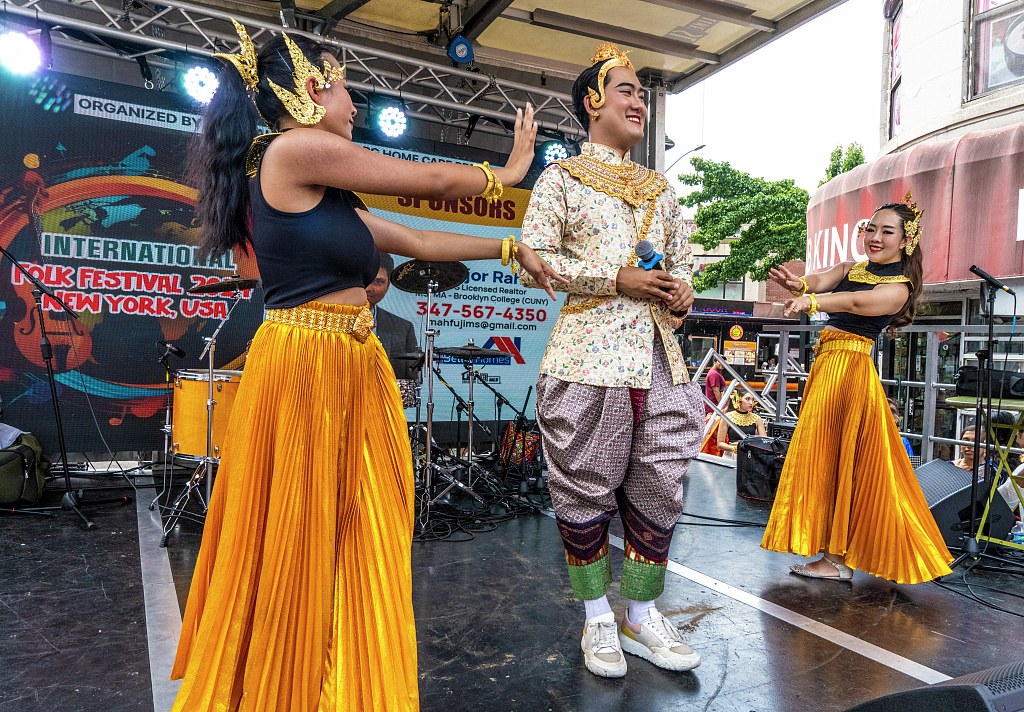
Suriya, Thai Folk singer, and dancers, International Folk Festival, Diversity Plaza, 37th Rd., Queens
Unknown artist
- Collection:
- Prints & Photographs
- Source:
- Library of Congress
- Rights:
- Rights vary by item — check the source record before reusing this image. Source record ↗
- Recorded as:
- Library of Congress — no known restrictions (verify per item)
This image documents diaspora folk performance in real time—how Thai cultural forms are transmitted, adapted, and celebrated outside their original geographic context. For dance historians and ethnographers, it shows the lived reality of folk dance performance in 21st-century America: the costumes, platforms, audiences, and personnel through which cultural identity is performed in community settings.
What you are looking at
An outdoor performance at the International Folk Festival in Queens, photographed during daytime under bright stage lights. Three performers in traditional Thai dress occupy a raised stage platform: a central male dancer in a cream-colored silk shirt with purple checkered lower garment and white sneakers, flanked by two female dancers in coordinating costumes of golden pleated skirts, black halter tops, and golden headdresses. The male figure appears to be singing or speaking while gesturing expressively with his hands; the women flank him symmetrically, their arms raised and bodies angled toward the center. Behind them, a banner identifies this as an "International Folk Festival" event in Queens, with contact information visible. The setting is urban and contemporary—a paved plaza with modern buildings and ivy-covered structures visible in the background. The lighting is theatrical but daylit, and the mood is celebratory and formal.
The dancing
The central male figure stands upright with weight evenly distributed, arms raised in an open, welcoming gesture—palms outward, elbows bent at roughly shoulder height in a pose that suggests speech or song rather than choreographed movement. The two female dancers stand symmetrically on either side, their bodies aligned in parallel, arms raised in a similar open position. All three figures maintain upright posture with relaxed knees. The spatial relationship is formal and hierarchical, with the male figure as the focal point and the women positioned as complementary elements rather than his dance partners in a partnered hold.
The dance depicted
This appears to be a performance of Thai folk music or folk theater rather than a discrete dance form. The catalogue identifies a "Thai folk singer" as the central figure, and the gesture and framing suggest a vocal or oratorical performance with accompanying dancers. Thai classical dance forms like Khon or Ramthai are typically highly codified, with specific hand positions (kranai) and formal court or sacred contexts; the contemporary outdoor setting, casual modern footwear, and relaxed arm positions indicate a more populist or diaspora folk performance. The two female dancers appear to provide visual framing and accompaniment rather than executing a choreographed narrative or mime.
How it was made
This is a color photograph, evidently digital or digitized from color film stock, taken outdoors under professional stage lighting. The sharpness and color saturation suggest relatively recent documentation—the photograph preserves the event as it occurred, without the interpretive choices of painting or printmaking. Its function is documentary: to record a community cultural performance for archive, social sharing, or curatorial purposes. The outdoor daytime setting with auxiliary stage lights indicates a public festival accessible to general audiences and photographers.
About this work
This photograph documents a contemporary performance of Thai folk culture at a public cultural festival in Queens, New York. The image captures a moment of cross-cultural performance in an urban American setting, showing how immigrant and diasporic communities sustain and present traditional cultural forms in new contexts. The photograph is part of the Library of Congress's collection of public performance documentation, marking it as a record of lived cultural practice rather than a trained or canonicalized dance form.
How to look at it
Observe the spatial arrangement and the asymmetry of gesture: the male figure is clearly the vocal or oratorical center, while the female dancers frame him and amplify the visual spectacle of the performance through their symmetrical positioning and raised arms. The costumes and headdresses are the primary visual markers of "Thai-ness"—silk, gold, formalized dress—rather than specific movement vocabulary. The modern sneakers and outdoor plaza, while incongruous with traditional Thai aesthetic norms, are pragmatic choices for a community festival. The moment captures performance as communication and celebration rather than as mastery of a complex technical form.
The artist
The photographer is not credited in the catalogue record. This is consistent with Library of Congress practice for documentary photography of public events, where the archivist's role may supersede individual authorial attribution.
The period
This photograph dates to 2024, a moment of increased visibility for Asian American cultural programming and public celebration of immigrant heritage in urban American festivals. The Diversity Plaza venue and the formal staging reflect late 20th and 21st-century practices of multiculturalism in American cities, where cultural festivals operate as both community celebration and tourism attraction. Thai cultural performance in the diaspora often emphasizes visible costume, formal platforms, and explicit ethnic identification rather than the temple contexts or court traditions of Thailand itself.
Where it lives
This photograph is held in the Library of Congress Prints & Photographs collection, sourced from public documentation of the International Folk Festival in Queens. It belongs to a category of community event documentation that the Library collects to preserve records of contemporary cultural practice in the United States.
Dance in this work
Questions about this work
Is this classical Thai dance?
No. Classical Thai dance forms like Khon require years of training in highly codified hand positions, footwork, and narrative mime. This is a folk or popular performance—a community celebration featuring Thai costume and music with accompanying dancers whose role is decorative and supportive rather than technically virtuosic.
Who is the central male figure?
The catalogue identifies him as 'Suriya, Thai Folk singer.' He appears to be the primary performer, likely singing or leading the performance verbally while the two female dancers provide visual accompaniment.
Where and when was this taken?
At the International Folk Festival in Diversity Plaza, 37th Road, Queens, New York, in 2024. The festival is an outdoor public event celebrating immigrant and diaspora cultures.
What is the significance of the symmetrical arrangement?
The two female dancers flanking the central male figure create a visually balanced, formal composition typical of festival performance. This arrangement prioritizes visual spectacle and ceremonial dignity over the narrative mime or storytelling of classical Thai dance.
More dance artwork





