49 works in this view — arrow keys or swipe to move between them.
Dance in Art
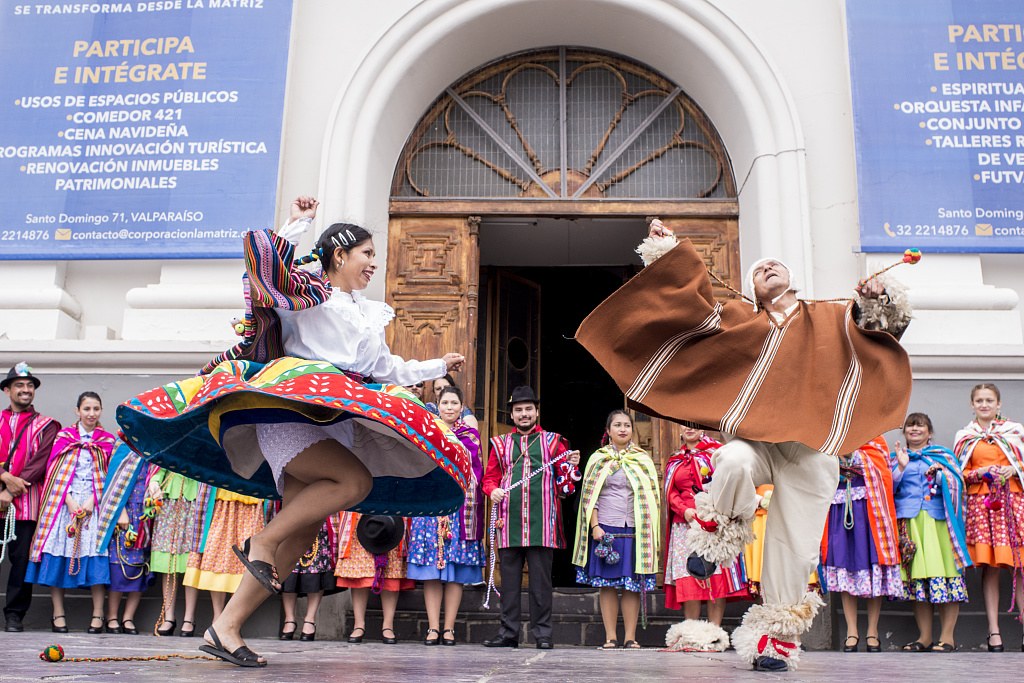
Folk dancing in front of the Iglesia de la Matriz, Valparaiso, Chile, 2018
Unknown artist
- Collection:
- Prints & Photographs
- Source:
- Library of Congress
- Rights:
- Rights vary by item — check the source record before reusing this image. Source record ↗
- Recorded as:
- Library of Congress — no known restrictions (verify per item)
For dancers and historians, this image documents the lived transmission of Chilean folk tradition: it shows cueca not in a theater or on a stage, but in the street, performed by community members of different generations in their own clothing, observed by peers. The photograph records how traditional dance persists and is practiced in twenty-first-century Latin America, marking the continuity and adaptation of these forms across time.
What you are looking at
A festive public gathering in front of the Iglesia de la Matriz (Matrix Church) in Valparaíso captures a moment of Chilean folk celebration. The scene is dominated by two central dancers in traditional costume executing an exuberant movement: a young woman in a white blouse and vibrant red patterned skirt with striped trim has kicked her leg high, her skirt billowing dramatically, while an older man in a brown poncho with cream stripes appears to be mid-spin or leap beside her, his arms extended in an expansive gesture. Behind them, a semicircle of approximately twenty dancers and onlookers in equally vivid traditional dress—featuring multiple shades of pink, purple, blue, green, and yellow in layered skirts and embroidered textiles—frames the action. The wooden double doors of the church with their decorative fanlight arch provide a formal architectural backdrop, while blue promotional banners with white text flank the church entrance. The daylight is bright and clear, casting sharp shadows and illuminating the rich colors of the costumes.
The dancing
The two foreground dancers occupy asymmetrical positions: the woman's upright posture is anchored by her lifted knee and extended arms, creating vertical lift and openness, while the man beside her appears weightless and spinning, his arms spread wide. The surrounding dancers stand in relatively static positions, some with arms at their sides or loosely held, suggesting they are either awaiting their turn or serving as witnesses to the central couple's performance. The woman's high kick and the man's apparent rotational movement suggest a dance form that prizes exuberance, lift, and individual display over formal partnering or synchronized group movement.
The dance depicted
This is Chilean cueca or a related folk form from the Andean or central Chilean tradition, recognizable by the combination of the vibrant layered skirts (polleras), the handwoven ponchos, and the celebratory outdoor performance context in front of a civic or religious landmark. Cueca is traditionally a courtship dance performed by couples facing one another, often with handkerchiefs or with hands in the air; this image captures the moment of playful challenge and exuberance central to the form. The high kick of the woman and the expansive gestures of the man are characteristic of the competitive display that defines cueca's choreography, where each dancer aims to outdo the other in vigor and joy. The crowd composition and the formal setting suggest a public cultural celebration or festival, likely organized around the church as a community gathering point.
How it was made
This is a color photograph, almost certainly digital or high-quality color film, taken in daylight. The clarity of detail, the saturated rendering of the traditional textiles, and the sharp focus across the scene suggest professional or semi-professional documentation, possibly commissioned for a cultural or tourism purpose—consistent with the promotional banners visible in the frame. The photographer has chosen a frontal, wide-angle composition that includes the architectural setting and the surrounding community, framing the dance not as an isolated performance but as a civic or festival event embedded in place and witnessed collectively.
About this work
This is a documentary photograph of Chilean folk dance captured in its living context: a public celebration in Valparaíso featuring cueca or a related Andean courtship form. The image records both the kinetic joy of the central dancers and the communal frame in which such dances are performed and transmitted—a crowd of costumed participants and witnesses gathered in front of a church, suggesting the entanglement of folk tradition with religious and civic life. The photograph is valuable precisely because it shows the dance as social practice rather than as abstracted movement, capturing the moment, the costume, the architecture, and the community in a single frame.
How to look at it
Observe the precise moment the photographer chose: the woman's leg at its apex, the man mid-rotation, capturing the peak of exuberance rather than a static pose. Notice the relationship between the central dancers and the crowd: they are not separated by stage or frame, but embedded in it, suggesting cueca's nature as a participatory social form rather than a spectator performance. Look also at the costume: the layered, colorful skirts and woven ponchos are not costumes in the theatrical sense, but the actual dress of the community, which tells you something about how this tradition lives.
The period
This photograph dates to 2018, a moment when Chilean folk traditions were undergoing renewed public visibility and documentation, particularly in the context of cultural tourism and civic pride. The image reflects broader global trends in the early twenty-first century toward recording and celebrating indigenous and folk practices as living cultural heritage, often in relation to place-based identity and community coherence. The formal, professional quality of the photograph suggests it was taken as part of a deliberate documentation or promotional project, possibly connected to the cultural organization whose banners appear in the frame.
Where it lives
The photograph is held in the Library of Congress Prints & Photographs collection. It was taken in Valparaíso, Chile in 2018; the promotional banners in the frame suggest it may have been commissioned as part of a cultural or civic project, though the specific commissioning context is not recorded.
Dance in this work
Questions about this work
What is cueca?
Cueca is a Chilean courtship dance traditionally performed by couples, often with handkerchiefs or with hands raised. It is characterized by playful competition between partners, exuberant footwork, and celebratory movement. The dance is strongly associated with Chilean national identity and is performed at festivals, weddings, and civic gatherings throughout the country and among Chilean diaspora communities.
Why is this dance being performed outside a church?
Churches and town squares in Latin America have historically served as gathering places for community celebrations, including folk performances and festivals. This image likely documents a planned cultural event or festival, possibly organized around a civic or religious calendar, where the church provides both a formal backdrop and a recognized community space.
Are the people in the background also dancers?
Some appear to be waiting dancers, costumed and participating in the event; others may be witnesses or community members who have gathered to observe. This is typical of folk dance contexts, where the boundary between performer and audience is often fluid, and participation is open or semi-open to community members.
What do the colorful skirts represent?
The layered, brightly colored skirts (polleras) are traditional Andean and Chilean women's dress, incorporating hand-woven textiles that often reflect indigenous weaving traditions and regional variations. They are not theatrical costumes but living tradition: the actual dress worn by women in these communities for celebrations and formal occasions.
More dance artwork





