49 works in this view — arrow keys or swipe to move between them.
Dance in Art
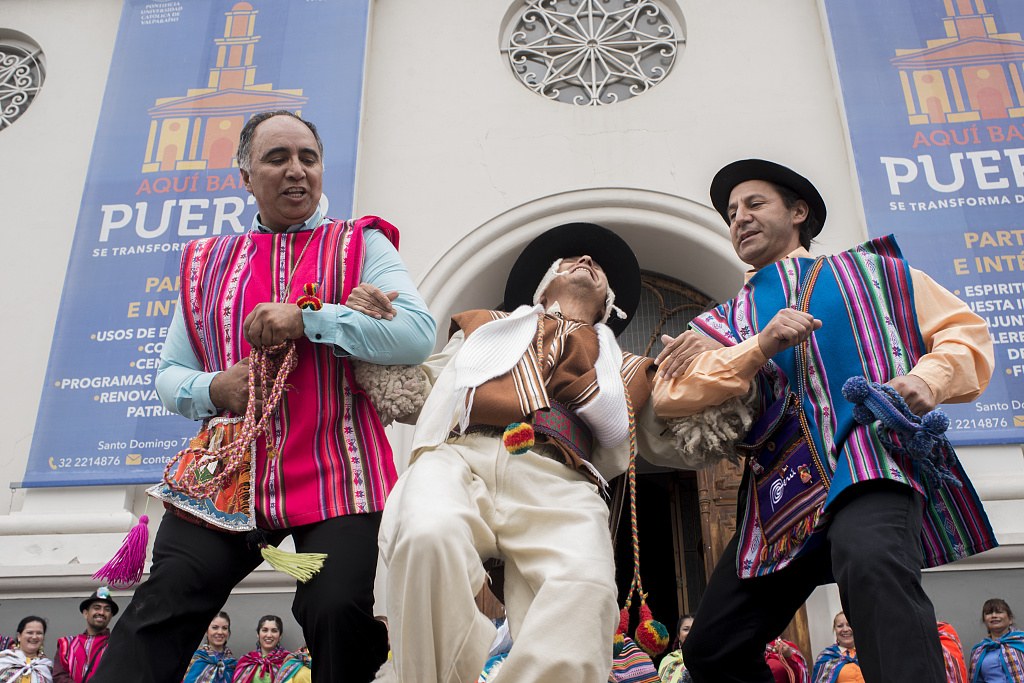
Folk dancing in front of the Iglesia de la Matriz, Valparaiso, Chile, 2018
Unknown artist
- Collection:
- Prints & Photographs
- Source:
- Library of Congress
- Rights:
- Rights vary by item — check the source record before reusing this image. Source record ↗
- Recorded as:
- Library of Congress — no known restrictions (verify per item)
Photographs of folk dance in authentic community contexts—as opposed to staged performances or costume displays—are essential historical records of how traditions are actually danced and transmitted. This image shows the real scale, setting, and social function of Andean folk performance in urban Chile in the 2010s, revealing how indigenous and mestizo dance practices remain central to community identity and public ritual.
What you are looking at
Three dancers in traditional Andean dress perform folk choreography on the steps of the Iglesia de la Matriz in Valparaíso. The building's white colonial architecture and rose window frame the performance space. Two male dancers in vibrant magenta and blue ponchos with traditional woven textiles flank a female dancer in white, who wears a striped waistband and holds a white cloth. The dancers' bodies are angled toward one another in an engaged spatial relationship, with the woman's arms extended and body turned. A gathered crowd of spectators sits in the foreground, partially visible, watching from below the church steps. The natural daylight and the architectural setting suggest a community cultural celebration or public festival event.
The dancing
Three dancers occupy the center; the two men frame the woman symmetrically. The male dancers stand with knees slightly bent and weight distributed evenly, arms extended in open, expressive gestures typical of Andean group dance. The female dancer's arms are raised and extended, her torso turned, the white cloth creating a sweeping line. All three dancers maintain upright posture with engaged cores. Their relative positioning—the woman between the two men—and their facing angles suggest a coordinated, structured choreography rather than improvisation, with clear spatial and gestural unity.
The dance depicted
This appears to be a form of Andean or Chilean folk dance, most likely a *cueca*, *tonada*, or regional variant of South American indigenous or mestizo dance tradition. The evidence lies in the traditional ponchos (*ponchos de lana*) in the bright saturated colors typical of Andean weaving, the structured three-person formation, and the gestural vocabulary of the raised arms and turned torso. The woman's white cloth is consistent with how women's roles are choreographed in many Andean courtship dances. The public, ceremonial setting on church steps suggests this is a community performance of living folk tradition rather than a historical or staged reconstruction, which places it within contemporary expressions of regional cultural identity.
How it was made
This is a color photograph, likely taken by a professional or trained documentarian. The image is sharp and well-composed, with good depth of field that keeps both the dancers and the architectural backdrop in focus. The color saturation and clarity suggest digital or high-quality film photography from the 2010s. As a photograph in an archival collection, it functions as documentary evidence of performance practice and community cultural life, capturing a specific moment in real time rather than an artistic interpretation. This medium privileges immediacy and factual record over stylization.
About this work
This photograph documents a live folk performance during a community celebration at a major colonial church in Valparaíso, Chile. The dancers wear traditional Andean textiles and perform what appears to be a regional South American dance form, likely a cueca or related tradition. The image captures not theatrical staging but authentic cultural practice—the presence of a gathered audience and the architectural framing of a public institution confirm that this is a communal event in which folk tradition is actively kept alive. For scholars of Chilean and Andean dance, this is primary-source documentation of how these dances are performed and valued in contemporary practice, not as museum objects but as living cultural expression.
How to look at it
Attend to the precise moment the photographer chose: this is not a dynamic leap or rapid turn, but a held, composed moment in which the three dancers are clearly visible and the spatial relationship between them is legible. The photographer positioned themselves to capture both the dancers and the architectural frame—the church steps and rose window—making clear that this performance is inseparable from the civic and spiritual identity of the place. Notice how the spectators' presence is suggested rather than prominent, centering the dance itself. The saturated colors of the ponchos and the white cloth read as conscious, formal dress, not everyday clothing, signaling that this is a prepared, valued performance.
The period
This photograph dates to 2018, a period of renewed interest in indigenous and regional cultural expression across Latin America, partly in response to globalization and the politics of cultural recognition. In Chile specifically, the early 2010s saw growing emphasis on regional identity and indigenous Mapuche and Andean heritage as part of larger social and political movements. Folk dance performance in public sacred spaces like churches reflects the complex history of syncretism in South America, where indigenous and mestizo traditions have been woven into community and religious life over centuries. The documentation of such events in photography reflects both touristic interest and genuine scholarly and community commitment to archiving living culture.
Where it lives
This photograph is held in the Prints & Photographs collection of the Library of Congress. It is catalogued as documentary photography from a 2018 cultural event in Valparaíso, and functions within the collection as evidence of contemporary folk practice in Chile.
Dance in this work
Questions about this work
What is the dance being performed here?
The specific dance form is not identified in the catalogue record, but the evidence points to a traditional Andean or Chilean folk dance, possibly a cueca or regional variant. The ponchos, the three-person formation with a central female dancer, the gestural vocabulary, and the use of a cloth are all consistent with South American courtship and celebration dances. Without audio, choreographic notation, or expert identification, the precise form cannot be stated with certainty.
Why are they dancing on church steps?
In many South American communities, churches are social and civic centers, and public spaces around them are used for community celebrations and cultural performances. This reflects centuries of syncretic practice in which indigenous and mestizo dance traditions have merged with Christian religious life. The choice of the church as a performance venue is not incongruous but rather typical of how folk traditions are woven into community identity and public ritual.
What are the woven cloths the dancers are wearing?
The bright, saturated woven textiles are traditional Andean ponchos and weaving patterns, made using centuries-old techniques. The colors and geometric patterns are characteristic of Andean textile traditions from across the region—Peru, Bolivia, Chile, and Ecuador. These are not costumes but genuine cultural dress, worn in performance to signal community identity and cultural continuity.
Is this a professional or community dance group?
Based on the informal setting, the public church-steps venue, and the gathered but non-ticketed audience, this appears to be a community performance rather than a professional theater production. This makes it more valuable as a document of how folk traditions are actually lived and transmitted in contemporary practice, rather than how they are staged for tourism or national spectacle.
More dance artwork





