49 works in this view — arrow keys or swipe to move between them.
Dance in Art
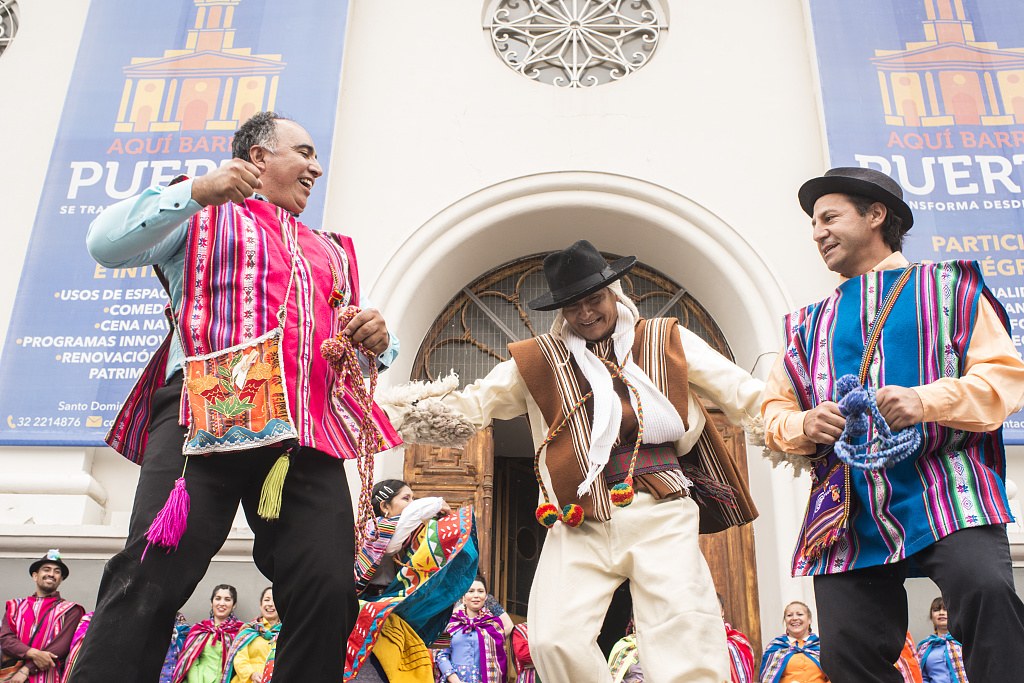
Folk dancing in front of the Iglesia de la Matriz, Valparaiso, Chile, 2018
Unknown artist
- Collection:
- Prints & Photographs
- Source:
- Library of Congress
- Rights:
- Rights vary by item — check the source record before reusing this image. Source record ↗
- Recorded as:
- Library of Congress — no known restrictions (verify per item)
The photograph documents Chilean folk dance—a regional tradition central to Andean and South American cultural identity—as it continues to be practiced in everyday public celebration. For dancers and historians, it provides visual evidence of authentic movement vocabulary, traditional costume detail, and the social context in which this dance actually lives, rather than how it might be staged or performed for international audiences.
What you are looking at
Three men in celebratory motion stand in front of the Iglesia de la Matriz in Valparaiso, performing traditional Chilean folk dance. The central figure wears a striking pink/magenta short jacket (likely a *huaso* or Chilean folk costume element) over black trousers, with a wide pink sash or belt and decorative tassels. To his left stands a man in cream and brown layered garments with a black hat, and to the right another dancer in a blue and multicolored striped vest. All three wear the characteristic woven ponchos or woven waistcoats with Andean-style geometric patterns in bright primary colors—red, blue, yellow, orange. Behind them, the white-painted church with its arched doorway and decorative round window provides architectural framing. The foreground shows onlookers seated, some also in traditional dress, suggesting a public celebration or festival. The photograph captures a moment of joyful, dynamic movement—bodies leaning, arms gesturing, weight shifting—frozen mid-performance against the colonial church backdrop. Daylight is bright and even, casting minimal shadow, suggesting midday outdoor performance.
The dancing
The three central dancers display open, celebratory posture with raised and extended arms, engaging in what appears to be a social or processional folk dance rather than a formation dance. Their bodies are upright, weight distributed for side-stepping or turning rather than balletic extension. The figure on the left has his arm raised and appears to be turning or pivoting; the central dancer's body is angled, suggesting forward or rotational movement; the figure on the right stands with arms partially raised. All three maintain individual spacing and positioning rather than a coupled or line formation, and their arm gestures are broad and expressive rather than precisely controlled. The visible footwork suggests a light, rhythmic stepping pattern typical of Latin American folk dance.
The dance depicted
This is Chilean folk dance, almost certainly *cueca* or a related regional Chilean folk form, performed at what appears to be a public festival or cultural celebration in front of a colonial church. The bright, patterned *ponchos* and *huaso*-style dress, the open celebratory posture, the outdoor public setting, and the three-person configuration all align with how Chilean folk dance was performed in community contexts in the early 21st century. The photograph documents living tradition rather than theatrical performance—this is vernacular social dance in its ordinary public context. The 2018 date places this within the contemporary practice of Chilean folk dance as a living cultural form.
How it was made
This is a color photograph, almost certainly digital or high-quality color film stock given the clarity, color saturation, and even exposure. The photographic medium allows documentary capture of fleeting movement, gesture, and facial expression in a way painting or engraving could not. The photographer has chosen a daylit outdoor moment with the church as stable architectural backdrop, and the technical quality suggests either professional or semi-professional documentation—likely created for cultural, archival, or journalistic purposes rather than fine-art exhibition. The medium and context suggest this is part of a larger documentation project of Chilean cultural practice.
About this work
A color photograph documenting three male dancers performing Chilean folk dance in traditional dress in front of the colonial Iglesia de la Matriz in Valparaiso, Chile, in 2018. The image captures a moment of public, celebratory folk performance—likely *cueca* or a related Chilean regional dance—showing the dancers in bright woven ponchos and traditional *huaso*-style garments with raised arms and dynamic posture. The photograph records living vernacular dance tradition in its ordinary social context rather than as staged theatrical performance.
This work belongs in a gallery of dance because it documents an important regional Latin American folk tradition in contemporary practice, showing how traditional dress, movement vocabulary, and celebratory social context remain vital in the 21st century. The image also demonstrates how folk dance exists in public space and community gathering, not only on concert stages, and it provides evidence of the specific movement qualities, costume, and social function of Chilean folk dance as performed outside theatrical contexts.
How to look at it
Attend to the open, celebratory arm gestures and upright posture of all three dancers—this is social, public folk dance, not a formation dance or balletic technique. Notice the specific cut and drape of the woven ponchos and the layered textile construction visible on each dancer; these details tell us about regional dress tradition. Watch the spacing between the three figures and the way they relate to each other and to the church behind them—they are not in a rigid formation or couple, but rather moving as individuals in a shared celebratory moment. The photograph freezes a moment of motion and joy, but the way the bodies are angled and the arms positioned suggests ongoing turning, stepping, and shifting rather than a held pose.
The period
By 2018, Chilean folk dance had experienced both decline and conscious revival over the preceding century. The *cueca* and related regional forms were recognized as national cultural heritage, and public performances at churches and civic spaces like Valparaiso had become common in cultural celebrations, Independence Day commemorations, and tourist-oriented festivals. The photograph sits within a broader 21st-century pattern of documenting and celebrating indigenous and regional Latin American dance traditions as living practice rather than historical artifact. The location in front of a colonial church also suggests the complex relationship between indigenous/mestizo folk culture and Spanish colonial heritage in Latin American public space.
Where it lives
The photograph is held by the Library of Congress Prints & Photographs collection and is catalogued as part of their archival holdings. It was likely created as documentary photography of cultural practice rather than fine-art photography, suggesting it may have been produced for cultural institutions, press documentation, or heritage preservation purposes.
Dance in this work
Questions about this work
What is the dance being performed?
The image most likely shows *cueca* or a related Chilean regional folk dance. These dances are characterized by open celebratory movement, bright traditional dress including woven ponchos, and are typically performed at public gatherings, festivals, and cultural celebrations. The specific movement vocabulary and costume are consistent with Chilean *huaso* (cowboy/rural) tradition and Andean mestizo culture.
What is a cueca and why is it important?
The *cueca* is Chile's national dance, performed at Independence Day celebrations and cultural festivals. It typically involves couples in a light, flirtatious movement pattern with handkerchief waving and turning, though group or male performances like this one also occur. It represents the blending of Spanish, indigenous Mapuche, and mestizo cultural traditions and remains a living symbol of Chilean identity.
Why are they dancing in front of a church?
The Iglesia de la Matriz is Valparaiso's oldest and most significant colonial landmark, making it a natural gathering place for public cultural celebrations. Folk dancing at civic and religious landmarks is a common practice in Latin American communities during festivals and holidays, where the dance celebrates both cultural and national identity in shared public space.
What does the woven poncho tell us?
The geometric-patterned woven ponchos are traditional to Andean and Chilean folk culture and represent specific regional and ethnic identity. The bright primary colors, striped patterns, and hand-woven construction visible in the photograph are characteristic of indigenous and mestizo textile traditions in the Andes. Wearing these ponchos during folk dance performance signals cultural pride and connection to regional heritage.
More dance artwork





