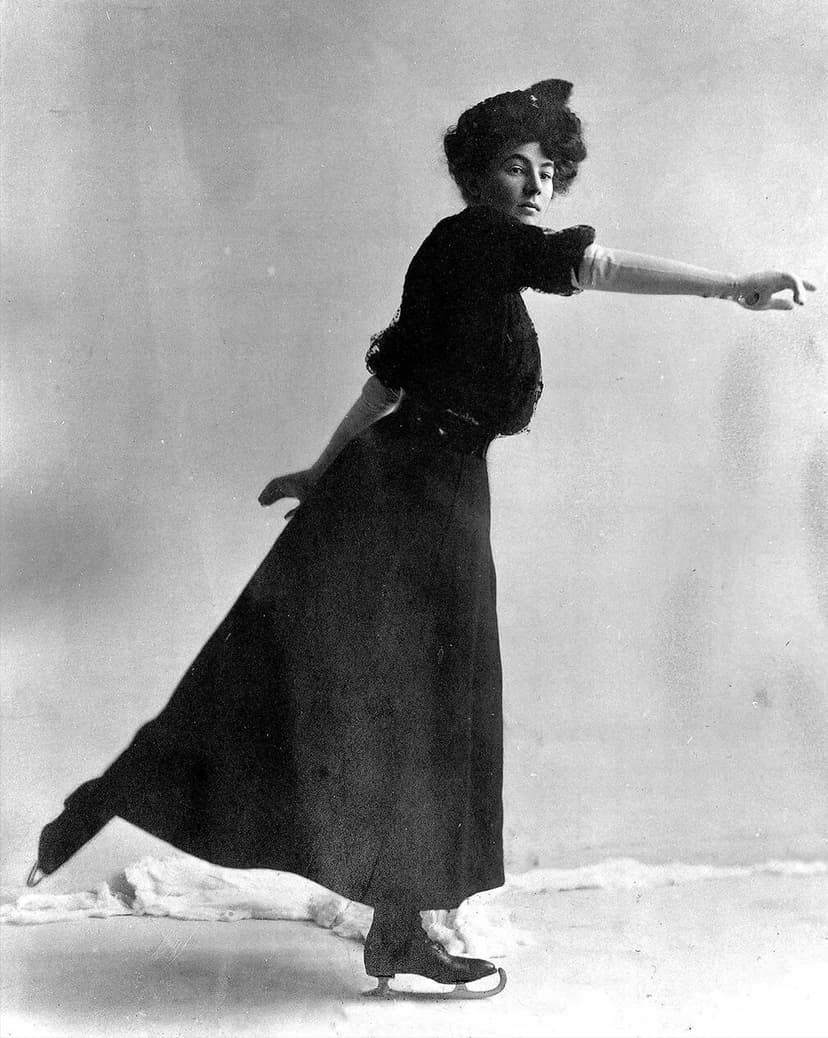
Florence Madeleine “Madge” Syers, née Cave
First Woman at the World Figure Skating Championships
Why They Matter
Syers changed figure skating by forcing institutions to respond to demonstrated ability. Her 1902 silver invalidated the notion that women’s exclusion could rest on custom alone, and her later world and Olympic victories established an elite women’s lineage with results equal in seriousness to the…
Biography
Florence Madeleine "Madge" Syers was the first woman to compete at the World Figure Skating Championships, the first women's world champion, and the first Olympic champion in women's figure skating. Born in Kensington in 1881, she learned to skate at Prince's Skating Rink in Knightsbridge, where she met Edgar Syers, an experienced skater and proponent of the "International" style. In contrast to the restrained English school, which emphasized precise tracings with limited upper-body movement, the International approach encouraged fuller carriage, flow, and expressive movement across the ice. Edgar coached Madge, became her pair partner, and married her in 1900. As Madge Cave, she won the 1899 Challenge Shield and the first British pairs competition with Edgar.
Syers's most consequential competitive act came in 1902. The World Figure Skating Championships had been treated as a men's event by convention, but its rules did not expressly prohibit women. Syers entered the London championship, skated against men, and finished second behind Sweden's Ulrich Salchow. The result exposed the instability of an assumed gender barrier: a woman had entered legally and become world silver medallist. The skating authorities subsequently excluded women before creating a separate women's competition. Syers won the women's world events of 1906 and 1907, both later recognized officially as World Championships. At home, she also won the open British singles championship in 1903 and 1904, defeating male competitors—including Edgar in 1904. These results show that her importance was not merely symbolic; she repeatedly succeeded within the era's actual judging system.
Figure skating appeared at the Olympic Games for the first time in London in 1908. Syers won the women's singles title at Prince's Skating Rink, receiving first place from all five judges in both compulsory figures and free skating. Later, she and Edgar won bronze in pairs. She thereby became the first woman to win two medals at a single Olympic Games and remains one of the rare skaters to medal in an individual and pair event at the same Olympics.
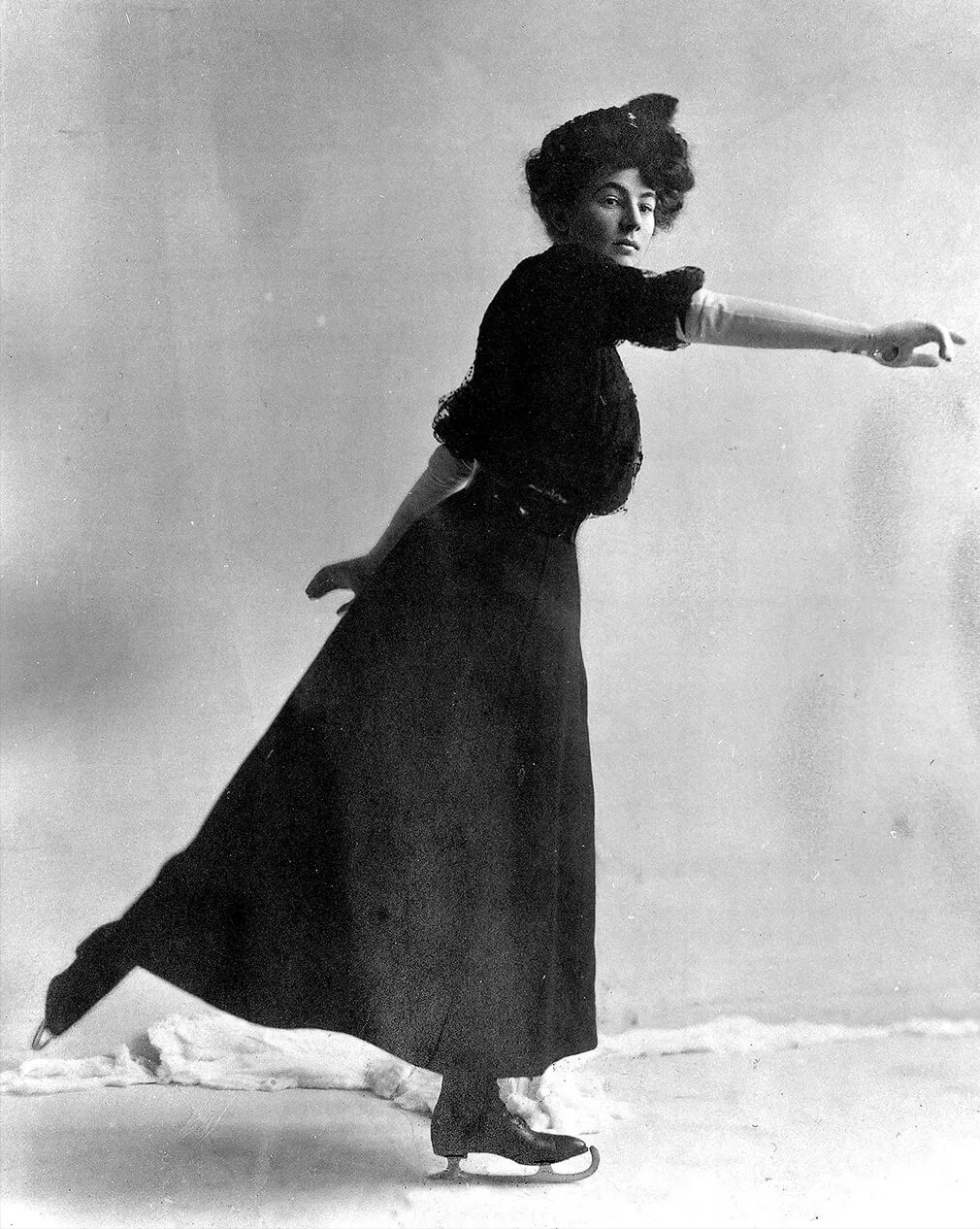
Syers's movement history is inseparable from her challenge to rules and costume conventions. Contemporary long skirts made footwork harder to evaluate; she wore a shorter, mid-calf skirt that allowed judges to see the edges and steps more clearly. Visibility of the skating foot affected both technical assessment and women's access to legitimate competition. Her carriage extended through the torso and arms rather than isolating the feet, integrating exact edge control with visible, whole-body phrasing.
Ill health led Syers to retire after the 1908 Games. She died in Weybridge in 1917, one week before her thirty-sixth birthday. In 1981 she was inducted into the World Figure Skating Hall of Fame.
Career Highlights
Won the Challenge Shield and, with Edgar Syers, the first British pairs competition. Olympedia Olympedia
Married Edgar Syers and continued competing with him in pairs. Olympedia Olympedia
Became the first woman to enter the World Figure Skating Championships and won silver behind Ulrich Salchow. Team GB Team GB
Won the open British singles championship ahead of male competitors. Olympedia Olympedia
Retained the British singles title, finishing ahead of her husband Edgar. Olympedia Olympedia
Won the inaugural women’s World Championship, later recognized officially by the ISU. Olympic history publication Olympic history publication
Successfully defended the women’s world title. Olympedia world medal list Olympedia world medal list
Won Olympic gold in women’s singles with first-place rankings from all five judges in both phases. Olympedia Olympedia
Earned Olympic pairs bronze with Edgar Syers. Olympedia pairs result Olympedia pairs result
Retired from international competition because of ill health. Olympedia Olympedia
Died in Weybridge at age 35. Olympedia Olympedia
Inducted posthumously into the World Figure Skating Hall of Fame. Team GB Team GB
Gallery
Legacy & Impact
Madge Syers changed figure skating by forcing institutions to respond to demonstrated ability. Her 1902 silver invalidated the notion that women's exclusion could rest on custom alone, and her later world and Olympic victories established an elite women's lineage with results equal in seriousness to the men's competition. She also embodied a transition in skating aesthetics—from restrained school figures toward flowing, body-conscious performance—making her important to both sport history and the history of movement on ice.
Related Legends

Axel Paulsen
Namesake of the Axel Jump

Jackson Haines
Skater Who Brought Dance to the Ice
Joseph Inman
Architect of Skating's Program Components
Andree Joly And Pierre Brunet
Double Olympic Champions in Pairs Skating

Barbara Ann Scott, later Barbara Ann Scott King
Olympic Figure Skating Champion, 1948

Barbara Wagner And Robert Paul
Olympic Pairs Skating Champions, 1960
Explore More Legends
Discover the dancers, teachers, choreographers, and cultural icons who shaped how the world moves.
Keep the thread going
Dance history, technique, and the occasional rabbit hole — in your inbox. Thoughtful, infrequent, unsubscribe anytime.
Free. No spam. One click to leave.