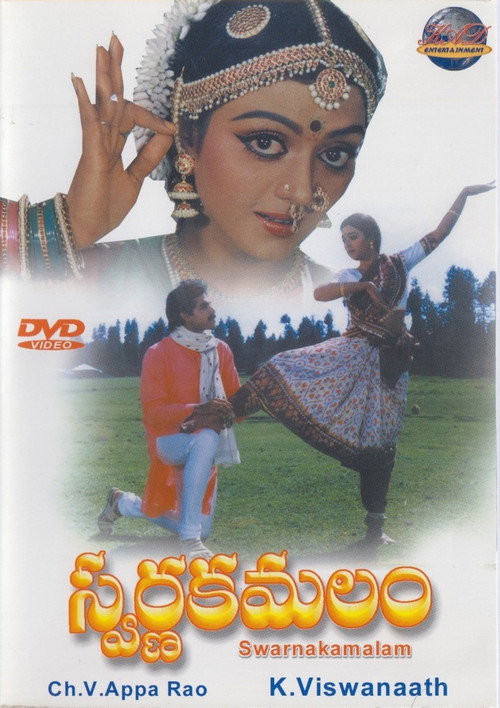
Dance in Film · 1988
Swarnakamalam (1988)
Bhanupriya carries a Telugu dance drama from reluctant Kuchipudi rehearsal to wholehearted performance, while Sharon Lowen’s on-screen Odissi recital becomes the decisive encounter with a living classical tradition.
Swarnakamalam is a 1988 dance feature film centred on Global South Asian Classical & Folk. For dancers, it's a chance to see the style performed on screen — the phrasing, partnering, and musicality that the same dances carry onto a real floor.
Jump to the 9 dance sequences ↓
Dance styles featured
Where to watch: No legitimate full-film stream was verified in India or the United States on 2026-08-09; JustWatch India and Plex listed no current viewing locations. Availability may change.
The dance sequences in Swarnakamalam
9 sequences — what is danced, by whom, and where to find it.
Aakasham Lo Aasala Harivillu
Danced by Bhanupriya · Choreography Seshu
Meenakshi dancing freely through a park while carrying out an ordinary errand.
The light park choreography lets Meenakshi’s body contradict her stated dislike of dance. Everyday steps and buoyant travel establish movement as her instinct before formal training becomes the story’s conflict.
Aangikam Bhuvanam Yasya public concert
Danced by Bhanupriya · Choreography K. V. Satyanarayana
A gifted dancer visibly sabotaging the performance that was meant to establish her.
The concert makes refusal choreographic: Meenakshi deliberately empties a classical recital of conviction and breaks the social contract between dancer, guru and audience. The failure matters because the body remains capable while the will withdraws.
Andela Ravamidi Guru Purnima finale
Danced by Bhanupriya; Venkatesh; Sharon Lowen · Choreography Gopi Krishna
Bhanupriya dancing across the Kashmir landscape as memory, weather and movement merge.
The finale turns remembrance into movement: respect for her father’s lineage releases Meenakshi into ecstatic lasya-inflected film choreography. Sharon Lowen’s account confirms Gopi Krishna’s principal choreography and her own classical-detail assistance.
Cheri Yasodaku hotel recital
Danced by Bhanupriya · Choreography K. V. Satyanarayana
Sharon Lowen quietly leaving as Meenakshi completes a polished but emotionally vacant recital.
The hotel recital shows technique without inner assent: Meenakshi performs for work after abandoning her vocation, and Sharon Lowen recognizes the absence of conviction. The scene prepares the film’s crucial distinction between executing steps and dancing from belief.
Ghallu Ghallu dream sequence
Danced by Bhanupriya; Venkatesh · Choreography Gopi Krishna
Bhanupriya’s movement opening out against snow-capped Kashmir scenery.
The dream enlarges attraction and artistic possibility into landscape-scale movement. Gopi Krishna’s film choreography lets classical inflection and popular cinematic sweep coexist without pretending the blend is one codified form.
Koluvai Unnade home rehearsal
KuchipudiDanced by Bhanupriya · Choreography K. Uma Rama Rao
Her precise body continuing the phrase while her face shows she would rather be anywhere else.
The home rehearsal holds disciplined Kuchipudi against visible reluctance: Meenakshi’s technique continues even while her attention wanders. Family rhythm and watching neighbours turn a private duty into a public inheritance.
Kottaga Rekkalochena acceptance dance
Danced by Bhanupriya; Venkatesh · Choreography Seshu
The once-reluctant dancer tying on her anklets with joy before joining the number.
Meenakshi willingly puts on her anklets, so the same screen-musical language that once expressed escape now registers consent and renewed purpose. Venkatesh’s answering movement keeps the change relational without displacing her agency.
Sakhi He Odissi recital
OdissiDanced by Sharon Lowen · Choreography Kelucharan Mohapatra
Lowen framed by Jagannath imagery as Meenakshi watches a chosen tradition transform into lived conviction.
Lowen performs a condensed ashtapadi in fully articulated Odissi, with the form’s sculptural line and expressive storytelling presented as art rather than decoration. Her first-person account confirms that Guru Kelucharan Mohapatra created the film version for her.
Siva Poojaku Chigurinchina dream debate
Danced by Bhanupriya; Venkatesh · Choreography Seenu
The contrast between ornate classical costumes and Meenakshi’s light salwar-kameez reply across outdoor landscapes.
Dance carries both sides of an argument about discipline and freedom, shifting between heavy classical-coded images and Meenakshi’s lighter counter-movement. Specialist testimony confirms taught Manipuri and Odissi details but not a full-form rendition throughout, so no exact style key is forced.
More dance films
Poster artwork from TMDB.
 This site uses TMDB and the TMDB APIs but is not endorsed, certified, or otherwise approved by TMDB.