Dance in Film · 1998
Tango (1998)
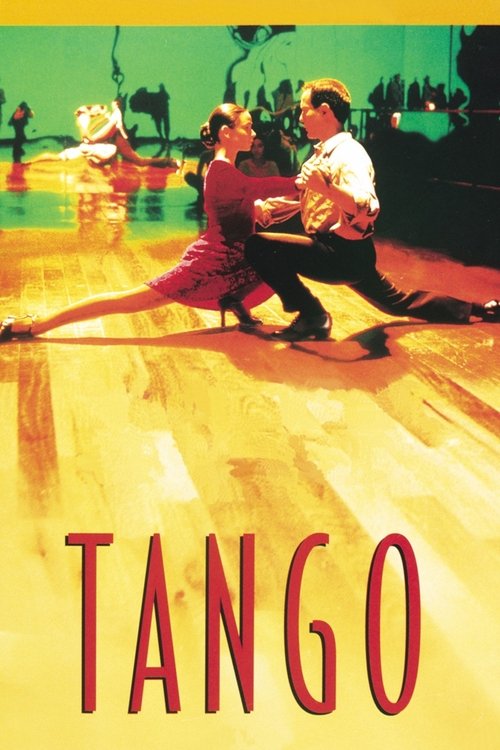
Carlos Saura stages Argentine tango as rehearsal, social ritual, erotic duet, queer role reversal, and political memory, with Juan Carlos Copes, Julio Bocca, and a vast ensemble moving through Vittorio Storaro’s colored studio architecture.
Tango is a 1998 dance feature film centred on Argentine Tango. For dancers, it's a chance to see the style performed on screen — the phrasing, partnering, and musicality that the same dances carry onto a real floor.
Jump to the 14 indexed dance sequences ↓
Dance styles featured
Where to watch: Sony Pictures' official U.S. page lists the DVD for purchase through Amazon; Plex listed no current streaming locations. Apple TV catalog pages were live in Spain and Brazil, but U.S. digital access was not verified. Availability checked 2026-08-09 and may change.
The dance sequences in Tango
14 sequences, 7 with a timestamp — what is danced, by whom, and where to find it.
Danced by Cecilia Narova; Carlos Rivarola
Laura and Ernesto’s profiles cutting through the dark before Mario enters the dance with a knife.
Silhouettes, reflections, and a driving pulse compress desire, jealousy, and violence into one volatile partnered tango. Mario’s intrusion with a dagger turns the duet into a rehearsal of possessive fantasy without breaking its continuous movement logic.
Open the film at this point · Stream or rental only — the timestamp is for when you have it playing.
Danced by Cecilia Narova; Carlos Rivarola
Two backs slowly resolving into one intimate tango hold.
The partners move from a guarded back-to-back start into a final embrace, letting the choreography perform emotional repair rather than merely illustrate it. Screen shadows preserve the sense that the relationship is still under construction.
Open the film at this point · Stream or rental only — the timestamp is for when you have it playing.
- 00:48:03
Nostalgias — Elena’s red-and-green shadow solo
Danced by Mía Maestro
Elena in red separating from her green-lit shadow.
Elena dances toward and then away from her own shadow, using tango phrasing without relying on a partner. The solo makes autonomy visible: her body answers the music while refusing to remain only an object of Mario’s gaze.
Open the film at this point · Stream or rental only — the timestamp is for when you have it playing.
Danced by Johana Copes
The child responding when the teacher calls his name inside the studio.
A dance teacher makes the form legible at child scale, linking technical transmission to Mario’s uncertain memories. The brief lesson folds apprenticeship into the film’s larger question of how tango survives between generations.
Open the film at this point · Stream or rental only — the timestamp is for when you have it playing.
Danced by Cecilia Narova; Mía Maestro; Carlos Rivarola
A triangular tango multiplied and distorted in the wall-sized mirror.
Three bodies make jealousy spatial: Ernesto becomes the hinge between the former and new leading women as a huge mirror fractures their alignments. Lime-green light and the visible camera keep rehearsal, fantasy, and emotional truth active at once.
Open the film at this point · Stream or rental only — the timestamp is for when you have it playing.
Danced by Cecilia Narova; Mía Maestro
Laura and Elena trading the lead amid wind-blown 1920s costumes and mirrors.
The women exchange lead and follow inside a theatrical milonga, loosening the dance’s conventional gender assignment without losing its intimate embrace. Wind, smoke, mirrors, and black-and-white costuming turn role-switching into the scene’s central craft.
Open the film at this point · Stream or rental only — the timestamp is for when you have it playing.
- 01:18:31
Tango Blanco & Negro — Julio Bocca and Carlos Rivarola’s ensemble duel
Danced by Julio Bocca; Carlos Rivarola; dance ensemble
Two male-led armies of dancers crossing a hard black-and-white border.
Black- and white-clad teams attack a chessboard-like floor with dragging feet, sharp crossings, and male duets that challenge the boundary between rivalry and comradeship. Storaro’s silhouettes make the dividing line itself function like a choreographic partner.
Open the film at this point · Stream or rental only — the timestamp is for when you have it playing.
Angelo’s salon — improvised social tango
Argentine TangoDanced by Mía Maestro; Vito Melino; salon dancers
A Buenos Aires salon alive with many different couples and vocabularies.
Improvised couples share a crowded floor where navigation, embrace, and rapid partner-reading matter more than display. Elena’s responsive following lets Saura contrast living salon practice with the staged tango that follows.
Open the film at this point · Stream or rental only — the timestamp is for when you have it playing.
Immigration suite — A Juan Carlos Copes milonga
MilongaDanced by Mía Maestro; Carlos Rivarola; Antonio Soares Junior; immigrant ensemble
The orchestra emerging as the immigrant gathering brightens into milonga.
The suite accelerates into an upbeat milonga as Elena and Ernesto dance with separate partners and the orchestra enters the frame. Its buoyancy shows how shared rhythm converts displacement into a new social world.
Open the film at this point · Stream or rental only — the timestamp is for when you have it playing.
Immigration suite — Corazón de Oro vals
Tango ValsDanced by Mía Maestro; Antonio Soares Junior; immigrant ensemble
Immigrant couples beginning to dance beneath gold, blue, and purple light.
A creole vals in 3/4 lets newly arrived immigrants turn homesickness into circling social connection. Period silhouettes and slowly warming color make the dance feel like a community assembling itself in real time.
Open the film at this point · Stream or rental only — the timestamp is for when you have it playing.
Immigration suite — La Cumparsita tango
Argentine TangoDanced by Cecilia Narova; Juan Carlos Copes; immigrant ensemble
A young girl watching Laura and Juan Carlos Copes dance La Cumparsita.
Laura’s dance with master Carlos Nebbia brings the historical suite to canonical Argentine tango, placing seasoned partnership under the gaze of a young observer. The scene makes tradition look transmitted rather than frozen.
Open the film at this point · Stream or rental only — the timestamp is for when you have it playing.
La Represión — Dirty War dance theatre
Danced by Mía Maestro; dance ensemble
Elena’s terrified body surrounded by a stark choreographed vision of Argentina’s Dirty War.
Saura replaces the ‘disappeared’ tango with ballet and modern dance, making absence itself the political device. The ensemble’s torture and massacre imagery forces historical violence into the body rather than explaining it through dialogue.
Open the film at this point · Stream or rental only — the timestamp is for when you have it playing.
Recuerdo — Juan Carlos and Johana Copes
Argentine TangoDanced by Juan Carlos Copes; Johana Copes
Juan Carlos and Johana Copes trading explosive gancho-ocho patterns.
The father-daughter pair alternate poised restraint with rapid gancho-ocho variations, turning a classic stage tango into a dialogue across generations. Their tandem hooks and figure-eight actions complicate fixed ideas of masculine command and feminine delicacy.
Open the film at this point · Stream or rental only — the timestamp is for when you have it playing.
Tango Bárbaro — staged stabbing at the immigrant dance party
Danced by Mía Maestro; Antonio Soares Junior; immigrant ensemble
Elena’s silhouette collapsing against a golden-orange field as the rehearsal spills into apparent tragedy.
The celebratory immigrant suite curdles into a staged stabbing as color, silhouette, and tango rhythm fuse historical memory with Mario’s private fear. The shock works because the choreography remains continuous enough to make fiction look momentarily real.
Open the film at this point · Stream or rental only — the timestamp is for when you have it playing.
More dance films
Poster artwork from TMDB.
 This site uses TMDB and the TMDB APIs but is not endorsed, certified, or otherwise approved by TMDB.