Billy the Kid is a one-act ballet score composed by Aaron Copland in 1938 on commission from Lincoln Kirstein, choreographed by Eugene Loring for Kirstein's touring company Ballet Caravan. It premiered on 16 October 1938 in Chicago in a two-piano version, with the first orchestral performance following in New York on 24 May 1939. The catalogue holds it as a Copland ballet; the wider record shows it is also a landmark of American narrative ballet, built on cowboy and folk melodies rather than a literal biography of the outlaw.
What is danced
The article gives a clear narrative and musical spine — nine numbered sections running from 'Introduction: The Open Prairie' through a frontier-town killing, a desert manhunt and gun battle, a jailbreak during a card game, a celebration, a waltz, Billy's death at the hands of Pat Garrett, and a closing reprise of the opening prairie music — but it does not describe the actual choreographic vocabulary Loring used to stage any of this. What can be said with confidence from the source is about the music that shapes the dancing: the score leans on named cowboy and folk tunes ('Great Grandad', 'Git Along, Little Dogies', 'The Old Chisholm Trail', 'Goodbye Old Paint') and inserts a Mexican Jarabe, played in 5/8 by a solo trumpet, immediately before 'Goodbye Old Paint' — evidence of a Mexican-inflected dance interlude distinct from the Americana material surrounding it.
Context
The article situates the work through Ballet Caravan, the company Lincoln Kirstein formed to commission new American ballets, and through its place beside Copland's later Rodeo and Appalachian Spring as one of his 'most popular and widely performed pieces' — a trio the article itself groups together as a recognisable line of Americana ballet scores. Beyond that grouping the article gives no account of the surrounding dance world; any broader claim about Ballet Caravan's role in the 1930s search for a native American ballet vocabulary, or about Loring's place relative to Balanchine within Kirstein's ventures, comes from outside the source and is not asserted here as documented fact.
Staging history
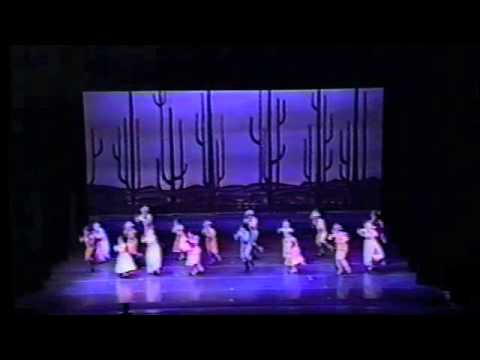
The article records the world premiere by the Ballet Caravan Company in Chicago on 16 October 1938, danced to a two-piano reduction played by Arthur Gold and Walter Hendl, and the first New York performance on 24 May 1939 with an orchestra under Fritz Kitzinger. It also points to a full filmed performance by Oakland Ballet from 1977 (held via CaliforniaRevealed.org) as an accessible later staging, and notes that jazz guitarist Bill Frisell used the ballet's eight movements as the basis for the first seven tracks of his album 'Have a Little Faith' — a musical afterlife rather than a stage revival, but evidence the score has travelled well outside the ballet house.
How to watch it
Watch the frame the article gives you: the ballet opens and closes on 'The Open Prairie', so the pioneer-trek music that begins the piece returns transformed at the end, and everything of Billy's life happens inside that frame. Listen for the shift in idiom between the folk-tune numbers (the frontier-town scene, the card game, the waltz) and the inserted Mexican Jarabe just before 'Goodbye Old Paint', and note where the orchestration turns overtly percussive for the gun battle — the article specifically calls out its 'prominent percussive effects' as the sound of the shootout rather than a spoken or mimed event.
Structure
- Introduction: The Open PrairieThe ballet opens with pioneers trekking westward across the open prairie.
- Street Scene in a Frontier TownIn a frontier town young Billy and his mother are present; she is killed by a stray bullet during a gunfight, and Billy stabs her killer before fleeing.
- Mexican Dance and FinaleListed as a number in the score's order; the article does not describe its specific stage action.
- Prairie Night (Card Game at Night, Billy and his Sweetheart)A night scene involving a card game and Billy's sweetheart; the article separately describes Billy later stealing a gun from a warden during a card game to escape jail, though it does not confirm this is the same episode.
- Gun BattleBilly, living in the desert, is hunted and captured by a posse in a gun battle marked by prominent percussive effects, then taken to jail.
- Celebration (After Billy's Capture)A celebratory number following Billy's capture by the posse.
- WaltzA waltz number in the score; the article does not specify its narrative placement.
- Billy's DeathBilly escapes jail and returns to his hideout believing himself safe, but sheriff Pat Garrett catches up and shoots him to death.
- The Open Prairie AgainThe ballet closes with the Open Prairie theme returning and pioneers once again travelling west.
Structure read from an encyclopaedia article, not from a libretto or score we hold. Confirm against a programme before treating the numbering as authoritative.
Credits
- composer: Aaron Copland
More from Aaron Copland
Other staged works in the register connected to this one by author or lineage.