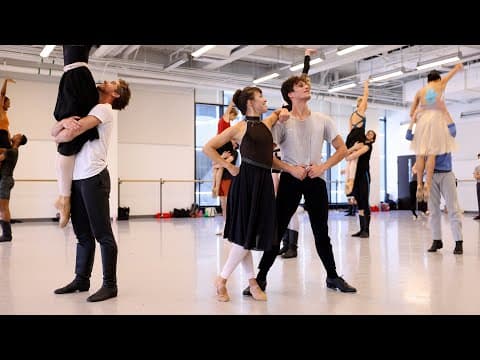
Rodeo is a one-act ballet, subtitled "The Courting at Burnt Ranch," made by choreographer Agnes de Mille to a commissioned score by Aaron Copland, premiered in 1942 by the Ballet Russe de Monte Carlo. It tells a slight, comic story of a tomboyish Cowgirl who competes with the more conventionally feminine Rancher's Daughter for the attention of the ranch hands, resolving when the Cowgirl finally appears in a dress and wins the Champion Roper.
What it contains
- Classical Ballet · The whole ballet — Classical ballet technique underlies the whole piece even as it absorbs Broadway energy and vernacular forms; the male corps performs balletic solo and group work while pantomiming riding and roping. Source: "Rodeo combines the exuberance of a Broadway musical with the disciplines of classical ballet."
- Classical Ballet — Buckaroo Holiday · Buckaroo Holiday, the opening section — Men dance solo and in groups while pantomiming riding and roping, an unusual assignment for male ballet dancers, performed in stylized western costume. Source: "the first scene requires men to pantomime riding and roping while dancing solo and dancing in groups (not very common for male ballet dancers)"
What is danced
The ballet's opening section requires the male corps to pantomime riding and roping while dancing solo and in groups, an unusual demand for male ballet dancers of the period, all executed in stylized western costume that the article notes makes the steps harder to perform. The Cowgirl role is built on contrast: she mimics the cowboys' movement to gain acceptance, producing rapid-fire footwork and pantomime that apes the men's bronco-busting, then must shift into vulnerability and conventional femininity for the closing sections, culminating in a climactic kiss with the Roper. De Mille wove in vernacular forms alongside the classical vocabulary -- the article specifically names a square dance and a cadenza for a tap dancer -- plus riding movements she had developed years earlier for a London recital with Peggy van Praagh and Hugh Laing. The narrative sections ('Corral Nocturne' and 'Saturday Night Waltz') use pairing-off and social-dance pantomime as ensemble device, contrasted against the Cowgirl's solitary, more balletic lyricism.
Context
Rodeo was made in a moment of rivalry between the Ballet Russe de Monte Carlo and Ballet Theatre, both scrambling for American identity after relocating to the United States during World War II; the commission pulled de Mille out of relative obscurity and gave her unusual creative control over a company otherwise steeped in European repertoire. Alongside Copland's earlier Billy the Kid, it is treated in the article as one of the earliest true American ballets, grafting Broadway-musical energy and American vernacular material onto classical ballet technique and structure. Its success directly led Rodgers and Hammerstein, who attended the premiere, to hire de Mille for Oklahoma!, linking the ballet stage directly to the Broadway musical's own choreographic turn.
Staging history
De Mille danced the Cowgirl herself at the Metropolitan Opera House premiere on 16 October 1942, and retained veto power over future casting, a control that made finding a satisfactory Cowgirl a recurring difficulty for companies staging the work. Staging passed through named custodians after her: Vernon Lusby and later Paul Sutherland handled physical staging, while Christine Sarry became, in de Mille's own view, the definitive interpreter of the Cowgirl and was named in de Mille's will as sole approver of future dancers in the role; after de Mille's death in 1993 rights passed to her son Jonathan Prude, who in 1999 assigned staging authority to Sutherland, who has since staged the ballet more than fifty times across North America and in Belgium.
How to watch it
Watch the first section for how the male ensemble is made to pantomime riding and roping as group and solo dance material, a reversal of typical male-corps convention. Track the Cowgirl's physical vocabulary against the other women's: her rapid, imitative footwork and pantomime are meant to read as a deliberate refusal of feminine convention, which only resolves at the final kiss. The vernacular interpolations -- a square dance and a tap cadenza -- are worth watching as departures from straight classical vocabulary within an otherwise balletic frame.
Structure
- Buckaroo HolidayThe Cowgirl seeks the Head Wrangler's attention while he favors the more feminine Rancher's Daughter; cowboys enter to 'Sis Joe' and 'If He'd Be a Buckaroo' with heavy group and solo pantomime of riding.
- Corral NocturneThe Cowgirl's lovesick solo in the empty corrals is discovered by the Head Wrangler, who exits confused with the Rancher's Daughter instead.
- Ranch House PartyIndoor honky-tonk dance music frames the Cowgirl caught between the Champion Roper and the Wrangler, both drawn to the Rancher's Daughter; she ends up alone.
- Saturday Night WaltzCouples pair off to a waltz built on the folk tune 'I Ride an Old Paint'; the Cowgirl is left partnerless until the Champion Roper approaches her.
- Hoe-DownBuilt on 'Bonaparte's Retreat' and 'Miss McLeod's Reel', the section builds to the climactic kiss between the Cowgirl and the Roper.
Structure read from an encyclopaedia article, not from a libretto or score we hold. Confirm against a programme before treating the numbering as authoritative.
Credits
- composer: Aaron Copland
Related works
Other staged works in the register connected to this one by author or lineage.
 Oklahoma!Musical theatre · 1943Mille · video
 Fall River LegendBallet · 1948Mille · video
 Appalachian SpringBallet · 1944Music by Copland · video
 Billy the KidBallet · 1938Music by Copland · video
 Rodeo: Four Dance EpisodesBallet · 2015Music by Copland · video
 Swan LakeBallet · 1877Same lineage · video
 Les RendezvousBallet · 1933Same lineage · video
 Western SymphonyBallet · 1954Same lineage · video