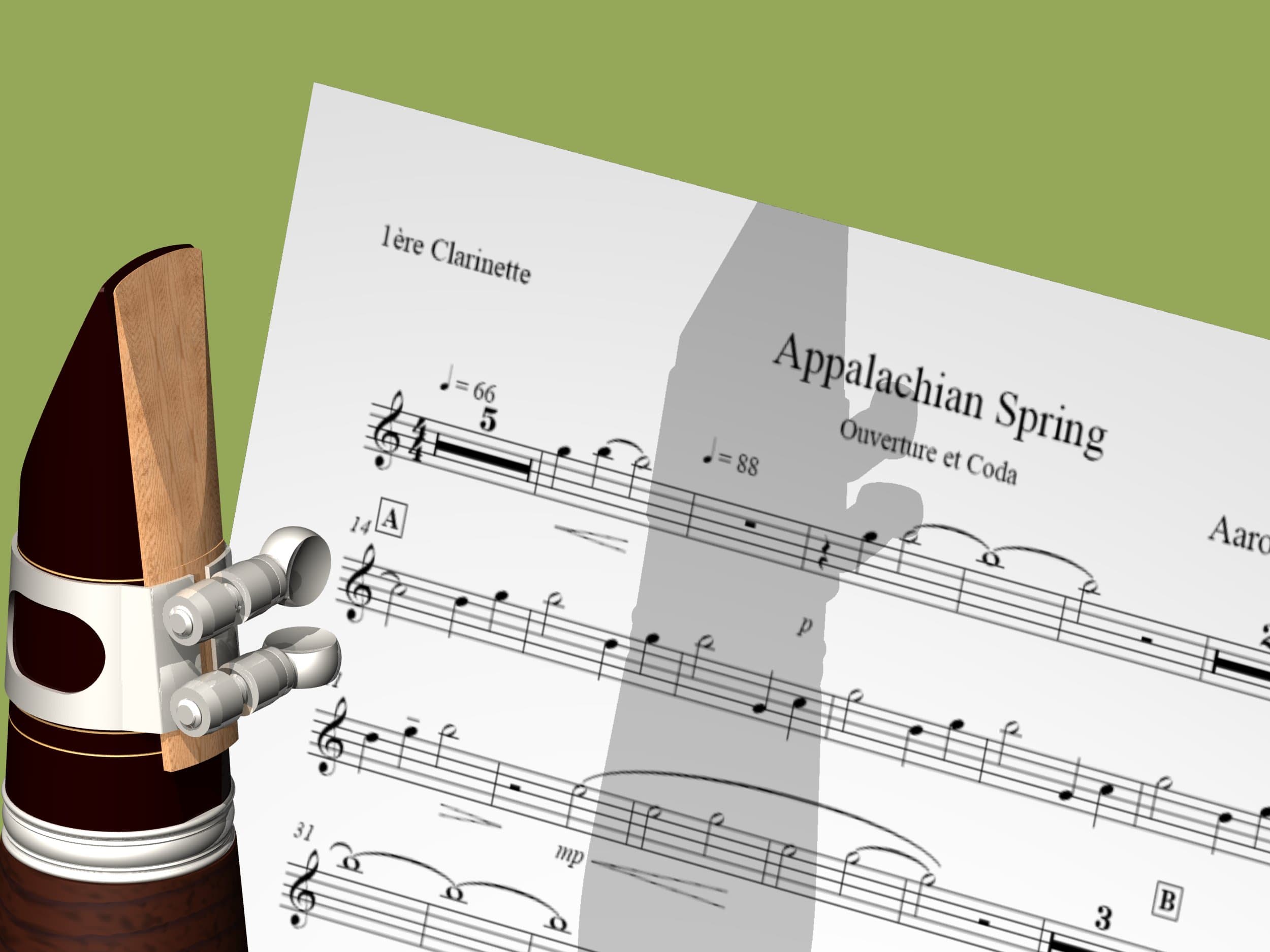
Ruizo — Own work · CC BY-SA 3.0
Appalachian Spring (1944) is a modern-dance work made by choreographer Martha Graham to a commissioned score by Aaron Copland, premiered at the Coolidge Auditorium and carried into the core repertory of the Martha Graham Dance Company. It sits in this catalogue as a ballet by designation, but its vocabulary is Graham's own dance-modernist idiom rather than academic ballet: nine dancers (the Bride, the Husbandman, the Pioneer Woman, the Revivalist and his four Followers) enact a non-literal wedding-day drama on an Isamu Noguchi set, with Copland's score - built around the Shaker tune 'Simple Gifts' - built to Graham's own scenario and revisions.
What it contains
- Graham Technique · The entire ballet, all eight episodes from Prologue to The Lord's Day — Distinct physical signatures per character built from Graham's own vocabulary: the Bride confined to quick patterns in an imaginary box, the Revivalist held in strict rigid posture, the Pioneer Woman moving with continuous flow. Source: "Graham was known for creating the "Graham technique" of dance"
- Graham Technique — Eden Valley · Eden Valley, group passages for the Revivalist's four Followers — Unison group solos built on a spiraling motion that resolves into a kneeling position, cued precisely to short woodwind motifs as each Follower sits. Source: "the group often features a "spiraling" motion, moving into a kneeling position"
- Graham Technique — Fear in the Night · Fear in the Night, the Revivalist's central solo — A convulsive solo of full-body shaking that travels through the torso and limbs, staged as an ecstatic, near-possessed state rather than pantomimed narrative. Source: "The Revivalist's solo uses violent shaking to relate the dance to traditional Shaker festivities; the shaking travels throughout the body, like a spirit trying to escape the body."
What is danced
The choreography does not mime a wedding step by step; instead each character is given a distinct physical signature that carries the emotional argument. The article describes the Bride's movement as 'quick patterns that stayed within an imaginary box around her,' set against 'the Revivalist's strict posture and the flowing movements of the Pioneer Woman' - a deliberate three-way contrast of confinement, rigidity and flow that a dancer taking any of these roles needs to hold onto rather than blend. The Husbandman's solo work is described as jagged and awkward in the courtship duet, then as a 'Davy Crockett-esque solo' at the height of the wedding festivities, and later as a leaping solo of anguish in 'Day of Wrath.'
Group work for the four Followers is built around unison and stillness rather than individual display: Graham wanted them 'perfectly still until their time came,' with group solos featuring 'a "spiraling" motion, moving into a kneeling position,' cued precisely to woodwind motifs. The Revivalist's central dramatic solo in 'Fear in the Night' uses 'violent shaking' that 'travels throughout the body, like a spirit trying to escape the body,' drawing directly on Shaker ecstatic movement. The overall physical vocabulary throughout is Graham's own technique - the article credits her explicitly with 'creating the "Graham technique" of dance' - and the piece is built to alternate between stylised courtship duets, communal celebration (with music the article ties to 'square dancing and fiddling' and an 'old-fashioned swing'), and passages of collective anxiety such as the frantic running and unison frenzy of 'Moment of Crisis.'
Context
Appalachian Spring arrived at a moment when both Graham and Copland were consolidating an American idiom against European models: Graham had spent the 1930s commissioning scores tied to American history and folklore (as in American Document), and Copland had been moving from dissonant, jazz-inflected writing toward the plain, folk-adjacent Americana style he had already tried in Billy the Kid, Rodeo and El Salón México. The commission, brokered by Erick Hawkins and funded by patron Elizabeth Sprague Coolidge, brought the two together for the first time on Graham's terms rather than a commercial choreographer's, and the result helped define what an American concert-dance modernism, distinct from both European ballet and Broadway spectacle, could look like at mid-century.
Staging history
The ballet premiered at the Coolidge Auditorium on October 30, 1944, and toured with the same cast before a celebrated New York run in 1945, the same week Copland won the Pulitzer Prize for Music. High licensing costs kept it exclusively within the Martha Graham Dance Company repertory for over fifty years; the Colorado Ballet became the first outside company to stage it, in 1998, followed by the Baltimore School for the Arts in 2013 (the first non-professional company granted permission) and later productions by companies including Nashville Ballet, Dance Kaleidoscope, and Sarasota Ballet. Two filmed versions exist that preserve close-to-original choreography: a 1958 film with Graham herself as the Bride, and a 1976 WNET 'Dance in America' film with Yuriko in the lead.
How to watch it
Watch for the deliberate non-literalism: there is no danced wedding ceremony, only a sequence of emotional states assigned to fixed physical vocabularies - the Bride's confined, quick patterning, the Revivalist's rigid stillness broken by convulsive shaking, the Pioneer Woman's flowing continuity. Note how closely the choreography is cued to the score's small chamber textures (the Followers' seated positions land on specific woodwind motifs), and listen for the four variations on 'Simple Gifts' in the Interlude, which the choreography treats as a structural spine rather than decoration.
Structure
- PrologueThe Revivalist, Pioneer Woman, Husbandman and Bride enter in sequence as daylight rises over the set, establishing the ballet's opening polychordal themes.
- Eden ValleyThe Bride and Husbandman dance a courtship duet framed by a recurring chorale theme, while the four Followers perform group solos including a spiraling motion into a kneeling position.
- Wedding DayCommunity celebration and a charivari surround the couple; the Husbandman and Bride each dance rhythmically complex solos before the Revivalist dances with his Followers.
- InterludeFour variations on the Shaker tune 'Simple Gifts' accompany the Bride and Husbandman's joyful duet and the townspeople's daily rounds, with the Revivalist and Followers joining toward the close.
- Fear in the NightThe Revivalist and his Followers warn the couple of coming separation in an agitated, violently shaking solo that frightens the Bride before she rejoins the Husbandman.
- Day of WrathThe Pioneer Woman enters in anger and prayer; the Husbandman performs a leaping solo of anguish before waving goodbye and leaving, apparently for war.
- Moment of CrisisThe Bride and the town's women dance in anxious, frenzied unison before calm returns with the Husbandman's brief reappearance and a final statement of 'Simple Gifts.'
- The Lord's DayThe community gathers for prayer; the Bride dances a final solo, briefly reunites with the Husbandman, and the ballet closes with her seated in the Pioneer Woman's rocking chair.
Structure read from an encyclopaedia article, not from a libretto or score we hold. Confirm against a programme before treating the numbering as authoritative.
Credits
- composer: Aaron Copland
Related works
Other staged works in the register connected to this one by author or lineage.
- JudithJudithBallet · 1950Graham
 LamentationBallet · 1930Graham · video
 Cave of the HeartBallet · 1946Graham · video
 ClytemnestraBallet · 1958Graham · video
 Errand into the MazeBallet · 1947Graham · video
- Imagined WingImagined WingBallet · 1944Graham
 Billy the KidBallet · 1938Music by Copland · video
 RodeoBallet · 1942Music by Copland · video