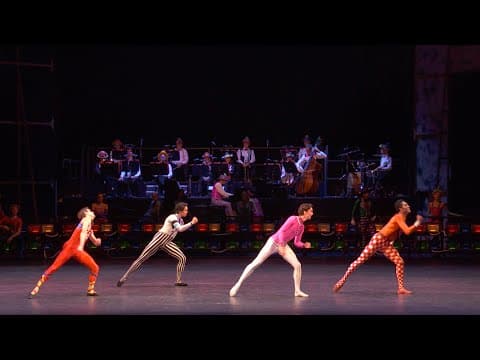
Elite Syncopations (1974)
Elite Syncopations is a one-act ballet made in 1974 by Kenneth MacMillan for The Royal Ballet, set to ragtime pieces principally by Scott Joplin but drawing on several other 'classic' ragtime composers. It premiered at the Royal Opera House on 7 October 1974, with an onstage 12-piece band and costumes by Ian Spurling evoking a 1920s party. It sits in the catalogue as a rare comic, popular-idiom showcase piece from a choreographer and company otherwise known for large narrative and dramatic ballets.
What it contains
- Vaudeville Jazz · Throughout the one-act ballet — Described as having an up-beat, hip swinging quality with easygoing, syncopated rhythms, staged as a 1920s party with a live onstage band, and judged broadly comic/'vulgar' by contemporary critics — consistent with early-20th-century vaudeville-jazz performance idiom rather than a purely classical vocabulary, though the article names no specific steps. Source: "It is described as having an up-beat, hip swinging aura of spontaneity, with 'easygoing rhythms'."
What is danced
The article's own description of the movement is brief but pointed: the ballet has 'an up-beat, hip swinging aura of spontaneity, with easygoing rhythms', staged as a 1920s party with a visible 12-strong band playing at the back of the stage while the 12 dancers perform in front. Individual principals were given featured turns tied to specific rags in the score — Merle Park to Stop Time Rag, Monica Mason to Calliope Rag, Michael Coleman to Friday Night, Jennifer Penney to The Cascades, and both Vergie Derman and Wayne Sleep to the Alaskan Rag — suggesting a structure of successive named solo or small-group numbers rather than a continuous narrative dance. The article does not specify individual steps, use of pointe, partnering holds or technical vocabulary, so no detailed choreographic description can be drawn from it beyond mood and casting.
Context
The piece was made for The Royal Ballet in 1974, entering a company repertory built largely around full-length dramatic and classical works; a broadly comic, jazz-age piece for a full ensemble plus visible onstage musicians was a departure in tone. Contemporary critics registered that departure directly: The Times and The Observer found it 'vulgar and unstylish', while Dance and Dancers called it 'cheerfully diverting' and praised the chance it gave 'some of the Royal Ballet's best and most distinctive principals' to show 'new facets of their artistry'. Reception shifted with distance from the London premiere: when the ballet reached New York in 1976 The New York Times reviewed it enthusiastically, and it has 'remained popular with audiences' since.
Staging history
The original Royal Ballet production was filmed by the BBC in 1975 with the premiere cast, staged in a big top in Battersea rather than a conventional theatre. The ballet entered the repertory of a second company, Birmingham Royal Ballet, on 10 February 1978 at Sadler's Wells Theatre. A 2003 DanceView notice, looking back on the piece, judged the humour 'broad' and the choreography 'simple minded' but noted it still 'offered opportunities for dancers to let loose', indicating the work had by then settled into repertory as a crowd-pleasing showpiece rather than a critical set text.
How to watch it
Watch for the 12-piece band placed visibly upstage, playing live as part of the stage picture rather than hidden in the pit — this is central to the 1920s party conceit. Attend to how individual principals are given a single rag each as a personal turn (listed by name against a specific tune in the original cast), which structures the piece as a sequence of character cameos rather than a through-danced narrative; Ian Spurling's costumes reinforce the jazz-age setting.
Structure
- Stop Time RagA featured turn danced by Merle Park in the original 1974 cast.
- Calliope RagA featured turn danced by Monica Mason in the original 1974 cast.
- Friday NightA featured turn danced by Michael Coleman in the original 1974 cast.
- The CascadesA featured turn danced by Jennifer Penney in the original 1974 cast.
- Alaskan RagA featured turn danced jointly by Vergie Derman and Wayne Sleep in the original 1974 cast.
Structure read from an encyclopaedia article, not from a libretto or score we hold. Confirm against a programme before treating the numbering as authoritative.
Credits
- composer: Scott Joplin
In the same lineage
Other staged works in the register connected to this one by author or lineage.


