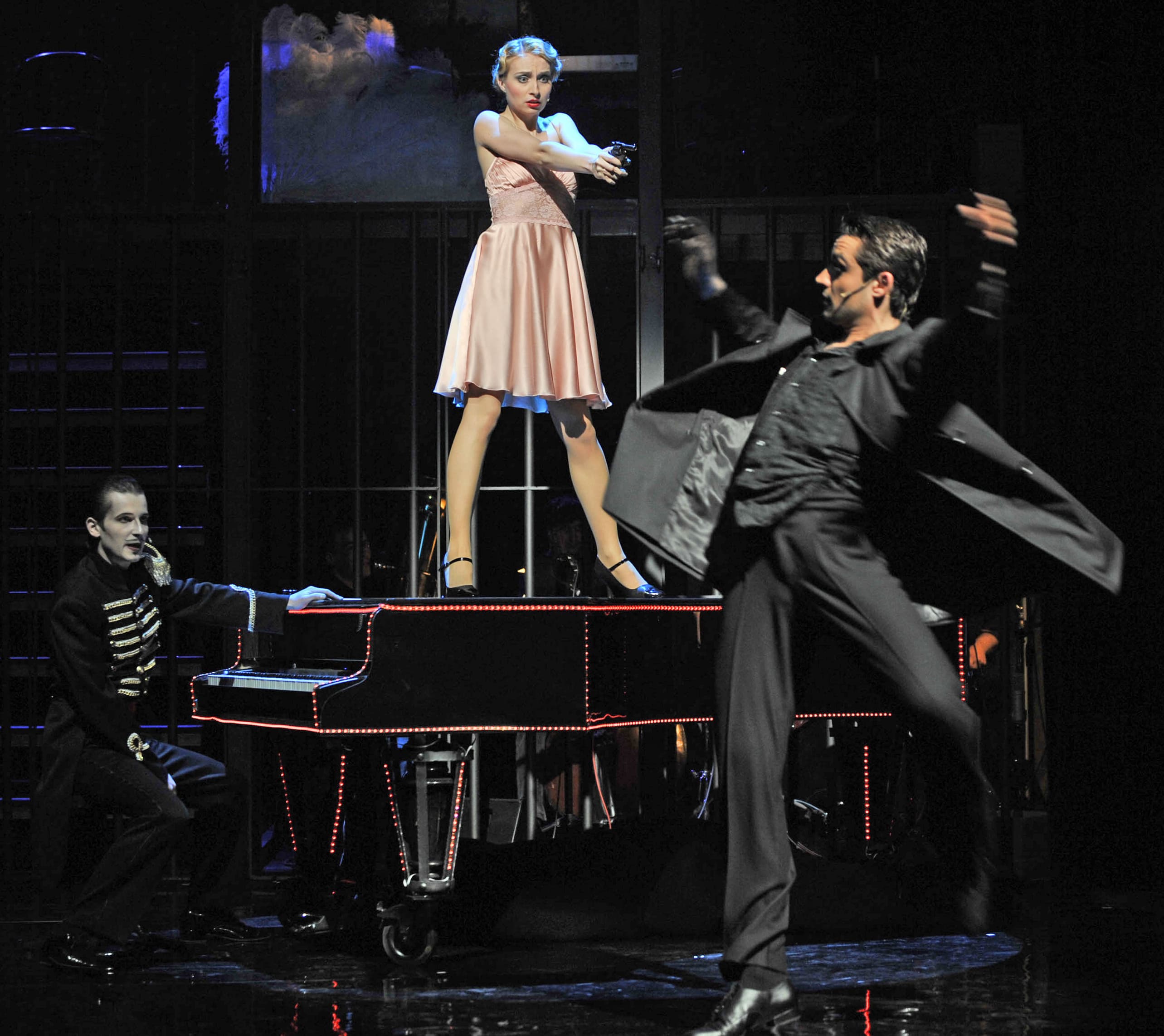
Jef Kratochvil — http://www.mdb.cz/galerie-4/?galerie=175 · CC BY-SA 3.0 cz
Chicago (1975)
Chicago is the 1975 Kander and Ebb musical, directed and choreographed by Bob Fosse, built on Maurine Dallas Watkins's 1926 play about two Jazz Age women on trial for murder in Cook County. Billed on its own title page as 'A Musical Vaudeville,' it frames a satire of celebrity-obsessed criminal justice as a string of specialty acts, each one modelled on a real vaudeville or nightclub performer, so that the dancing is never incidental decoration but the show's structural conceit.
What it contains
- Fosse Style · Entire production, original and subsequent stagings — Isolations, turned-in positions, hat and glove work, and the added finger-snap gesture in 'Razzle Dazzle' are cited as staging conventions that became identified with the show and its choreographer. Source: "Fosse directed and choreographed the original production, and his style is strongly identified with the show"
- Vaudeville Jazz · The show's musical numbers throughout, described as 'A Musical Vaudeville' — Each number was built as a discrete, presentational vaudeville-style act modeled on a specific period performer's persona and delivery, rather than integrated into naturalistic scene action. Source: "modeling each number on a traditional vaudeville number or a vaudeville performer"
- Burlesque & Neo-Burlesque — All I Care About · Act I, 'All I Care About' — A chorus of fan dancers performs around Billy Flynn during his anthem number, a burlesque fan-dance staging device. Source: "his anthem, complete with a chorus of fan dancers"
- Broadway Tap — A Tap Dance · Act I, the number titled 'A Tap Dance' — The scene in which Roxie convinces Amos to fund her defense is staged as a Broadway-style tap number per its own title. Source: "Roxie convinces Amos to pay for Billy Flynn to be her lawyer ("A Tap Dance")"
What is danced
The article is explicit that the musical's numbers were built as vaudeville turns rather than integrated book songs: Kander and Ebb 'modeled each number on a traditional vaudeville number or a vaudeville performer' (Roxie as Helen Morgan, Velma as Texas Guinan, Billy Flynn as Ted Lewis, Mama Morton as Sophie Tucker). Fosse's own choreographic identity is described as inseparable from the piece — 'his style is strongly identified with the show' — and the article records specific staging choices that became fixed conventions of the role, including the added double finger-snap in 'Razzle Dazzle' (Ebb's suggestion to Kander, kept once Fosse heard it) and the rejection of an orgiastic courthouse-steps staging for that same number in favour of a subtler treatment.
Named numbers described in the synopsis point to specific dance content: 'All I Care About' is staged 'complete with a chorus of fan dancers,' pointing toward burlesque-adjacent fan choreography around Billy Flynn; 'A Tap Dance' is the title given to the scene in which Roxie persuades Amos to pay her lawyer, implying a tap turn at that moment; and the finale 'Hot Honey Rag' has the reveal that Mary Sunshine is a man shaping Roxie and Velma's closing duet 'to make it as sexy as possible.' The original finale was cut and reworked in rehearsal — a doubles number called 'Loopin' the Loop' for Verdon and Rivera was replaced by 'Nowadays' because Fosse wanted something 'more glamorous in pretty gowns,' a decision that shows the choreography being actively revised against the material rather than fixed from the page.
Beyond these specifics, the article does not give step-by-step choreographic description — no positions, holds, or technical vocabulary are itemized for any number. What can be established is genre and stylistic lineage (vaudeville-era specialty acts filtered through Fosse's own movement idiom), not the actual physical vocabulary a dancer would need to reconstruct a number.
Context
The show opened on Broadway in June 1975, the same season as Michael Bennett's A Chorus Line, against which it lost commercially and at the Tony Awards; the article notes its Brechtian, fourth-wall-breaking style 'made audiences uncomfortable' at the time, a harder sell than Bennett's warmer backstage narrative. Where A Chorus Line integrated dance into an emotionally continuous story, Chicago's vaudeville-act structure, explicitly modeled on named period performers, kept its dance numbers presentational and ironic — a distinct answer to the same mid-1970s moment in commercial theatrical jazz.
Staging history
The original 1975 production (directed and choreographed by Fosse, starring Gwen Verdon, Chita Rivera, Jerry Orbach and Barney Martin) ran 936 performances before closing in 1977, with Liza Minnelli filling in for an ill Verdon for over a month. The 1996 Broadway revival, developed from a City Center Encores! concert staging, was choreographed by Ann Reinking 'in the style of Bob Fosse' rather than as a strict restaging of the original, and this stripped-down, minimalist production (band on stage as a jury box) is the version that has since become the long-running standard, transferring twice within Broadway and generating the London 1997 production, national tours, and licensed productions worldwide (Argentina 1977, Australia 1981, Japan, France, Korea, Peru, Costa Rica, Indonesia, among others). The article records that the original 1975 cast recording was later added to the National Recording Registry, evidence of the production's retrospective canonical status.
How to watch it
Watch for the show's presentational, direct-address staging — numbers are announced and performed to the audience as acts, not folded into naturalistic scene continuity — and for isolated Fosse-idiom gestures such as the finger-snaps built into 'Razzle Dazzle.' Because the influential 1996 staging is deliberately minimalist (a bare set with the band as a visible jury box), the dancing itself, rather than scenery, carries the show's argument about performance and celebrity; compare any production against how tightly its choreography still tracks the vaudeville-performer models named for each principal.
Structure
- Act I · Cell Block TangoRoxie is sent to the women's block of Cook County Jail, where the female inmates, including Velma Kelly, are introduced.
- Act I · A Tap DanceRoxie convinces Amos to pay for Billy Flynn's services as her lawyer.
- Act I · All I Care AboutBilly Flynn sings his anthem to his all-woman prison clientele, staged with a chorus of fan dancers.
- Act II · Razzle DazzleBilly calms the terrified Roxie before trial by promising to turn the proceedings into a show.
- Act II · ClassRoxie steals Velma's stage business, including her rhinestone garter, to Mama's and Velma's dismay.
- Act II · Hot Honey RagThe revealed male vaudeville promoter (formerly Mary Sunshine) shapes Roxie and Velma's closing duet to be as sexy as possible.
Structure read from an encyclopaedia article, not from a libretto or score we hold. Confirm against a programme before treating the numbering as authoritative.
On screen
In the same lineage
Other staged works in the register connected to this one by author or lineage.


