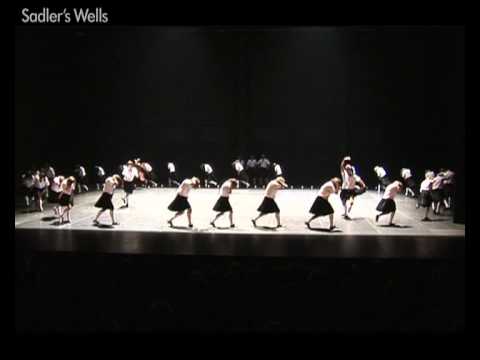
Impressing the Czar is a large-scale, multi-part theatrical work made by William Forsythe for Ballet Frankfurt, first given complete in 1988. It is built from five distinct, self-contained sections rather than a through-line story, and it uses ballet's own history and economics — auctions, patronage, imperial spectacle — as its subject matter, with the title itself referring to Tsar Nicholas II's lukewarm reaction to Petipa's The Sleeping Beauty.
What is danced
The article describes the piece almost entirely through its thematic and dramaturgical content rather than through named steps or technique, so a precise account of the vocabulary danced in each section cannot be drawn from it. What can be established structurally: the ballet opens with 'Potemkin's Signature,' a section built on cultural references to the history of ballet itself; its second section, 'In the Middle, Somewhat Elevated,' is a stand-alone piece originally made in 1987 for the Paris Opera Ballet and premiered there by four named soloists, and is described as one of Forsythe's most famous creations and now widely performed independently by companies around the world. The third section, 'La Maison de Mezzo-Prezzo,' stages characters being auctioned off in gold costume as a satire on the commodification of art. The fourth section, 'Bongo Bongo Nageela,' involves a large group of dancers moving around a central figure, Mr. Pnut, in a circling pattern the article explicitly likens to folk dance 'though not of any particular kind' — a deliberately unspecific comparison that should not be read as naming an actual folk-dance style. The final section, 'Mr. Pnut Goes to the Big Top,' ends with the title character blowing a party favor as the lights cut out.
Because none of this constitutes a description of steps, holds, partnering or technique, no movement-vocabulary claims can be responsibly coded from the source text as given.
Context
The work dates from Forsythe's directorship of Ballet Frankfurt in the late 1980s, a period in which he was reworking classical ballet's formal vocabulary and institutional rituals from the inside rather than abandoning them. The article frames the piece as explicitly engaging with ballet history — invoking Petipa's imperial-era Sleeping Beauty and the culture of courtly spectacle — while treating that history satirically, which situates it within the broader postmodern turn in ballet toward self-reference and irony rather than narrative illusion.
Staging history
The full four-act version premiered with Ballet Frankfurt in Frankfurt am Main in 1988. Its second section, 'In the Middle, Somewhat Elevated,' had an earlier, separate premiere in 1987 with the Paris Opera Ballet, danced by soloists Isabelle Guérin, Sylvie Guillem, Laurent Hilaire, and Manuel Legris, and has since entered the repertory of numerous ballet companies as an independent piece; a 1992 performance of it by the Royal Ballet Flanders received the Laurence Olivier Award for Outstanding Achievement in Dance.
How to watch it
Watch for the absence of a single narrative thread — the five sections function almost as satirical sketches on different aspects of ballet's cultural and economic history, from imperial patronage to art-market auction to circus spectacle. Note that the second section, 'In the Middle, Somewhat Elevated,' is frequently programmed on its own outside the context of the larger work, so seeing it inside Impressing the Czar versus as a stand-alone piece changes what surrounds and frames it.
Structure
- Potemkin's SignatureOpens the ballet with a commentary on the culture and history of ballet, dense with cultural references in its character names and plot pieces.
- In the Middle, Somewhat ElevatedA stand-alone piece originally made in 1987 for the Paris Opera Ballet, referring in its title to two cherries suspended over the stage; now one of Forsythe's most widely performed creations.
- La Maison de Mezzo-PrezzoCharacters are auctioned off, clothed in gold, as commentary on the commoditization of the arts.
- Bongo Bongo NageelaA large group of dancers surrounds Mr. Pnut, portrayed as a Saint Sebastian-type figure with an arrow in his chest, moving in a circling pattern likened to, but not identified with, a particular folk dance.
- Mr. Pnut Goes to the Big TopThe final section, ending as Mr. Pnut blows a party favor toy and the lights go out.
Structure read from an encyclopaedia article, not from a libretto or score we hold. Confirm against a programme before treating the numbering as authoritative.
Credits
- composer: Ludwig van Beethoven
- composer: Tom Willems
Related works
Other staged works in the register connected to this one by author or lineage.

