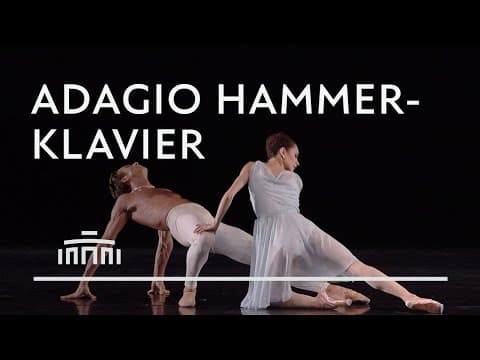
Adagio Hammerklavier is a plotless ballet for three couples, made by Hans van Manen for the Dutch National Ballet and set entirely to the slow third-movement Adagio of Beethoven's Piano Sonata No. 29 (the 'Hammerklavier'). It premiered on 4 October 1973 at the Stadsschouwburg, Amsterdam, and has since entered the repertories of major companies internationally, becoming one of van Manen's most widely performed works.
What it contains
- Neoclassical Ballet · the whole ballet, continuous through the single Adagio movement — Plotless choreography for three couples built on unison partnering, women curling and drooping to the floor rather than lifted, and walks breaking into stamps — restrained, detail-driven ballet vocabulary rather than classical narrative dancing. Source: "Like many of van Manen's works, Adagio Hammerklavier is a plotless work with a strong edge of sexual drama."
What is danced
The ballet has no narrative; its interest is entirely in the handling of six bodies across the length of one very slow movement of music. Dance critic Zoë Anderson describes women 'curling and drooping to the floor' rather than being lifted overhead in the manner then fashionable, and couples spending stretches of the piece 'in unison.' The vocabulary is understated by design: van Manen builds drama out of small shifts rather than virtuosic display, so that 'walks will turn into stamps' and a turn of the head or a change of pose carries the emotional weight normally given to bigger steps. Van Manen's own account of his intent — adagio as 'total balance,' compared to 'a wheel that you push – and that moment where the wheel is still moving, just before it falls' — points to sustained, off-balance partnering and control at extreme slowness as the technical core of the piece, danced against Christoph Eschenbach's unusually slow recording of the Adagio. The costuming (chiffon dresses for the women, bare-chested men in white tights and necklaces) leaves the body largely exposed, which is consistent with the article's description of 'a strong edge of sexual drama' running through the choreography.
Context
The ballet was made in 1973, a period the article notes was marked by choreographers 'experimenting with complex lifts' in pas de deux work; van Manen's choice to strip that back toward floor-bound, unison, restrained movement reads as a deliberate counter-move within that moment. It grew out of practical circumstance as much as concept — van Manen used six Dutch National Ballet dancers who were free from the daytime Swan Lake rehearsal schedule — which the article frames as the immediate origin of the piece rather than a commissioned concept ballet.
Staging history
The work premiered with the Dutch National Ballet in Amsterdam in 1973 and has since been staged by, among others, the Royal Ballet, Houston Ballet, Berlin Opera Ballet, Mariinsky Ballet, English National Ballet, Stuttgart Ballet, La Scala Theatre Ballet, Pennsylvania Ballet and Northern Ballet, per the article's repertory listing — evidence of a long afterlife well beyond its originating company.
How to watch it
Watch for what is withheld rather than shown: the choreography trades big lifts for women sinking or curling to the floor, and for couples moving in strict unison before breaking into small, pointed departures — a walk snapping into a stamp, a head turning late. Because the piece is set to an exceptionally slow recording of the Adagio, sustained balance and control at low speed are the real technical test, not amplitude or speed.
Credits
- composer: Ludwig van Beethoven
More from Ludwig van Beethoven
Other staged works in the register connected to this one by author or lineage.
 Impressing the CzarBallet · 1988Music by Beethoven · video
 ApolloBallet · 1928Same lineage · video
 AgonBallet · 1957Same lineage · video
 Les bichesBallet · 1924Same lineage · video
 JewelsBallet · 1967Same lineage · video
 OrpheusBallet · 1948Same lineage · video
 Kammermusik No. 2Ballet · 1978Same lineage · video
 IvesianaBallet · 1954Same lineage · video