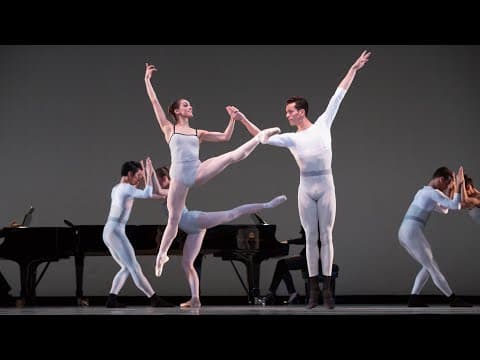
In Creases is a plotless ensemble ballet by Justin Peck, made in 2012 as his first commission for New York City Ballet, where he was then a corps de ballet dancer. It is set to Philip Glass's Four Movements for Two Pianos (2008), performed live by two onstage pianists alongside eight dancers, and its title puns on both the folding structure of the music and Peck's choreographic idea of dividing and creasing stage space with bodies.
What is danced
The article describes the choreography in conceptual rather than step-by-step terms: Peck set out to have the eight dancers 'consume as much space as possible' and then explored how to 'divide and fold or crease the space using the bodies of the dancers.' He has said the movement draws on two non-dance concepts — the withdrawal reflex and the attraction/repulsion of magnetic poles — as generative ideas for how dancers move toward, away from, and around one another. Beyond this, the source gives no synopsis, no named variations or pas, and no technical detail (pointe work, partnering holds, floor patterns) that would let a specific vocabulary be attributed section by section.
Context
The ballet was made in 2012 within New York City Ballet, the company most associated with the Balanchine/neoclassical tradition, at a moment when Peck — still a rank-and-file dancer — was being tested with his first main-stage commission after several years choreographing at the New York Choreographic Institute. Its use of a Philip Glass score situates it within a long line of dance works built on Glass's minimalist music, a pairing Peck says he approached cautiously because it had already been used by many choreographers before him.
Staging history
In Creases premiered on July 14, 2012, at the Saratoga Performing Arts Center during New York City Ballet's annual summer season there, with its New York City premiere following on May 29, 2013. It was subsequently toured by the smaller troupe New York City Ballet Moves, including at the Vail Dance Festival. The Joffrey Ballet's 2015 production was the first staging of a Peck/NYCB ballet by another company; the Paris Opera Ballet followed in 2016, staged by original cast member Christian Tworzyanski, who has since also mounted it for Ballet Austin, The Washington Ballet and BalletMet. Boston Ballet and Ballet Arizona have also performed the work.
How to watch it
Because the ballet has no narrative, attention should go to the spatial organisation Peck describes — how the eight dancers expand to fill and then fold or crease the stage in relation to Glass's two-piano score, played live onstage. Watch for structural rather than illustrative gestures: the piece is built from an idea about withdrawal and magnetic attraction/repulsion rather than a story, so contact, retreat and regrouping among the dancers are the load-bearing devices, not mime.
Credits
- composer: Philip Glass
Related works
Other staged works in the register connected to this one by author or lineage.


