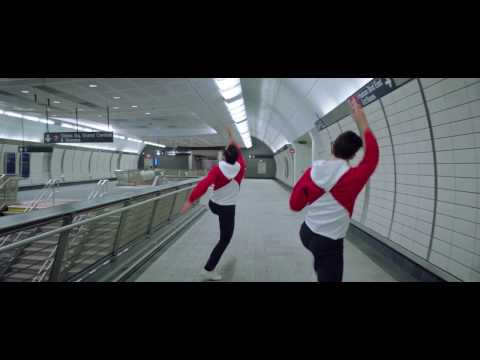
The Times Are Racing is a one-act contemporary ballet made by Justin Peck for New York City Ballet, premiered 26 January 2017 at the David H. Koch Theater, set to "USA I-IV" from Dan Deacon's electronic album America. It was made during and immediately after the 2016 US presidential election and is danced in sneakers rather than ballet slippers or pointe shoes, with costumes by Humberto Leon of Opening Ceremony and lighting by Brandon Stirling Baker.
What it contains
- Contemporary Ballet · Whole ballet, as danced by the twenty-member NYCB cast — Classical ballet technique fused with tap, hoofing and soft-shoe footwork, performed in sneakers rather than pointe shoes or slippers, described by the choreographer as rhythm tap and hoofing meeting ballet. Source: "by then he was known for a "hypermodern direction""
What is danced
The ballet is built for a cast of twenty and fuses classical ballet phrasing with tap and vernacular street/theatrical dance idioms, made possible by Peck's decision to put the dancers in sneakers. Peck has described the resulting vocabulary directly: "rhythm tap and hoofing meets Fred Astaire soft-shoe, and Gene Kelly classical tap-film movements meets ballet" — i.e. a ballet-trained ensemble executing footwork patterns borrowed from American tap and film-musical dance traditions rather than from the danse d'école repertoire alone.
The most specific set piece described is a tap duet for Robert Fairchild and Peck himself, conceived as a nod to the video game Dance Dance Revolution: Peck built the sequence so the two dancers appear to be "following along" a scrolling step track, effectively staging a rhythm-game interface as a tap number inside a ballet. A female soloist, Ashly Isaacs, was cast as an alternate for this role specifically for her tapping ability, and the role is treated by the company as a gender-neutral principal part — later performed by a male dancer partnering another man in revival casting.
Beyond the tap duet, the article gives no scene-by-scene breakdown or synopsis, so the full ensemble vocabulary for the remaining sections of the ballet cannot be itemized from this source.
Context
The ballet was made in 2016-17 while Peck was NYCB's resident choreographer and already associated with a "hypermodern" strand of ballet-making — pairing classical technique with contemporary scores and, here, streetwear-adjacent footwear. Choosing an electronic score by Dan Deacon, an artist not associated with ballet commissioning, was itself an unusual move for the company's home stage, and Peck has said he pursued it despite expecting it to be unpopular with some audiences. Made across the arc of the 2016 election, Peck described the finished work as darker than he had intended, and critics read it as a departure from his earlier, more purely celebratory manner.
Staging history
The Times Are Racing premiered with New York City Ballet on 26 January 2017. In later NYCB revivals the role originated by Tiler Peck was recast for the male principal Taylor Stanley, partnered by Daniel Applebaum, a change Peck has linked explicitly to continuing the ballet's exploration of gender-neutral casting. The Joffrey Ballet in Chicago staged the work in 2020, and when the pandemic cancelled performances that year NYCB streamed the Fairchild/Peck tap number online as part of a digital season. Pacific Northwest Ballet has staged it twice, in 2022 and 2024, the latter as the closing work on a mixed program alongside pieces by Edwaard Liang and Price Suddarth-choreographer Kiyon Ross's colleague Alice Klock's... [no further programme detail given]; PNB's costuming carried slogan graphics reading "protest," "defy," and "shout."
How to watch it
Watch the footwork specifically: the piece asks classically trained dancers to execute tap-derived rhythms and soft-shoe phrasing while still in ballet's turned-out, lifted carriage, so the interest is in the friction between the two vocabularies rather than a seamless blend. The Fairchild/Peck duet is built to look like two figures tracking a scrolling game interface — watch for the illusion of "following" an invisible track rather than dancing a conventional pas de deux.
Structure
- Act I · Tap duet (Fairchild and Peck)A duet for Robert Fairchild and Justin Peck built as a tap number inspired by the video game Dance Dance Revolution, designed to look as if the two dancers are following a scrolling step track.
Structure read from an encyclopaedia article, not from a libretto or score we hold. Confirm against a programme before treating the numbering as authoritative.
Credits
- composer: Dan Deacon
More from Justin Peck
Other staged works in the register connected to this one by author or lineage.
 In CreasesBallet · 2012Peck · video
 Pulcinella VariationsBallet · 2017Peck · video
 Year of the RabbitBallet · 2012Peck · video
 West Side StoryMusical theatre · 1957Same lineage · video
 SylviaBallet · 1876Same lineage · video
 Carmen SuiteBallet · 1967Same lineage · video
 The CageBallet · 1951Same lineage · video
 IvesianaBallet · 1954Same lineage · video