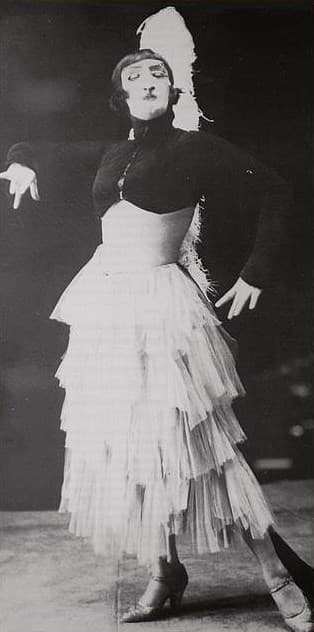
Studio Henry · Public domain
La belle excentrique (1921)
La Belle Excentrique is a short dance suite by Erik Satie, composed in 1920 and conceived from the outset as a piece for the stage rather than the concert hall. The article calls it a work that 'by modern standards can be considered a ballet,' but its actual origin was a solo recital vehicle: it was commissioned by the dancer Caryathis (Élisabeth Toulemont) as a music-hall parody, with the title supplied by Jean Cocteau and costume designed by Cocteau with a mask by Nicole Groult.
What is danced
The surviving record is almost entirely musical and production history, not choreographic notation, and this has to be stated plainly: no description of Caryathis's actual steps, floor pattern, or technique for La Belle Excentrique survives in this account. What is documented is the suite's shape — a Marche, a waltz, a Cancan grand-mondain, and a recurring Grande Ritournelle meant as a costume-change interlude — and that Satie composed the Marche's opening specifically to mark 'the title character's first appearance onstage,' implying a clear, staged entrance rather than abstract concert choreography. Caryathis's general performing style is described as 'rooted in character dance' and mixing 'classical technique, popular and international dance forms, pantomime, eroticism, and ironic humor,' but the article presents this as a description of her career manner, not a documented account of what she danced in this specific piece, so it cannot be treated as settled movement vocabulary for the work itself. Cocteau wanted the piece staged as African-American jazz dance; Satie rejected this and insisted the character be 'thoroughly Parisian,' and Cocteau's programmatic text does not survive — so even the intended dramaturgy of the piece is only partially resolved, let alone its steps.
Context
The work belongs to the moment when Satie, after the deliberately austere Socrate and the Nocturnes, returned to the cabaret and music-hall idiom of his earlier Chat Noir years, and when Cocteau and Les Six were promoting a self-consciously anti-Romantic, popular-entertainment aesthetic in Parisian avant-garde performance. Caryathis's own reputation as an 'outré' interpreter of contemporary music during and after the First World War made her a natural vehicle for this kind of hybrid, ironic solo theatre piece, sitting between concert dance, cabaret turn, and character-dance recital rather than inside the classical ballet repertory of the period.
Staging history
The piece was premiered as a one-woman show by Caryathis at the Théâtre du Colisée in Paris on 14 June 1921, conducted by Vladimir Golschmann, following an invitation-only preview at actor Pierre Bertin's home in January 1921. The production transferred the following month to Paul Poiret's garden theatre L'Oasis, where Satie himself made his only guest appearance conducting the piece — his first time conducting since his Chat Noir days and, as it turned out, his last time ever. After this run the work fell into obscurity along with much of Satie's output; it was not heard in Britain until a 1949 BBC broadcast with Constant Lambert and the London Symphony Orchestra, and the article gives no record of the choreography being revived or restaged as dance since Caryathis's original performances — subsequent history is entirely a performance and recording history of the music (orchestral and piano-duet versions).
How to watch it
There is no film or notated choreography to watch; what can be attended to is the music's staged function — the Marche as an entrance number written to announce the character with deliberate dissonance, the Grande Ritournelle as a structural interlude (originally meant for costume changes), and the Cancan grand-mondain as the vaudeville-styled close. Anyone approaching this as a dance work should treat the surviving suite as a script for tone and pacing rather than for steps.
Structure
- MarcheThe character's first entrance onstage; Satie rewrote its opening bars 25 times to get the dissonance he felt matched her appearance.
- Grande RitournelleA recurring instrumental interlude intended to give the performer time to change costumes between dances, though only one costume was used in the 1921 premiere.
- Cancan grand-mondainThe suite's can-can finale number, named in later publication history of the piano arrangement.
Structure read from an encyclopaedia article, not from a libretto or score we hold. Confirm against a programme before treating the numbering as authoritative.
Credits
- composer: Erik Satie
More from Erik Satie
Other staged works in the register connected to this one by author or lineage.

