Rouart, Lerolle & Cie. — https://www.schubertiademusic.com/details/multiple_catalogs:yes/desc:Satie,+Erik.+(1866-1925). · Public domain
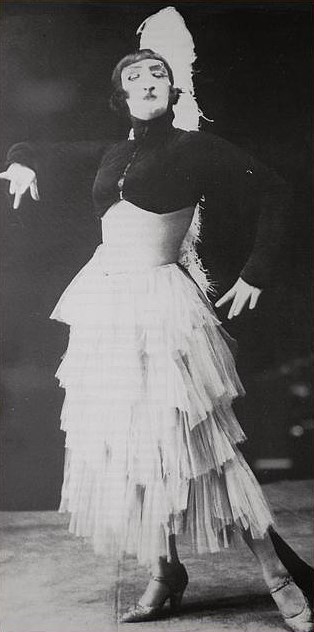
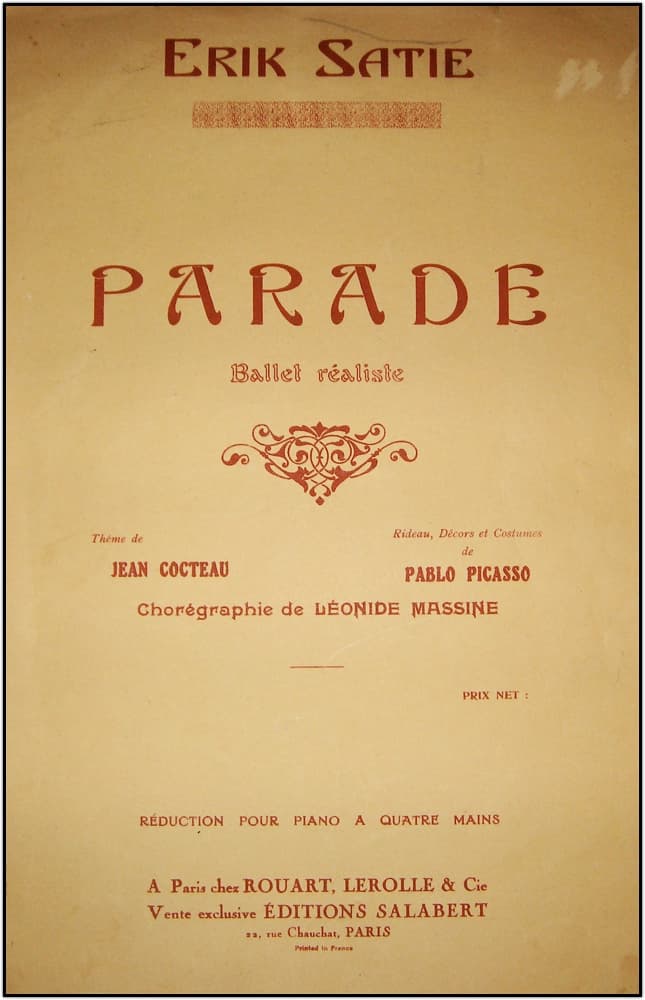
Parade is a one-act ballet made for Sergei Diaghilev's Ballets Russes, premiered at the Théâtre du Châtelet in Paris on 18 May 1917. It brought together Erik Satie's score, Jean Cocteau's scenario, Léonide Massine's choreography (Massine also danced in it) and Pablo Picasso's cubist sets and costumes, under Ernest Ansermet's baton — the first ballet either Satie or Picasso had worked on, and their first collaboration with Diaghilev's company.
What is danced
The article gives little technical detail of steps or vocabulary; what it documents instead is the conceptual and physical constraints the production placed on the dancers. Picasso's cubist costumes were built in solid cardboard for some performers, which the source says allowed 'only a minimum of movement' — a design choice that itself shaped the choreography by restricting range of motion rather than showcasing academic ballet technique. The scenario has three groups of circus and fairground performers (a Chinese conjuror-type act among the troupes implied by the 'parade' premise, though the article does not itemise them) attempting, and failing, to draw a crowd into their show, so the danced material is bound to pantomime and popular-entertainment gesture rather than a set-piece ballet vocabulary of the classical kind.
Context
Parade was made in the middle of the First World War, in the years immediately after Vaslav Nijinsky's departure left Massine as the Ballets Russes' new principal choreographer-dancer. It arrived a few years after Stravinsky's Le Sacre du Printemps had already established the company's appetite for a succès de scandale, and the article frames Parade's own uproar — including a courtroom brawl and Satie's eight-day jail sentence over a postcard insult to a critic — as part of that same lineage. Its significance for dance history, per the article, is that it imported the vocabulary and subject matter of Parisian music-halls, fairgrounds and American silent film into a form previously reserved for elite theatrical ballet, and it was on this production's programme note that Apollinaire first used the word 'surrealism.'
Staging history
The article records the Paris premiere (18 May 1917, Théâtre du Châtelet) and an English premiere by the Ballets Russes at London's Empire Theatre on 14 November 1919, which it says 'became a cultural event.' Beyond this it does not describe later revivals or restagings; the Joffrey Ballet is listed under 'See also' without explanation, so any connection to a Joffrey production is not something this source establishes.
How to watch it
Watch for how the costumes limit or shape the performers' movement rather than expecting virtuosic classical dancing; the cubist casings on some figures were built to restrict motion, not display it. Listen for the score's incorporated everyday noises — typewriter, foghorn, milk bottles, pistol — layered against the ragtime-inflected finale, in which, per the source, the whole cast makes 'a last desperate attempt to lure the audience in to see their show.'
Credits
- composer: Erik Satie
Related works
Other staged works in the register connected to this one by author or lineage.