Sasha — This file comes from Gallica Digital Library and is available under the digital ID btv1b7002611c · Public domain
Mercure is a 1924 ballet made for Comte Étienne de Beaumont's short-lived Soirées de Paris company, with choreography by Léonide Massine (who also danced the title role), music by Erik Satie, and décor and costumes by Pablo Picasso. Subtitled "Plastic Poses in Three Tableaux," it dispenses with narrative and instead presents a sequence of loosely mythological episodes — Mercury interfering with Apollo and Venus, the bathing Three Graces, the abduction of Proserpine — staged as living pictures rather than a story ballet.
What is danced
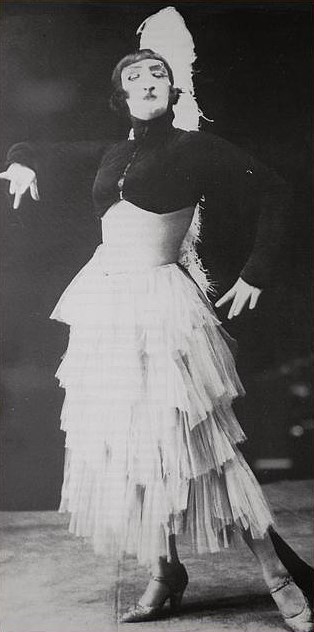
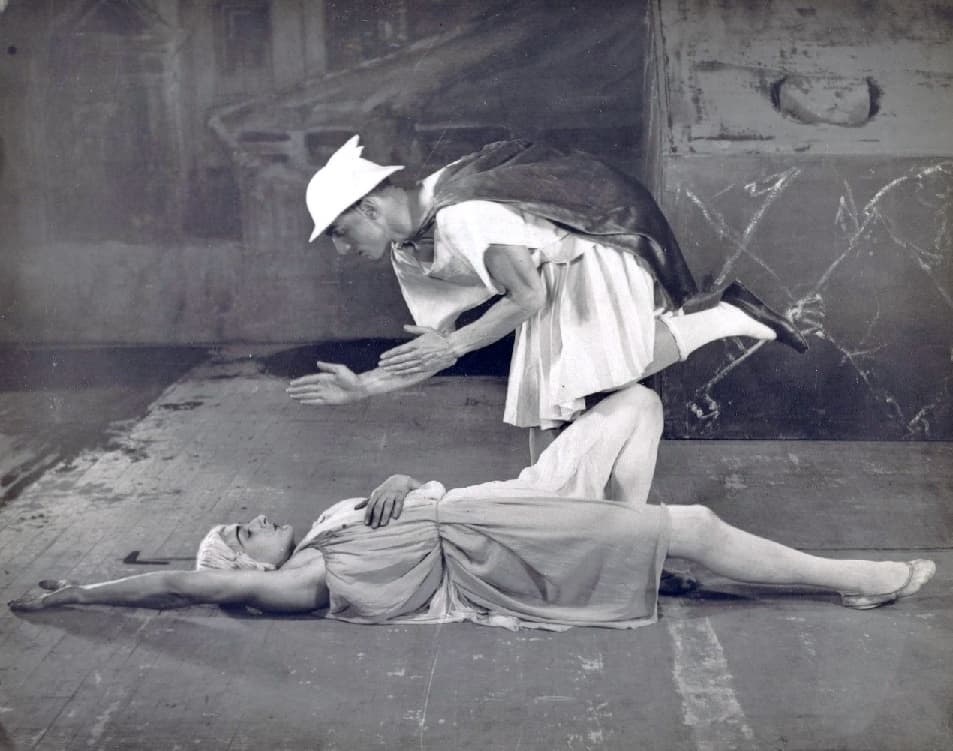
The article's account of the choreography is thin on step vocabulary and heavy on staging concept: Massine himself later said the work was 'predominately Picasso's work,' and described his own role as a series of differentiated comic-dramatic 'adventures' (intervening in Apollo's affairs, directing the Zodiac, arranging Proserpine's abduction) rather than a set of danced variations. The governing device was the contrast between Massine's static tableaux — described as 'plastic poses' — and Picasso's moving scenery (painted rattan-and-wire cutouts shifted by hidden dancers, a shield-like three-headed Cerberus, amorphous flats standing in for the Three Graces), which the article explicitly calls a participant in the dance: 'Picasso's mobile scenery became part of the dance.' Mercury himself is the one figure kept in continuous motion — 'through this series of plastic poses flew Mercury, a vivid figure in white tunic and scarlet coat, enthusiastically danced by Massine' — while the Three Graces were performed by men in drag with exaggerated false breasts for comic effect.
Context
Mercure reunited Massine, Satie and Picasso for the first time since their landmark Ballets Russes collaboration Parade (1917), on a commission designed by Beaumont to challenge Diaghilev's dominance of Parisian modernist theatre. It came at a pivot point for both principal collaborators: for Massine it was a comeback vehicle after his 1921 split from Diaghilev, and for Picasso it was a deliberate return to the modernist avant-garde after a fashionable 'Neoclassical' period, described in the article as 'an important link between Picasso's Neoclassical and Surrealist phases.' The premiere became a flashpoint of factional Parisian art politics: André Breton's Surrealists disrupted the June 15, 1924 opening chanting support for Picasso and hostility to Satie, in a dispute stoked by Georges Auric's feud with Satie, and the Surrealists subsequently published a public tribute claiming Picasso as their own against his collaborators.
Staging history
Diaghilev, who watched the Soirées de Paris uneasily, took the unusual step of buying the ballet outright from Beaumont in 1926 — the only ready-made ballet he ever acquired — and the Ballets Russes performed it three times in 1927, in Paris and London, with Massine recreating his own choreography; it received poor reviews in London and was never staged again in its original form. Alternative versions followed: Adolph Bolm's Chicago Allied Arts company presented the score in 1926 as Parnassus on Montmartre with new material; Ballet Rambert mounted a more faithful production at the Lyric Theatre, Hammersmith in 1931 with choreography by Frederick Ashton (who also danced Mercury) alongside guest star Tamara Karsavina, revived for the Camargo Society in 1932; and the Littlefield Ballet in Philadelphia staged an adaptation, The Home Life of the Gods, choreographed by Lasar Galpern, in 1936. Since the Second World War the ballet has survived mainly as a concert piece, with only Picasso's drop curtain (restored 1998, Musée National d'Art Moderne) and a few design sketches surviving from the original production.
How to watch it
Watch for the counterpoint the article stresses between Massine's held 'plastic poses' and the constant manipulation of Picasso's painted cutout scenery by hidden dancers — the scenery, not just the bodies, is doing the choreographic work. Mercury (danced by Massine in the original) is the one figure who moves continuously through otherwise static tableaux, and the Three Graces sequence is played for burlesque via cross-dressed casting rather than danced technique.
Structure
- Act INight. Apollo and Venus make love while Mercury surrounds them with the Signs of the Zodiac; Mercury, jealous of Apollo, kills him by cutting his thread of life, then revives him.
- Act IIThe Three Graces dance, then remove their pearls to bathe; Mercury steals the pearls and flees, pursued by Cerberus.
- Act IIIDuring a feast of Bacchus, Mercury invents the alphabet; at Pluto's behest he arranges for Chaos to abduct Proserpine, who is carried off on a chariot in the finale.
Structure read from an encyclopaedia article, not from a libretto or score we hold. Confirm against a programme before treating the numbering as authoritative.
Credits
- composer: Erik Satie
Related works
Other staged works in the register connected to this one by author or lineage.